Planning for year-round outdoor hospitality seating beyond summer
If you run a pub or café with outdoor seating, you’ll know how valuable that extra space can be during summer. But when the weather changes, tables that contribute to a busy trading day can suddenly become difficult to use. The challenge is finding a way to make that existing space more dependable without committing to improvements that your business may not need.
In Short
Pubs and cafés can extend their outdoor trading season by providing suitable weather protection, customer comfort and service arrangements that allow external seating to be used more consistently. Whether this is commercially worthwhile depends on customer demand, operating costs, the intended period of use and whether the site can accommodate the necessary improvements.
Trading priorities at a glance
- Dependable seating matters more than the number of tables. Outdoor accommodation only provides reliable trading capacity when customers can comfortably use it during the periods in which you intend to operate.
- Weather protection and extended trading accommodation are different. An awning or canopy may improve an outdoor area’s usability, but more substantial protection could be necessary for sustained use during colder months.
- The additional area must work alongside your existing business. Heating, ventilation, lighting, access, staff movement and customer facilities all influence whether extended outdoor seating is practical.
- Customer demand must justify the investment. A busy summer terrace doesn’t automatically mean customers will use the same space throughout autumn and winter. Additional operating costs also need consideration.
- Every site requires individual assessment. Available space, ground conditions, infrastructure, planning requirements and the intended duration will influence whether a longer-term solution is appropriate.
Table of Contents
- Planning for year-round outdoor hospitality seating beyond summer
- Table of Contents
- Why Does Outdoor Seating Become Unreliable Beyond Summer?
- What Makes an Outdoor Hospitality Area Suitable for Extended Use?
- Weather Protection Versus Dependable Trading Accommodation
- How Should Heating, Ventilation and Customer Comfort Be Considered?
- Integrating Outdoor Accommodation With Existing Hospitality Operations
- Would Longer Seasonal Trading Justify the Investment?
- Site Suitability and the Decision to Investigate a Longer-Term Structure
- Next Step: Exploring Longer-Term Outdoor Accommodation
- Frequently Asked Questions
Why Does Outdoor Seating Become Unreliable Beyond Summer?
A pub garden or café terrace can work perfectly well for several months of the year without providing reliable customer accommodation during the rest. The difficulty isn’t necessarily a lack of physical space. It’s that the conditions affecting that space become too unpredictable for the business to depend on it.
Consider a pub with a popular beer garden. During warmer weather, the landlord can accommodate customers across both indoor and outdoor areas, potentially increasing the number of people served during busy periods. As autumn approaches, however, the same garden might remain largely empty, even when customers are struggling to find a table indoors.
For an independent café with a limited number of indoor tables, the problem can be particularly noticeable. A terrace that provides valuable additional seating during summer may become difficult to include in normal reservation arrangements once temperatures fall and rainfall becomes more frequent.
In both situations, the question is whether the existing outdoor area can be adapted to provide more predictable accommodation. Before considering improvements, it’s worth understanding exactly what makes the space unreliable.
Weather exposure and customer comfort
Rain is often the most obvious limitation, but it is rarely the only one.
An uncovered terrace may become unusable during persistent rainfall, while a partially sheltered pub garden might remain uncomfortable because of wind or low temperatures. Shorter daylight hours can also make an area less inviting, particularly where existing lighting was intended mainly for occasional summer evening use.
Wet or uneven surfaces, exposed entrances and poorly protected access routes can introduce further difficulties for customers and staff.
These conditions vary considerably between premises. A café terrace sheltered by surrounding buildings may experience very different conditions from an open beer garden with little protection from prevailing winds.
Even within a single site, some tables may remain relatively sheltered while others become uncomfortable. This can make it difficult to treat the entire outdoor area as consistently available customer space.
Customer expectations also change according to how the seating is presented.
Someone choosing an outdoor table on a mild summer afternoon may accept a level of exposure that would be unsuitable during a colder evening. If a venue offers covered outdoor seating as suitable for autumn or winter dining, customers may reasonably expect more dependable protection and comfort.
This doesn’t mean that every external area needs to provide conditions equivalent to an indoor dining room. The appropriate standard depends on how the space will be used, the time of year and what customers have been led to expect.
However, if customers are regularly uncomfortable, need to relocate indoors or leave earlier than intended, the seating may not be providing the dependable accommodation the business needs.
For operators considering how to make a pub garden usable in winter, identifying these environmental limitations is a more useful starting point than immediately choosing a canopy or enclosure.
The effect of unreliable seating on reservations and staffing
Weather-dependent accommodation can become a commercial and operational problem long before customers actually arrive.
If a café has ten indoor tables and another six outside, it cannot necessarily treat all sixteen as available for every service. During uncertain weather, the owner may be reluctant to accept reservations for the terrace because there is no guarantee that customers will be comfortable using it.
Accepting those reservations creates a risk of disappointing customers if the external area becomes unsuitable. Restricting bookings to the indoor tables avoids that uncertainty but means the terrace contributes little additional capacity during less favourable periods.
For a pub, the problem may be more complicated because customers arrive throughout the day, often without reservations.
The landlord may anticipate demand for outdoor seating, but cannot easily predict whether the garden will remain suitable. This affects decisions about staffing, table service and the practical use of different areas of the premises.
When the weather deteriorates unexpectedly, staff may need to move customers indoors, clear outdoor tables or reorganise service arrangements.
If the indoor area is already busy, suitable alternative seating may not be available.
These difficulties can also affect the consistency of the customer experience. People who have booked a table or chosen to visit because of available seating may be disappointed if the accommodation cannot be used as expected.
There is a financial distinction here worth recognising. The commercial value of outdoor seating depends on how often it can reliably accommodate customers, not simply how many people it could seat in ideal conditions.
A terrace containing twenty covers may contribute less to the business than a smaller area that can be included more consistently in normal trading arrangements.
Nevertheless, unreliable outdoor seating doesn’t automatically mean lost revenue.
If customers are unlikely to use additional seating during colder months, substantial improvements may make little commercial sense. Equally, a venue that already has sufficient indoor capacity may have no compelling reason to extend its outdoor trading season.
The strongest case for investigating improvements arises where the business can identify a genuine requirement for additional dependable seating, rather than simply wanting to keep its outdoor tables occupied.
Understanding that requirement is the first step towards deciding what level of accommodation might be appropriate.
What Makes an Outdoor Hospitality Area Suitable for Extended Use?
Making outdoor seating available for a longer period involves more than keeping customers dry. The space needs to function as part of your existing pub or café, providing accommodation that customers are willing to use and that your staff can manage effectively.
That distinction becomes particularly important when you want to accept bookings for an external area rather than offering it only when conditions happen to be favourable.
A covered terrace may look like useful additional capacity, but it won’t necessarily deliver the expected benefit if customers are uncomfortable, staff struggle to provide an efficient service or access becomes difficult during wet weather.
Before considering the type of structure or protection required, it’s worth establishing how the additional accommodation would actually be used.
Customer expectations during colder periods
The first consideration is the experience you need to provide.
A pub may want to offer sheltered seating for customers having drinks, while a café could be looking to accommodate people having breakfast or lunch throughout the colder months.
Both requirements involve outdoor space, but the practical expectations may differ.
Customers seated for a full meal may expect greater protection from draughts, suitable temperatures and comfortable access to the main premises. Those using an outdoor area for a shorter visit may be satisfied with a different level of protection.
The type of service also matters. A café offering table service needs an environment in which customers can remain comfortably seated while ordering, eating and paying. If conditions regularly force customers to move indoors, the additional space may not be dependable enough to support advance bookings.
For a pub, the intended operating hours are another consideration. An area used mainly during daylight may have different lighting and environmental requirements from one intended for evening service.
When assessing how to extend the outdoor dining season for a café, the owner should therefore consider not only when the terrace might be available, but whether customers would choose to use it during those periods.
A technically usable space isn’t necessarily one that customers will find appealing.
Equally, providing a comfortable covered or enclosed area doesn’t guarantee increased demand. The business still needs to understand whether its customers would want the additional accommodation outside summer.
This distinction helps avoid spending money on improvements that solve the problem of weather exposure without addressing the underlying commercial requirement.
Operating requirements beyond weather protection
Once the intended customer experience is clearer, the next consideration is whether the existing business can operate the additional seating effectively.
For example, a café terrace immediately outside the main entrance may be relatively straightforward for staff to serve. Food and drinks can be carried directly from the existing premises, and customers may have convenient access to toilets and other facilities.
A pub garden situated some distance from the bar or kitchen presents different challenges.
Staff might need to travel further between the building and the additional seating, particularly during busy periods. If the garden is intended to operate throughout colder weather, those routes must remain practical and suitable when conditions are wet or temperatures are low.
It’s also worth considering how the outdoor area would affect existing customer circulation.
Would customers have clear access to the additional seating? Could they move comfortably between the main premises and the outdoor area? Would any proposed covering or enclosure obstruct an existing entrance, delivery route or access to customer facilities?
These issues may appear secondary to the choice of weather protection, but they can determine whether the adapted space is genuinely useful.
An outdoor area becomes dependable trading accommodation when it can be included realistically in the venue’s normal operating arrangements.
That means considering the relationship between the additional tables and the existing business.
For a café with limited staff, several extra tables might create a manageable extension of the existing service. A larger or more detached area could require different staffing arrangements, potentially increasing operating expenditure.
Similarly, a pub may have enough space to accommodate substantial additional seating but lack the service arrangements to manage it efficiently during its busiest periods.
These factors don’t necessarily make extended outdoor trading impractical. They establish the operating requirements that any proposed adaptation needs to address.
The suitability of existing infrastructure must also be considered.
Lighting, electricity, suitable surfaces, drainage and other facilities may already be available, but this should not be assumed. A space developed primarily for occasional summer use may require improvements before it can support a longer operating period.
Heating and ventilation could become particularly relevant where the operator is considering a more substantial enclosure. However, the appropriate arrangements will depend on the actual environment, intended use and relevant safety considerations.
The key is to identify the accommodation standard required before deciding how that standard might be achieved.
For some businesses, modest improvements may provide enough additional usability to meet their needs. Others may discover that dependable extended trading requires a more substantial covered or enclosed environment.
That decision should be based on how the space needs to function, rather than simply how it might look once adapted
Weather Protection Versus Dependable Trading Accommodation
Once you’ve established what prevents your outdoor seating from being used consistently, the next question is how much protection would actually be needed to make a difference.
For some pubs and cafés, relatively modest improvements may provide enough additional flexibility. Others may need an environment that functions more like an extension of their existing premises, particularly if they want to accept reservations or provide table service throughout colder periods.
The distinction matters because improving an outdoor area’s usability is not necessarily the same as creating dependable accommodation for extended trading.
Fair-weather outdoor seating
An uncovered beer garden or café terrace can be entirely appropriate when the business mainly needs additional capacity during favourable weather.
A pub that attracts customers to its garden on sunny weekends, for example, may have little reason to invest in substantial weather protection if demand falls significantly during winter.
Similarly, a café with sufficient indoor seating during colder months may find that its existing terrace already fulfils its commercial purpose.
There are advantages to maintaining this arrangement. The area can remain open and adaptable, with relatively limited requirements for additional infrastructure or environmental control.
The obvious limitation is that customer numbers and seating availability remain affected by the weather.
This is not necessarily a problem if the operator understands those limitations and plans accordingly.
Before investing in improvements, it’s worth establishing whether the business actually needs the seating to be available more consistently. If there is little evidence of demand outside summer, increasing the level of protection may simply introduce costs without creating a corresponding trading benefit.
H3: Partially covered or weather-protected areas
Awnings, canopies and other partial weather-protection measures can help extend the usefulness of an existing outdoor area.
For example, a café may find that an appropriate covering makes its terrace usable during light rainfall, allowing customers to remain seated in conditions that would previously have forced them indoors.
A pub might introduce covered outdoor seating to provide greater shelter during changeable autumn weather.
These measures can be valuable where the objective is to make existing seating available more often without fundamentally changing how the area operates.
However, the protection they provide will depend on the installation, surrounding environment and prevailing weather conditions.
An overhead covering may reduce exposure to rainfall without providing meaningful protection from cold winds. A partially enclosed area may offer greater shelter but still become uncomfortable during particularly cold periods.
It’s also possible for protection that works well during one season to be less effective during another.
This is particularly relevant when considering covered outdoor seating for pubs in winter. Customers might be comfortable using a sheltered area on a mild afternoon but find the same accommodation unsuitable on a cold, windy evening.
The operator must therefore distinguish between extending occasional usability and creating seating that can confidently be included in normal trading plans.
Where the business only requires some additional protection, a modest improvement may be sufficient. Where dependable accommodation is the objective, more substantial measures may need investigation.
Accommodation designed for extended trading
A different set of requirements emerges when a pub or café wants its existing outdoor seating to function consistently throughout autumn, winter and other periods of less favourable weather.
At this point, the operator may be considering a more substantial covered or enclosed environment.
The purpose is not simply to prevent customers from getting wet. It is to establish conditions in which the area can support normal hospitality activities over an extended period.
Depending on the intended use, this could involve consideration of heating, ventilation, lighting, suitable flooring, customer access and connections to existing services.
An enclosure may provide greater protection from wind and rainfall, but it can also change the environmental characteristics of the space. Temperature management, moisture and airflow may become more important, particularly when the accommodation is occupied for extended periods.
There are operational implications too.
If a café intends to accept reservations for its enclosed terrace throughout colder months, the seating needs to be sufficiently dependable for customers to arrive with reasonable expectations of comfort and service.
A pub considering enclosing part of its beer garden must establish whether staff can serve customers effectively and whether the additional area can function alongside the existing bar, kitchen and customer facilities.
More substantial accommodation can also involve greater project commitments, potential regulatory requirements and ongoing operating expenditure.
These considerations become more significant when the proposed installation is intended to remain in place for several seasons or years.
The appropriate level of protection should be determined by how consistently, and for how long, you need the outdoor area to function.
A partial covering may be the proportionate response for occasional autumn use. A longer-term enclosed dining area may warrant investigation where there is sufficient customer demand and a genuine requirement for dependable additional seating.
Neither approach is automatically preferable.
The decision should follow the intended trading requirement rather than begin with the assumption that a particular type of structure is necessary
How Should Heating, Ventilation and Customer Comfort Be Considered?
Extending outdoor hospitality trading into colder periods means paying closer attention to the conditions customers will experience while using the space.
Keeping rainfall away from tables is only part of the challenge. A covered or enclosed area also needs to provide an appropriate environment for its intended activities, whether customers are having a quick drink or spending longer enjoying a meal.
The degree of environmental control required will depend on the venue, the proposed accommodation, customer expectations and the periods during which the space will operate.
Temperature and weather exposure
Customer comfort is likely to be one of the main factors determining whether an adapted outdoor area can be used consistently.
An enclosure that provides effective protection from rainfall may still be uncomfortable if it allows significant draughts or cannot maintain suitable temperatures during colder weather.
Equally, a structure that performs well during winter may need arrangements that allow customers to remain comfortable during warmer periods.
The operator should therefore consider the range of conditions in which the space is intended to operate, rather than focusing only on the coldest part of the year.
For example, a café that wants to use its terrace from early spring through autumn may have different requirements from a pub seeking dependable customer seating across several winters.
Heating can be part of the solution, but the equipment and arrangements must be suitable for the proposed environment.
A heater intended for an open outdoor area should not automatically be assumed appropriate for an enclosed space.
The Health and Safety Executive’s guidance on gas safety for employers identifies fire, gas leakage and carbon monoxide as important hazards associated with improperly installed or maintained gas appliances. It also emphasises appropriate ventilation and the use of suitably qualified people for relevant gas work.
These are matters for appropriate assessment, equipment selection and professional installation where required.
For the hospitality operator, the immediate question is whether the proposed accommodation can realistically provide suitable environmental conditions without creating unacceptable safety or operating difficulties.
That assessment should take place before assuming that adding heating will make an external area suitable for sustained winter use.
Ventilation, condensation and moisture
Introducing a more substantial enclosure changes the way an outdoor seating area interacts with its surroundings.
An open terrace benefits from natural airflow, but it also exposes customers to changing weather conditions. Enclosing the area may reduce that exposure while creating a greater need to consider ventilation and moisture management.
Customers, food and drink service, heating arrangements and differences between internal and external temperatures can all affect conditions within the space.
If ventilation and moisture are not managed appropriately, condensation may develop on internal surfaces, affecting comfort and potentially creating maintenance concerns.
An operator considering how to weatherproof a café seating area should therefore avoid treating complete enclosure as a solution in itself.
The enclosure must be appropriate for the activities taking place inside it.
This includes considering how fresh air will be provided, whether the proposed heating equipment is suitable and how the environment will remain comfortable during normal service.
The necessary arrangements will vary according to the structure, occupancy, equipment and intended use.
There is no single ventilation or heating specification that can be assumed appropriate for every covered pub garden or enclosed café terrace.
These questions should be addressed through suitable site-specific assessment rather than relying on assumptions about the performance of a particular covering or building.
Lighting, flooring and general comfort
Environmental comfort extends beyond temperature.
During autumn and winter, shorter daylight hours can affect the usefulness of outdoor seating, particularly for businesses that remain open into the evening.
Lighting should support the intended activities, allowing customers to move safely and comfortably while enabling staff to provide an effective service.
A space that works well for casual summer afternoon seating may need different lighting arrangements to support evening meals or regular table service.
Flooring and walking surfaces also deserve attention.
An existing terrace may have paving, decking or other surfaces that are suitable during dry weather but become more difficult to use when wet. If customers and staff are expected to use the area throughout colder periods, access routes and surface conditions need to remain appropriate for that use.
Where an enclosure is being considered, the suitability of existing ground levels, drainage and flooring may influence whether additional preparation is necessary.
Customer accessibility must also form part of the assessment.
The proposed arrangement should not create avoidable barriers between the existing premises and the additional accommodation or obstruct routes needed by customers and staff.
These practical details contribute to whether the space feels like a usable part of the venue rather than an area that happens to have been covered.
They also affect operating costs.
Heating, lighting, cleaning and maintenance may introduce additional expenditure, particularly where an installation is intended to remain operational throughout several colder seasons.
The business must consider those commitments alongside the potential benefit of making additional seating available.
A more dependable outdoor dining area needs an appropriate operating environment, not simply protection from individual weather conditions.
Where the business is investigating sustained use, environmental suitability should be considered alongside customer demand and the practical requirements of operating the additional space.
Integrating Outdoor Accommodation With Existing Hospitality Operations
Even if an outdoor area can provide suitable conditions for customers, it still needs to operate effectively alongside the existing pub or café.
An additional dining area doesn’t function independently of the main business. It depends on staff, facilities, access routes and service arrangements that may already be working close to capacity during busy periods.
When considering making restaurant terraces usable beyond summer, or adapting an existing beer garden, it’s worth assessing how customers and staff would use the additional accommodation throughout a normal trading day.
Food and drink service arrangements
The location of the outdoor area can have a significant effect on service efficiency.
A café terrace positioned immediately outside the main entrance may be relatively easy to incorporate into normal table service. Staff can move between the existing premises and the additional seating without travelling substantial distances.
However, a covered seating area at the far end of a pub garden may create a different operating requirement.
Staff might need to carry food and drinks over longer distances, move through exposed areas or manage additional doors and access points. These arrangements can become less practical during busy periods or when the weather is poor.
The operator should consider whether the proposed accommodation would require additional staffing, different service arrangements or changes to existing procedures.
A larger number of available tables does not necessarily mean the business can serve more customers efficiently.
If staff spend substantially longer moving between the kitchen, bar and additional seating, the resulting inefficiencies may reduce the value of the extra capacity.
It’s also worth considering how customer orders, payments and table management would work.
For a pub offering counter service, the principal question may be whether customers can move conveniently between the bar and the outdoor area. For a café with table service, staff circulation and the ability to maintain service standards may be more significant.
These requirements need to be established before deciding how an enclosure or covered structure should relate to the main building.
Customer access and existing facilities
Customers using the additional seating will normally continue to rely on the facilities provided by the existing premises.
The business therefore needs to consider whether entrances, toilets, circulation routes and other facilities can support the intended use.
For example, enclosing a terrace directly outside a café might appear straightforward, but the proposed arrangement could affect an existing entrance or create congestion where customers enter, leave or wait for tables.
A pub garden may have adequate seating space but lack a convenient route to customer toilets during wet or colder weather.
Accessibility must also be considered, particularly where changes to ground levels, thresholds or circulation routes are involved.
The practical relationship between the additional accommodation and existing services can influence whether the space is suitable for sustained use.
Electricity, lighting and other utilities may also be required, depending on the proposed arrangements.
Deliveries, waste collection and access for maintenance must not be overlooked. An area that appears available for customer seating may already serve an important operational purpose.
These considerations are particularly relevant when contemplating enclosing a pub garden for year-round trading, because the installation may remain in place for extended periods.
Rather than treating the external area as a separate addition, the operator needs to consider how the entire premises will function once the space is adapted.
For businesses progressing towards a more substantial installation, the practical requirements of integrating an additional dining area with existing premises deserve further examination.
The immediate priority is to identify the main operational constraints and establish whether they can realistically be addressed.
Additional accommodation is only commercially useful when the existing business can support it efficiently. Providing more seating should not undermine service quality or create operating costs that outweigh the potential trading benefit.
Would Longer Seasonal Trading Justify the Investment?
An outdoor seating area may be physically suitable for adaptation without representing a worthwhile commercial investment.
Before committing to substantial weather protection or enclosure, the operator needs to establish whether customers are likely to use the additional accommodation frequently enough to justify the project and its ongoing costs.
This is especially important when the proposed space is intended to remain operational across several colder seasons.
Establishing demand beyond summer
A busy summer terrace demonstrates that customers value outdoor seating when conditions are favourable. It does not necessarily establish that they would use the same area during winter.
A pub might attract substantial numbers of customers to its beer garden on warm weekends but experience much quieter trading during colder months.
Enclosing part of the garden could make additional seating more comfortable, but it would not automatically create sufficient demand to fill those tables.
For a café, the situation may be different.
If indoor tables are regularly occupied during autumn and winter, and customers are frequently turned away or unable to make reservations, there may be a stronger case for investigating additional dependable seating.
The important distinction is between unmet customer demand and simply having outdoor space that is not being used.
Operators should examine their own trading patterns rather than relying on general assumptions about seasonal hospitality demand.
Useful evidence may include booking enquiries, occasions when customers cannot be accommodated, differences between weekday and weekend trading, and the frequency with which indoor capacity becomes constrained.
It may also be worth considering whether demand is concentrated around particular services.
A café that is consistently busy at weekend brunch might have a credible requirement for additional seating during those periods, even if weekday winter demand is relatively modest.
A pub might experience regular evening demand throughout the year but have limited additional customer interest during quieter daytime periods.
These distinctions affect how frequently the adapted accommodation would contribute to trading.
It’s also important to consider whether providing additional seating would increase the number of customers served or simply spread existing customers across a larger area.
If the business already has sufficient capacity to accommodate normal demand, additional covered seating may improve customer choice without generating a meaningful increase in trading.
That may still have value, but the operator needs to understand the nature of the benefit before deciding how much to invest.
Trading contribution and ongoing operating costs
If there is credible demand for additional seating, the next question is whether the expected trading contribution would justify the costs of providing it.
These costs extend beyond the initial accommodation.
Depending on the proposed arrangements, the business may need to consider heating, lighting, cleaning, maintenance, staffing and additional service requirements.
Environmental control can be particularly important during colder months, when the additional energy required to maintain suitable customer conditions may be material.
Current industry research reinforces the importance of these costs. An October 2026 survey reported by UKHospitality on rising operating costs and investment pressures found that 74% of respondents had experienced increased electricity bills, while 80% said prevailing business conditions were restricting investment. These findings reflect the businesses surveyed rather than establishing the financial position of every pub or café.
For an individual operator, the practical implication is straightforward: additional trading opportunity needs to be considered alongside the expenditure required to support it.
An area that attracts customers regularly throughout colder months may be easier to justify than one used only occasionally, particularly if substantial heating and staffing commitments are involved.
However, the relationship is not determined by occupancy alone.
The value of additional customers will depend on the venue’s trading model, the expenditure associated with serving them and the costs of operating the adapted space.
This is why assessing whether winter outdoor dining would be commercially worthwhile requires realistic assumptions about customer demand rather than a simple calculation based on the number of available tables.
The operator should also recognise that leaving the existing arrangement unchanged may be commercially appropriate where the additional trading opportunity is limited.
The importance of installation duration
The intended period of use can have a substantial influence on which approach is worth considering.
A pub requiring additional protection for occasional autumn weekends may find that a relatively modest improvement is sufficient.
A café seeking dependable customer accommodation across several autumn and winter seasons could have a stronger reason to investigate a more substantial covered or enclosed solution.
Longer-term requirements may allow the business to assess the potential benefits across an extended operating period rather than judging the investment against a single season.
However, a longer duration also introduces continuing commitments relating to maintenance, energy and the operation of the additional space.
The operator needs to understand whether those commitments are proportionate to the expected use.
At this stage, a broad assessment of demand, intended duration and additional operating requirements should help establish whether further financial investigation is justified.
A complete evaluation would also need to consider the proposed accommodation arrangements, relevant project expenditure and ongoing financial commitments.
For operators considering a substantial installation, a more detailed assessment of long-term temporary hospitality building costs can help establish whether the investment is commercially appropriate.
The article’s central question remains whether improved accommodation would allow the business to serve enough additional customers, often enough, to justify progressing.
Where credible demand exists, and suitable operating conditions appear achievable, the opportunity may warrant a more detailed feasibility assessment.
Where demand is uncertain or the additional operating costs are likely to be disproportionate, further investment should be approached cautiously.
Site Suitability and the Decision to Investigate a Longer-Term Structure
Once you’ve established that there may be sufficient demand for extended outdoor trading, and that the additional accommodation could work alongside your existing business, the next consideration is whether the site itself is suitable.
An existing beer garden or café terrace may appear to offer plenty of available space, but that doesn’t automatically mean it can accommodate a substantial covered or enclosed structure.
Ground conditions, access, neighbouring properties, existing services and regulatory requirements can all influence what is achievable.
These factors should be considered before committing to a particular accommodation approach.
Site conditions and available space
The suitability of an existing outdoor area depends on more than its dimensions.
A level, paved terrace immediately adjacent to a café may present different practical requirements from a sloping pub garden with planted areas, uneven ground or restricted access.
Relevant considerations include the amount of usable space, existing surfaces, ground levels, drainage and the proximity of neighbouring buildings.
Installation access can also be important.
A proposed structure may fit within the available area but require consideration of how materials, equipment and installation teams could reach the site.
Restricted entrances, narrow access routes and existing buildings may influence the practical options.
The operator should also consider how an installation might affect normal activities around the premises.
A pub garden could contain routes used for deliveries or waste collection, while a café terrace may sit alongside a busy entrance or pedestrian route.
If those activities need to continue, the proposed accommodation must be assessed in relation to them.
The availability of infrastructure is another consideration.
An extended-use seating area may require electricity, lighting, heating arrangements or other services, depending on how it will operate. The presence and suitability of existing connections should be established rather than assumed.
Drainage and surface conditions may also influence whether the area requires preparation.
These questions don’t necessarily prevent an outdoor space from being adapted, but they can affect the scope and commercial practicality of the project.
A promising trading opportunity still needs a physically suitable site.
Identifying constraints early can help avoid pursuing an accommodation arrangement that becomes impractical or disproportionately expensive once detailed requirements are examined.
Permissions and project responsibilities
More substantial outdoor hospitality accommodation may also involve planning, licensing and other regulatory considerations.
The requirements will depend on the location, nature of the proposed installation, intended use and relevant regulations.
It’s important not to assume that describing a structure as temporary automatically removes the need for planning permission.
The Planning Portal’s guidance on permission for temporary buildings explains that temporary structures may qualify for particular planning arrangements in certain circumstances, but the applicable position depends on the proposal and relevant criteria.
An operator considering a significant terrace enclosure should therefore establish the planning position for the actual site before proceeding.
The distinction between ordinary outdoor furniture and more substantial accommodation is particularly relevant to cafés with pavement seating.
In England, the GOV.UK pavement licences guidance explains the arrangements for placing certain removable furniture on eligible highway areas outside hospitality premises. This does not provide general permission to install a substantial enclosed building.
Other matters may also require attention.
Fire safety, safe access, accessibility and the practical arrangements for customers using the additional area must be considered in relation to the proposed installation.
The Government’s fire safety guidance for small and medium places of assembly provides relevant information for premises such as pubs and certain temporary structures, including the importance of appropriate fire risk assessment and escape arrangements.
The operator should also consider whether the proposed accommodation affects neighbouring properties.
Lighting, customer activity, noise and the intended operating hours may be relevant, particularly where outdoor seating is close to residential premises.
These are site-specific matters. Requirements and responsibilities should be established with the appropriate authorities and competent specialists where necessary.
A temporary-building supplier may assist with relevant project information and coordination, but that does not automatically transfer planning, licensing or statutory responsibilities away from the business or other responsible parties.
When a managed longer-term solution merits consideration
If your business has identified credible customer demand beyond summer, and the site appears capable of supporting an appropriate installation, it may be worth investigating a more substantial temporary or semi-permanent hospitality structure.
This is particularly relevant where the aim is to create dependable seating over several seasons rather than provide occasional shelter.
The accommodation would need to respond to the specific requirements of the premises, including customer comfort, staff service, access, infrastructure and the intended period of operation.
There is also a practical programme to consider.
An operator hoping to use additional seating during a particular autumn or winter should allow for the necessary feasibility assessment, potential permissions, design considerations, site preparation and installation planning.
These activities may influence when the accommodation could become available.
Installation itself may also affect existing outdoor seating, customer access, deliveries or staff routes. The potential consequences should be understood during planning rather than assuming that normal operations can continue entirely unaffected.
LM Structures has relevant experience providing managed longer-term hospitality accommodation.
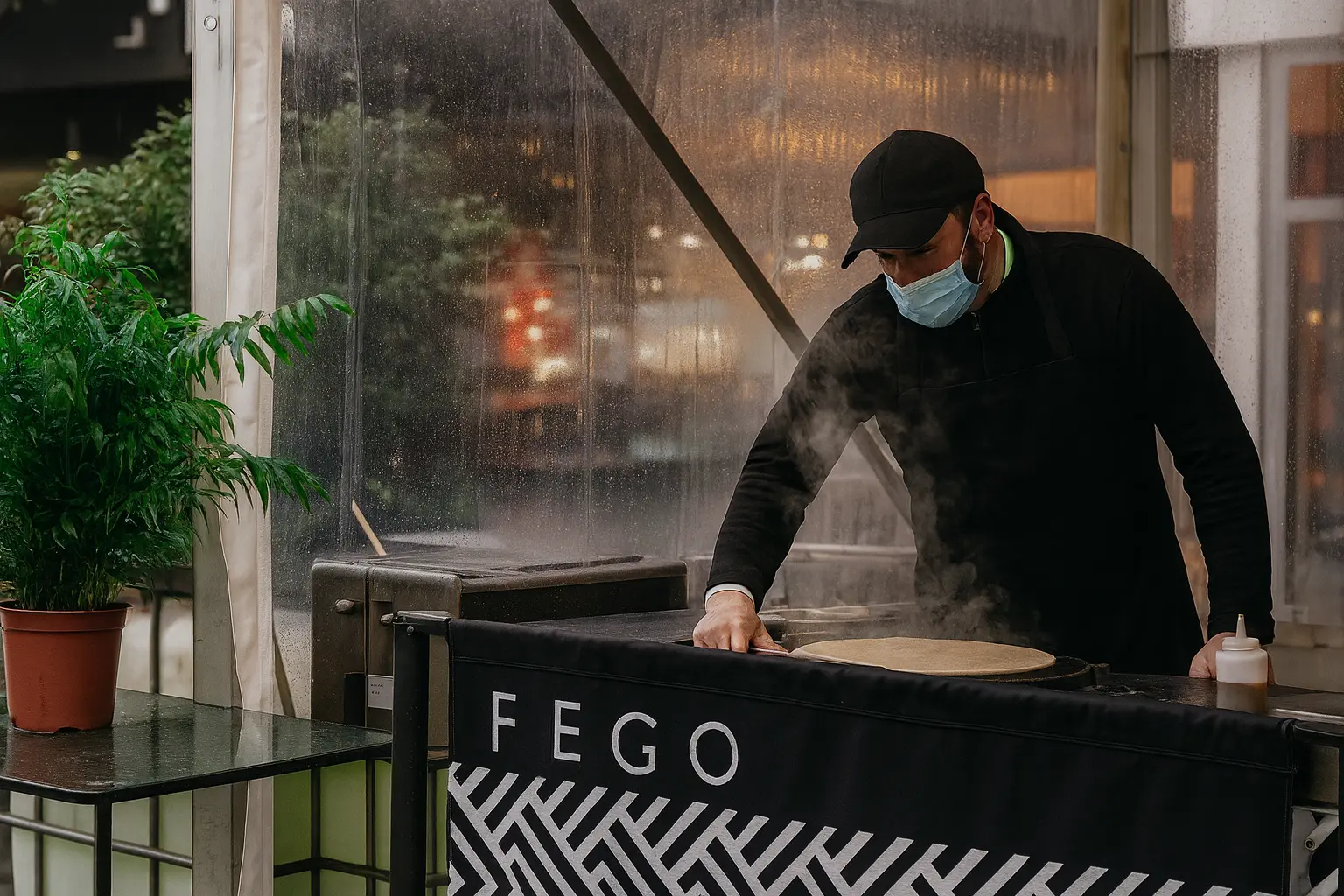
For example, its case study covering temporary café extensions for Fego Restaurants describes installations at Gerrards Cross and Cobham that were developed around different site conditions and operating requirements.
The Gerrards Cross installation was connected to the rear of the existing café, with hardstanding and other existing site features influencing the arrangement.
At Cobham, a restricted frontage, neighbouring boundaries and existing equipment affected the accommodation requirements.
Both projects involved additional customer accommodation intended to provide protection from seasonal weather. The original requirement arose during COVID restrictions, but the structures were planned for extended use, including the winter period.
The example illustrates why site-specific assessment matters. It does not mean that the same arrangements, performance or commercial outcomes can be assumed at other premises.
For operators with a credible requirement for dependable covered or enclosed seating, LM Structures provides temporary and semi-permanent hospitality buildings that can be considered in relation to the intended operating period and site requirements.
The appropriate approach will depend on the business’s needs and the outcome of relevant feasibility assessments.
A more substantial installation is not automatically the best response to an underused outdoor area.
It becomes worth investigating when there is a convincing reason to make that area available more consistently, the existing business can support the additional accommodation and the site appears capable of accommodating a suitable solution.
Extending the useful trading season of a pub garden or café terrace is therefore a question of making existing space dependable, not simply adding shelter. The right approach must provide suitable customer accommodation, work alongside normal service arrangements and be supported by realistic demand. Some businesses may achieve what they need through modest improvements, while others may have a credible case for investigating a longer-term enclosed space.
Understanding your site’s limitations and the commercial purpose of the additional seating will help determine which route is appropriate.
Next Step: Exploring Longer-Term Outdoor Accommodation
If you’ve established that your outdoor seating could support meaningful additional trading beyond summer, but the existing area cannot provide dependable accommodation, this is the point to investigate whether a managed longer-term structure could meet your requirements.
LM Structures can discuss the intended use, operating period and practical characteristics of your site to help establish which temporary or semi-permanent accommodation options may warrant further assessment.
Beginning that discussion before committing to a particular structure allows customer comfort, existing service arrangements, infrastructure and potential site constraints to be considered together.
The aim is to establish whether an appropriate solution is feasible and commercially proportionate, rather than committing to additional accommodation before the requirements are clear.
Contact our team on 0333 3584989 or by email enquiries@lmstructures.co.uk
Frequently Asked Questions
The starting point is to establish whether customers are likely to use the additional accommodation frequently enough to justify the investment. Historical trading patterns, unmet demand, expected utilisation, staffing, heating, maintenance and the intended period of use are all relevant. Where the potential benefit appears credible, a more detailed assessment of project costs and site feasibility can help determine whether to proceed.
Planning permission may be required for a substantial covered or enclosed hospitality area, even when the proposed structure is temporary. The applicable requirements depend on the location, proposed works, intended use and relevant planning rules. Existing permission for removable pavement furniture does not automatically authorise the installation of an enclosed building.
Heating equipment must be suitable for the proposed environment, and appropriate ventilation is particularly important where an area is substantially enclosed. Equipment selection, airflow, moisture management and relevant safety requirements should be assessed for the specific installation. Outdoor heaters must not automatically be assumed suitable for enclosed use.
Enclosing a café terrace may make additional seating more dependable, allowing the business to consider accepting bookings during periods when the area was previously unavailable. However, increased bookings depend on actual customer demand, suitable comfort conditions and the ability to provide an efficient service. The café should establish whether there is sufficient unmet demand before investing in substantial accommodation.
A pub garden may be suitable for extended winter use where appropriate weather protection, customer comfort and operating arrangements can be provided. The level of accommodation required will depend on the location, intended use and environmental conditions. No covering or enclosure should automatically be assumed suitable for every weather condition.