What to do after a storm damages your building
Severe weather does not simply damage a building; it destabilises operations. If your industrial or warehouse facility has experienced significant storm impact, your immediate concern is not just repair, it is control, containment and operational continuity.
This article is written for Facilities Managers responsible for live industrial environments who are facing active disruption and need structured next steps for storm damage industrial building recovery. The focus is infrastructure-led, commercially pragmatic and sequenced around real operational decision points.
What Storm Damage Typically Means for Industrial Buildings
Most UK industrial buildings are steel portal frame structures clad in profiled metal sheet systems, often with composite insulated roof panels or built-up assemblies incorporating insulation and vapour barriers. These systems are designed to withstand significant wind loading, but extreme conditions introduce specific failure modes.
Common forms of storm damage include:
- Uplifted or detached roof sheets
- Fixing failure along eaves and ridge zones
- Displaced flashings and ridge caps
- Compromised rooflights
- Dislodged wall ladding panels
- Distorted or detached gutters
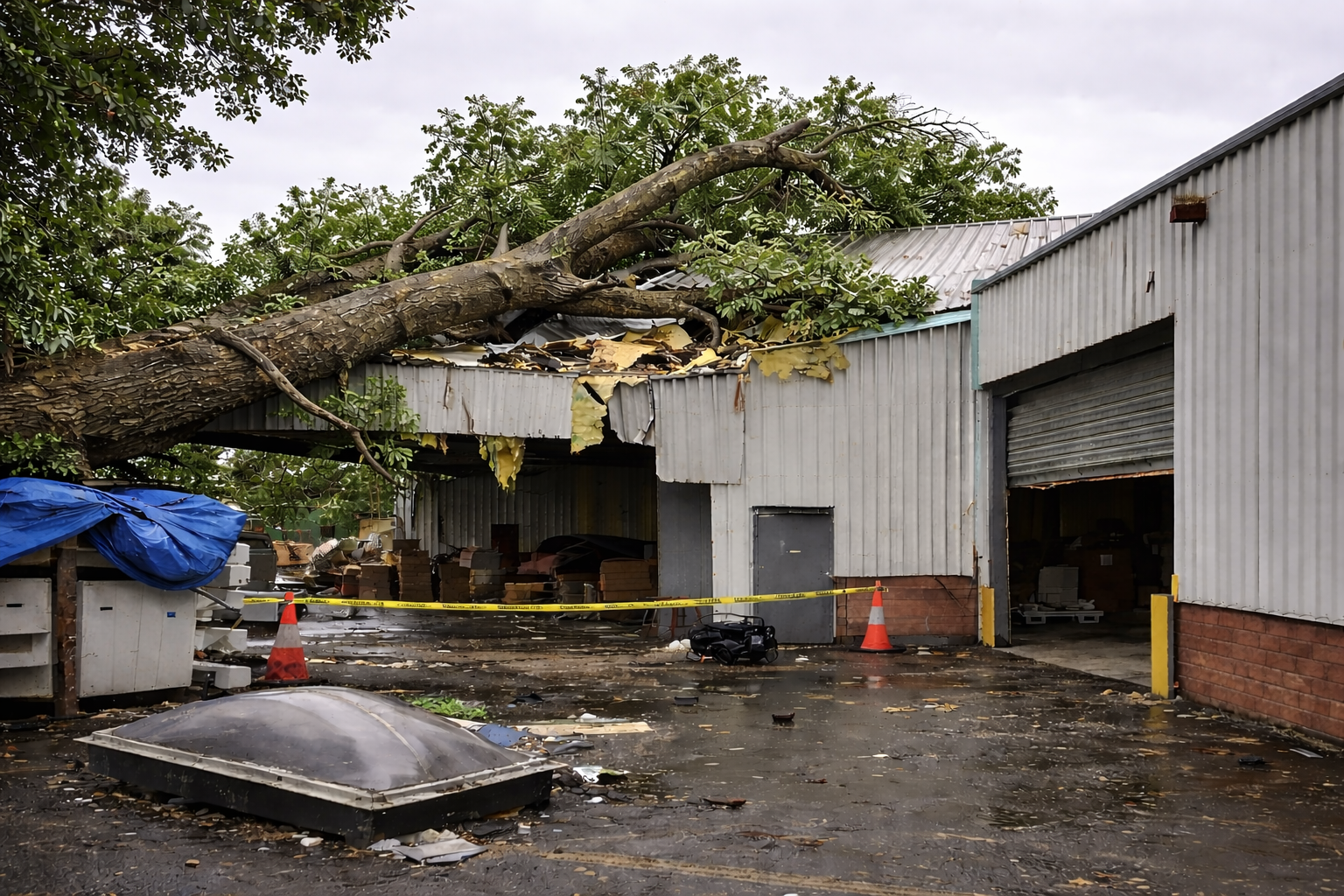
- Impact damage to loading doors and shutters
It is important to distinguish between structural frame integrity and envelope performance. The steel portal frame may remain structurally stable while the roof and cladding systems – which provide weather protection – are compromised.
Wind uplift does not act randomly. Forces travel across sheet spans and transfer into fixings. When one fixing fails, adjacent fixings may experience increased load. This progressive stress transfer can mean that panels adjacent to visibly damaged areas are also weakened, even if they appear intact.
Similarly, flashing displacement at a single penetration point can create delayed water ingress. The absence of obvious structural collapse does not equate to safe operational continuity.
Understanding these behavioural patterns helps Facilities Managers move beyond surface-level inspection and towards structured evaluation.
Immediate Priorities: Safety, Stabilisation and Containment
The first 24–48 hours focus on control. Roof areas that have experienced uplift or visible damage must be treated as unstable until assessed by competent professionals. The UK Health and Safety Executive provides guidance on working safely on roofs and fragile surfaces following severe weather. Internal staff should not attempt informal inspection or temporary repair.
Immediate actions may include:
- Establishing exclusion zones beneath compromised roof sections
- Restricting access to external elevations with displaced cladding
- Preventing unauthorised roof access
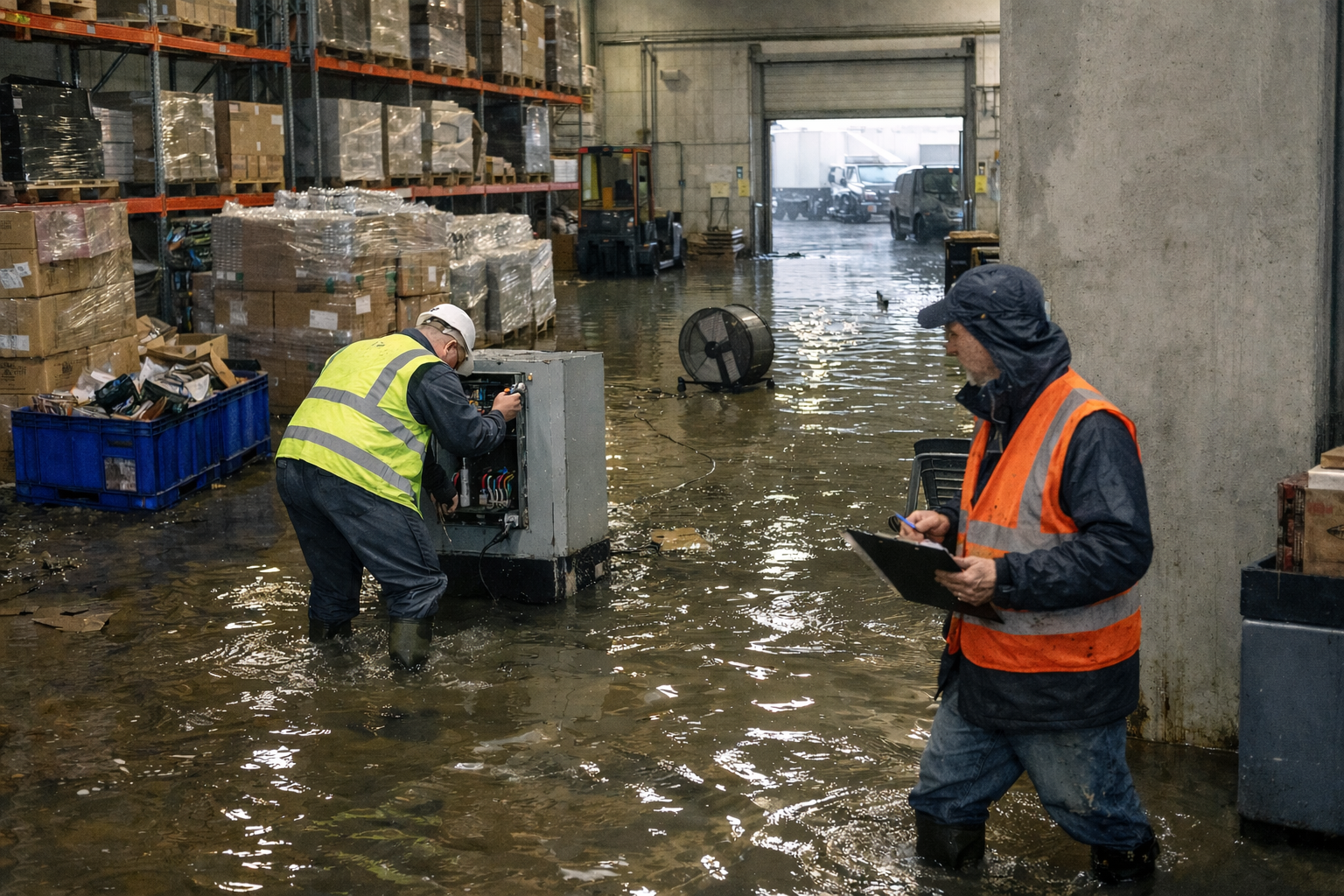
- Isolating affected electrical systems where water ingress presents risk
- Protecting high-value stock or equipment below damaged zones
- Engaging competent contractors for temporary weatherproofing
Temporary containment may involve protective sheeting, localised panel replacement or short-term coverings. These are interim measures designed to prevent further ingress – not substitutes for structured reinstatement.
Documentation at this stage is critical. Photographs, time-stamped records and maintenance logs establish an incident chronology. Even where insurance involvement follows, operational documentation serves internal governance as much as external reporting.
Decision Gate 1: Is the Building Safe to Remain Operational?
Facilities Managers must evaluate whether operations can continue safely.
If falling debris, structural instability or uncontrolled ingress remain active risks, affected zones should be suspended immediately. Where damage is clearly contained and risk mitigated, partial operation with defined exclusion areas may be feasible.
The priority is not continuity at any cost. It is controlled risk management.
Assessing the Extent of Infrastructure Impact
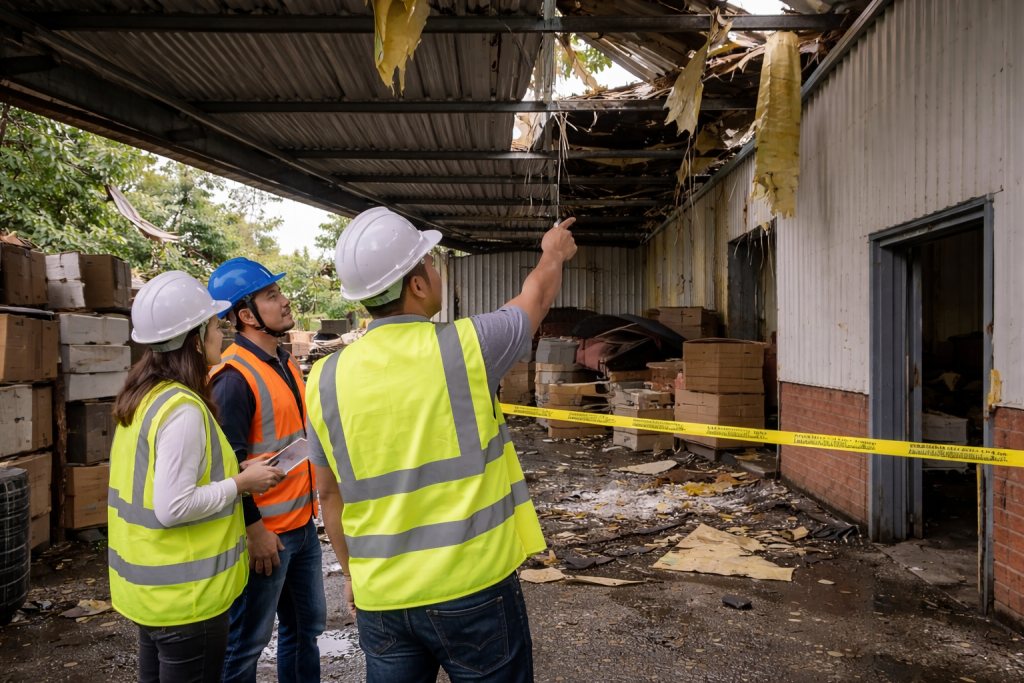
Once immediate hazards are stabilised, a structured assessment should determine the full extent of impact.
This evaluation should address:
- Roof sheet alignment across full spans
- Fixing integrity beyond the visibly damaged zone
- Ridge and eaves detailing
- Condition of rooflights and penetrations
- Vapour barrier disruption
- Gutter alignment and water discharge paths
- Wall cladding continuity
- Evidence of internal moisture migration
- Structural frame condition where wind loading has been extreme
Moisture migration deserves particular attention. Water entering through displaced sheets may travel laterally across insulation layers, follow purlin lines or saturate insulation systems. Saturated insulation reduces thermal performance and may introduce longer-term corrosion risk to internal metal components.
In high-bay warehousing, even minor ingress over extended periods can create stock contamination risk. Moisture may not present immediately as pooling; it may accumulate within composite panels or insulation layers.
Facilities Managers should seek competent professional inspection rather than rely solely on visual surface assessment.
Decision Gate 2: Is the Damage Localised or Systemic?
If damage is confined to a defined roof zone with intact adjacent fixings and stable panels, repair scope may be controlled.
If uplift stress has affected wider spans or if multiple elevations show displacement, systemic remediation may be required. Systemic damage alters repair logistics, material procurement requirements and programme duration.
Early clarity avoids underestimating reinstatement complexity.
Operational Disruption and Commercial Exposure
Storm damage industrial building recovery intersects directly with operational continuity.
Facilities Managers must assess impact across:
- Usable storage footprint
- Racking accessibility
- Forklift circulation routes
- Loading dock functionality
- Temperature and humidity control
- Stock sensitivity to moisture
- Fire detection and suppression integrity
Secondary damage modelling is important. For example:
- Water tracking along purlins may compromise lighting circuits.
- Removal of roof sheets during repair may temporarily expose sprinkler systems.
- Internal scaffold erection may reduce operational floor area.
- Temporary crash decks may restrict vertical clearance.
Commercial exposure increases when reduced capacity intersects with contractual obligations. Dispatch delays, production slowdowns and emergency storage arrangements introduce cost escalation.
Where insurance is engaged, loss adjusters may attend site to assess the damage in relation to policy conditions. Their function is evidential. Operational continuity decisions remain within the remit of site management.
Decision Gate 3: Can Operations Continue Safely With Mitigation?
Mitigation may include reconfiguring stock locations, isolating damaged zones or implementing short-term coverings. However, if envelope instability persists or environmental control cannot be maintained, continued operation may introduce compounding risk.
Facilities Managers must assess whether operational persistence protects revenue or increases exposure.
Programme Planning: Short-Term Stabilisation vs Structured Recovery
Recovery planning typically unfolds in parallel tracks:
- Temporary stabilisation works
- Permanent repair and reinstatement planning
Temporary works reduce immediate exposure but should not obscure long-term repair complexity.
Permanent reinstatement may involve:
- Removal of affected roof sheets across wider spans
- Internal scaffold erection
- Installation of crash decks
- Temporary lighting provision
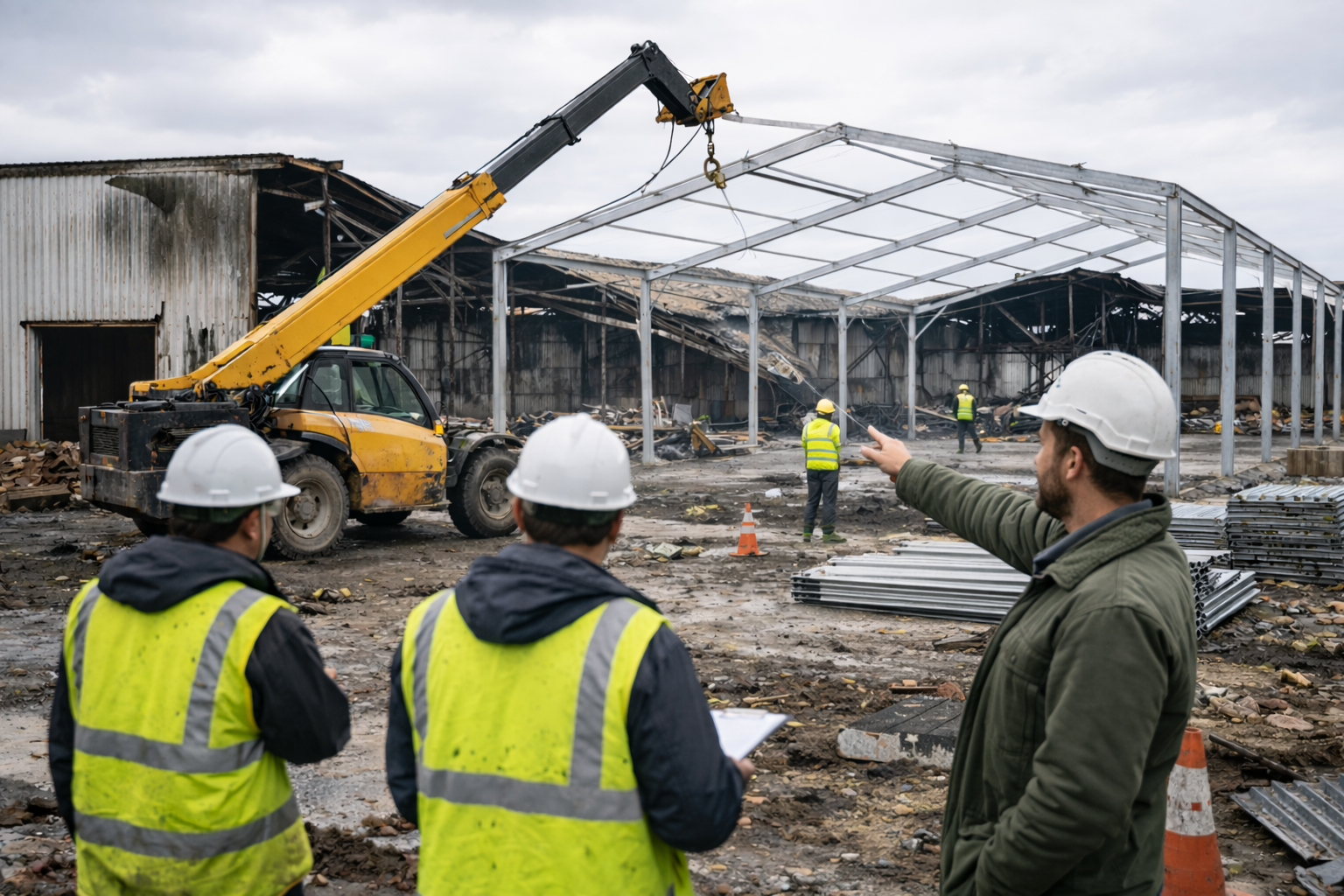
- Crane access planning
- Controlled removal of insulation layers
- Coordination with fire detection systems
Repair logistics can significantly affect operations. Scaffold footprint reduces usable space. Internal crash decks restrict vertical access. Removal of cladding panels may temporarily affect compartmentation.
Material procurement can also introduce delay. Matching existing cladding profiles, colours or insulation specifications may require manufacturing lead times. Following major storm events, contractor availability may be constrained across the region.
Decision Gate 4: Will Repairs Materially Disrupt Operations?
If permanent repair requires extended exclusion zones, scaffold erection across operational areas or phased roof removal, operational disruption may exceed acceptable thresholds.
At this point, continuity modelling becomes central.
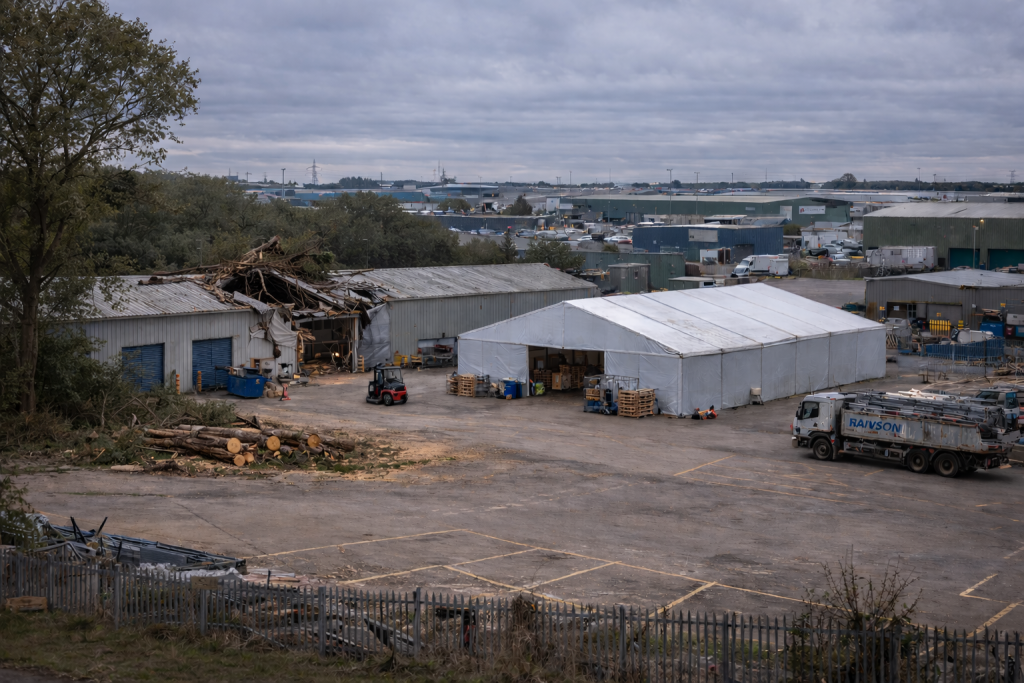
When Temporary Industrial Space Becomes a Practical Continuity Measure
Storm damage to a warehouse roof does not automatically require decanting. However, where reinstatement extends beyond short-term tolerance, interim space may provide operational stability.
Temporary industrial buildings can serve as:
- Additional covered storage zones
- Segregated stock holding areas
- Temporary dispatch facilities
- Phased operational buffers during roof removal
- Protected loading bays during cladding replacement
These structures occupy a space between permanent construction and lightweight coverings. They provide weather-protected, structurally robust interim capacity while remaining more flexible than permanent build solutions.
The trigger for consideration lies in continuity thresholds, including:
- Duration of anticipated repair works
- Percentage of floor area rendered unusable
- Environmental sensitivity of stored goods
- Contractual throughput requirements
- Revenue exposure modelling
- Site layout flexibility
Continuity solutions should sit within a broader recovery framework. LM Structures outlines structured business continuity planning considerations in more detail on our business continuity page.
The objective is not opportunistic expansion. It is stabilised operational continuity during structured repair.
Compliance and Risk Considerations During Storm Recovery
Storm recovery engages regulatory awareness.
Facilities Managers should consider:
- Working at Height Regulations for roof access
- Fragile surface classification
- CDM role awareness where repair works constitute construction activity
- Temporary works coordination responsibilities
- Fire compartmentation integrity during cladding removal
- Impact on sprinkler coverage if roof sheets are removed
- RAMS approval and contractor supervision
Even temporary stabilisation introduces risk. Contractor access to compromised roofs must be controlled through documented method statements and competent supervision.
Regulatory awareness does not require engineering oversight from the Facilities Manager, but it does require structured coordination.
Structured Recovery, Not Reactive Repair
Storm damage industrial building recovery requires calm sequencing. The objective is not rapid patching or reactive decision-making. It is controlled assessment, phased repair and structured continuity planning.
Facilities Managers operate at the junction of safety, infrastructure and commercial accountability. Distinguishing between structural frame stability and envelope performance, modelling moisture migration, anticipating repair logistics and evaluating continuity thresholds are all part of disciplined recovery.
When properly sequenced, recovery restores operational certainty – not simply building fabric.
If Storm Damage Is Affecting Your Industrial Operations
Storm damage to industrial buildings rarely follows a predictable path. Initial containment may stabilise the situation, but longer-term recovery often raises wider operational questions, particularly where repairs affect usable floor space, loading access or internal workflows.
In some situations, organisations introduce temporary covered space to maintain storage, protect stock or support dispatch activity while reinstatement works are underway. These structures can form part of a broader continuity strategy where operational capacity would otherwise be reduced.
LM Structures works with organisations across the UK to plan and supply temporary industrial buildings that support operational continuity during infrastructure disruption, phased refurbishment or capacity constraints.
If you are assessing recovery options following storm damage to an industrial facility, our team can provide practical guidance on how temporary structures may support your recovery planning.
Call 0333 358 4989 or email enquiries@lmstructures.co.uk
Photographs, inspection reports, contractor documentation, maintenance records and internal incident logs should be retained to support governance and any insurer engagement.
Where repair timelines exceed operational tolerance, or where usable floor area reduction threatens throughput stability, interim covered space may provide structured continuity.
Yes. Water may migrate across insulation layers or structural members before becoming visible. Continued monitoring following temporary repairs is advisable.
Not necessarily. Portal frames may remain structurally sound while cladding systems are compromised. However, envelope failure can still materially affect operational safety and environmental control.
Duration depends on scope. Localised panel replacement may resolve within weeks. Widespread envelope compromise or structural intervention may extend significantly longer, particularly where material procurement or regional contractor capacity affects timelines.