What Are Your Options After Storm Damage Makes Your Building Unsafe?
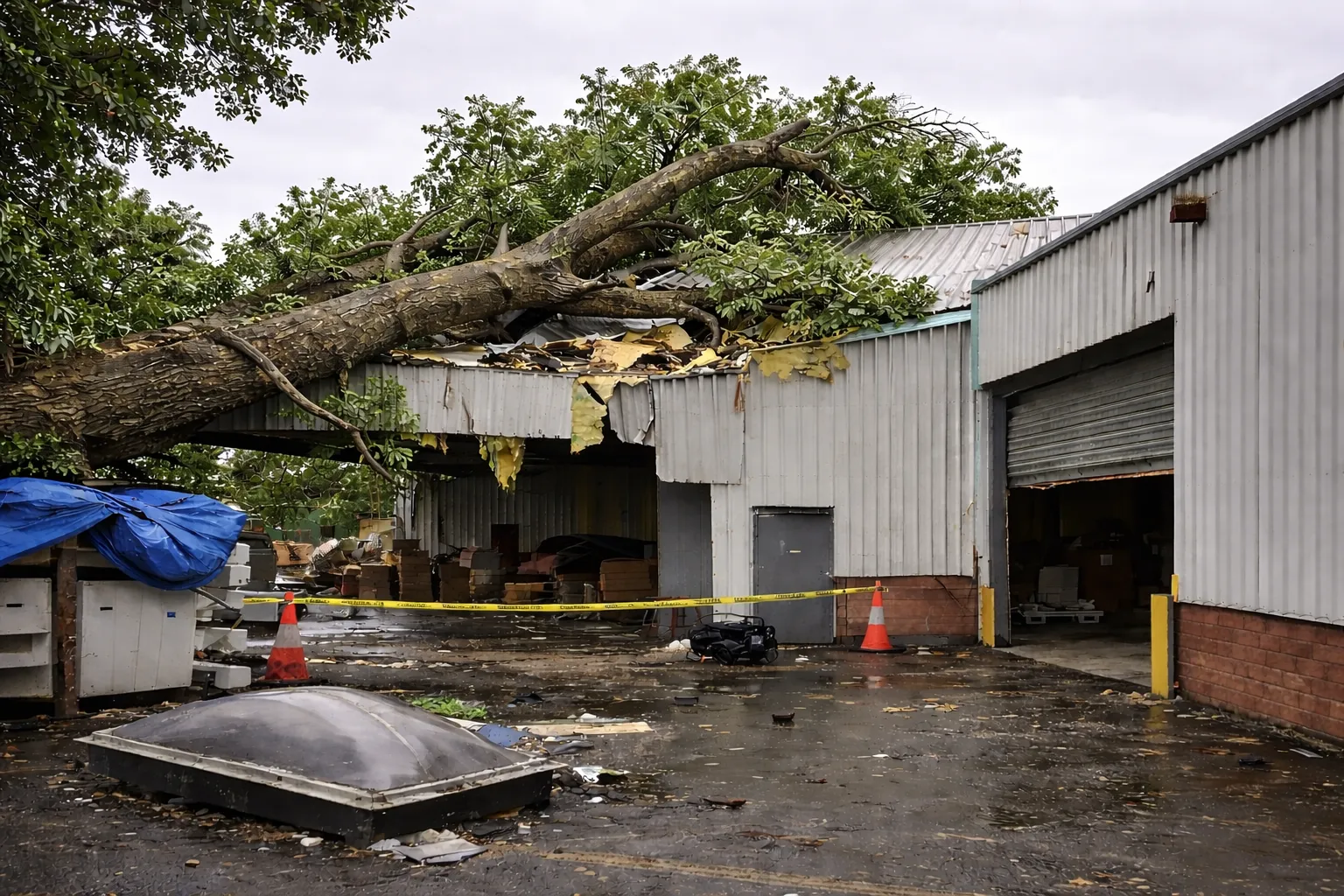
Storm damage can leave a building legally, structurally or practically unsafe before the full extent of the damage is understood. In that situation, the priority is not to keep using the space at any cost, but to protect people, restrict access and identify a safe route for operational continuity.
In short
If storm damage has made your building unsafe, restrict access, secure the affected area and arrange a competent assessment before allowing normal operations to continue. Once safety is understood, your options are usually repair, relocation, partial operation or temporary buildings that provide safe replacement space while recovery work continues.
Recovery Priorities at a Glance
- Prioritise people, access control and site safety before operational recovery.
- Do not assume a storm-damaged building is safe because damage appears limited.
- Identify which operations must continue, pause, relocate or move into temporary space.
- Consider repair, relocation and temporary structures as part of one continuity pathway.
- Act early to reduce avoidable downtime, stock exposure and operational uncertainty.
Table of contents – in this article
What should you do immediately after storm damage makes a building unsafe?
The first priority after storm damage is to prevent people from entering areas where the level of risk is unknown. Even where damage appears localised, high winds, impact, roof damage, water ingress or displaced materials can affect parts of the building that are not immediately visible.
Access should be restricted until the site has been made safe enough for assessment. That may mean closing parts of the building, isolating affected zones, redirecting vehicles, protecting stock or equipment where this can be done safely, and keeping staff away from areas where debris, instability or further weather exposure could create additional risk.
This is the point where operational pressure can lead to poor decisions. A warehouse, workshop, retail unit, production space or storage building may still contain essential stock, machinery or live customer commitments, but safety has to override the instinct to recover everything immediately. The commercial risk of downtime is real, but it should not be managed by allowing people back into an uncertain structure too soon.
A controlled first response should usually focus on:
- Preventing unauthorised access
- Identifying visible hazards
- Protecting people before property
- Recording the condition of the site
- Notifying relevant internal teams, insurers or advisors
- Separating urgent operational needs from unsafe recovery activity
This is also where business continuity planning becomes practical rather than theoretical. The question is not simply “how quickly can we reopen?” but “which activities must continue, and where can they be carried out safely?”
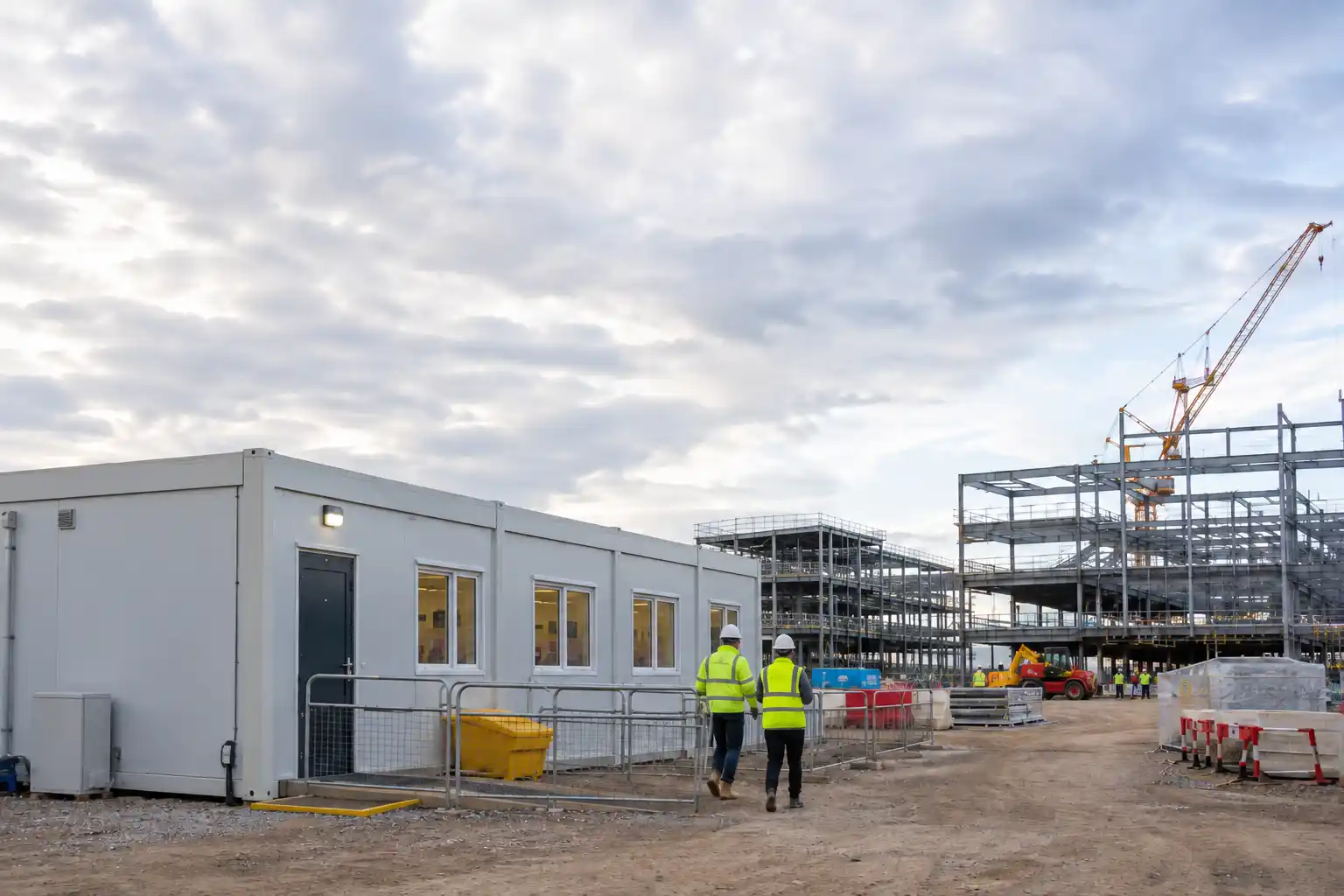
For organisations that cannot operate from the damaged building, Business Continuity Structures may become part of the early recovery conversation. They should not replace structural assessment or repair planning, but they can help create safe operational capacity while the original site is being evaluated.
How do you assess whether a building is safe to use after a storm?
A storm-damaged building should be assessed carefully because visible damage does not always reflect the full level of risk. A damaged roof, cladding failure, movement in structural elements, water penetration or impact damage may create uncertainty that cannot be resolved through a quick visual check.
Storm damage does not always occur in isolation. Wind uplift, impact and structural stress can affect surrounding elements beyond the visibly damaged area. For example, failure in one section of roof sheeting can increase load on adjacent fixings, and displaced elements may allow water ingress to travel beyond the original point of damage. This means areas that appear unaffected may still be compromised and require assessment.
For decision-makers under pressure, this distinction matters. A building may look partially usable, but still present risks to staff, contractors, visitors, stock or equipment. The fact that one area appears unaffected does not automatically mean that access routes, roof structure, loading bays, utilities or adjoining areas remain safe.
Assessment should consider both the building and the operational environment around it. Storm damage may affect:
- Roof coverings or roof structure
- External walls, cladding or doors
- Drainage and water ingress
- Electrical systems or utilities
- Loading areas and access routes
- Ground conditions around the building
- Nearby trees, fencing, debris or loose materials
Where there is concern about instability, collapse risk or dangerous structures, specialist input may be required before any decision is made about reoccupation. HSE guidance on structural stability reinforces the need to protect people from collapse and falling materials where structural integrity is uncertain.
The practical decision is often not binary. The outcome may be full closure, controlled partial access, temporary relocation of specific functions, or short supervised entry for recovery activity. What matters is that access decisions are made through assessment and control, not assumption.
Commercially, this stage affects more than safety compliance. If the assessment process is delayed, unclear or poorly coordinated, the business may lose time deciding what can continue and what must move elsewhere. That can affect customer commitments, stock movement, fulfilment, production schedules and wider operational confidence.
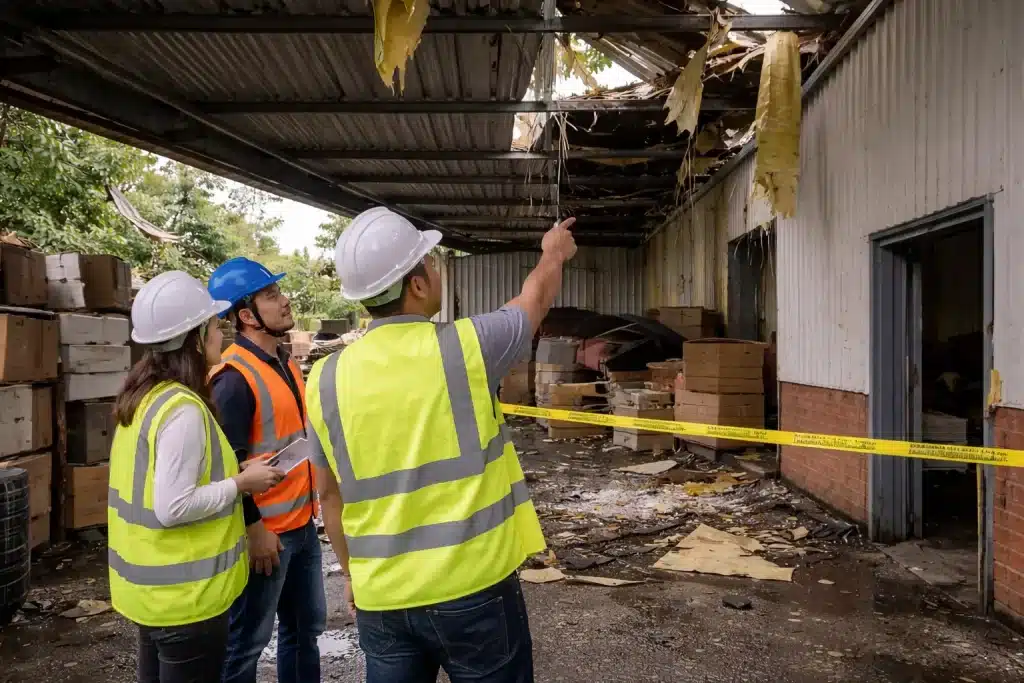
What are your options if your building is no longer safe to operate in?
If the building cannot be used safely, the main recovery options are repair, relocation, temporary operational space or a combination of all three. The right route depends on the severity of the damage, the function of the building, site access, weather exposure, insurance requirements and how long operations can realistically remain disrupted.
Repair is often the long-term requirement, but it may not solve the immediate continuity problem. Roof repairs, structural works, replacement cladding, drying out, inspection, approvals and reinstatement can all take time. During that period, the business may still need storage, production, dispatch, welfare, customer-facing space or protected working areas.
Relocation may be suitable where another site is already available and operationally practical. However, it can introduce its own disruption: transport changes, staff travel, customer access, handling inefficiencies, temporary racking or equipment moves, and the difficulty of recreating operational flow in a space that was not designed for the work.
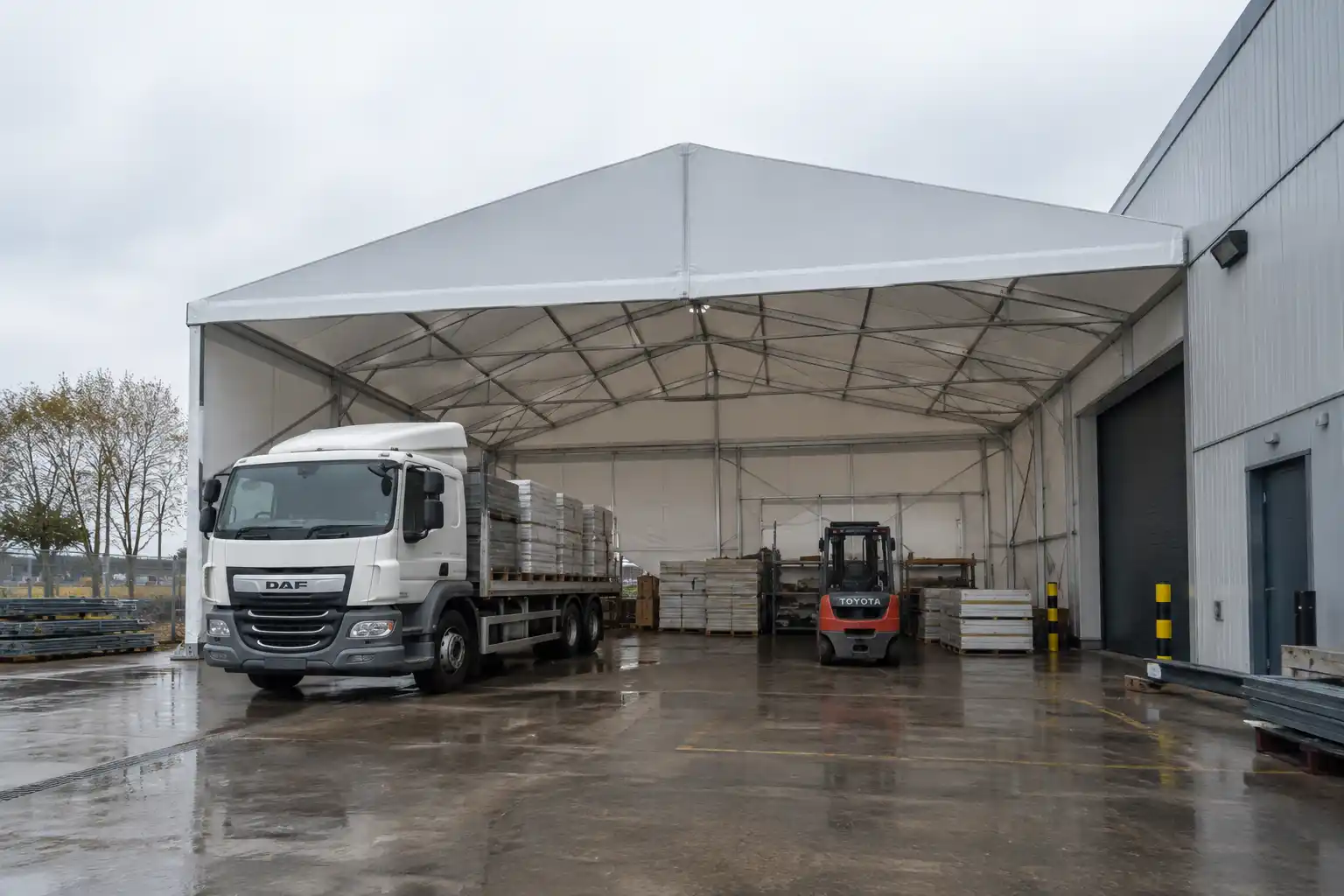
Temporary buildings can provide a middle route where the business needs safe, usable space, and selecting which temporary building types are suitable for business use becomes an important part of that decision. Depending on site conditions and feasibility, a temporary structure may be used to support warehousing, covered working areas, equipment protection, dispatch functions or other continuity needs.
This is where the decision becomes commercially important. Waiting for repair may appear simpler, but it can extend downtime, and may also raise questions around whether insurance covers temporary buildings where continuity space is required if essential activities have nowhere safe to operate. Relocation may create continuity, but it can also fragment operations. A temporary building may help maintain control by keeping key activities close to the existing site, provided access and installation conditions are suitable.
In practical terms, disruption often extends beyond the immediate loss of space. Reduced storage capacity, restricted access routes, limited loading functionality and changes to internal workflow can all affect throughput. Even where parts of the building remain usable, these constraints can impact dispatch, production or fulfilment, increasing pressure on existing operations and contractual commitments.
The recovery decision should therefore be based on three questions:
- What activities are safety-critical or business-critical?
- Which of those activities can continue away from the damaged building?
- What form of replacement space will reduce disruption without introducing new risk?
Can temporary buildings provide a safe alternative after storm damage?
Temporary buildings can provide a controlled, weather-resistant environment, forming part of a wider approach to how temporary buildings support business continuity, when the original structure is unsafe or unusable, but only once site conditions allow safe installation. They are typically considered where operations cannot pause entirely and where repair timelines are uncertain or extended.
In a storm damage scenario, their value is not simply speed, but controlled separation from risk. A temporary structure can allow staff, stock, equipment or processes to operate away from unstable elements, damaged roofs, exposed areas or ongoing weather ingress.
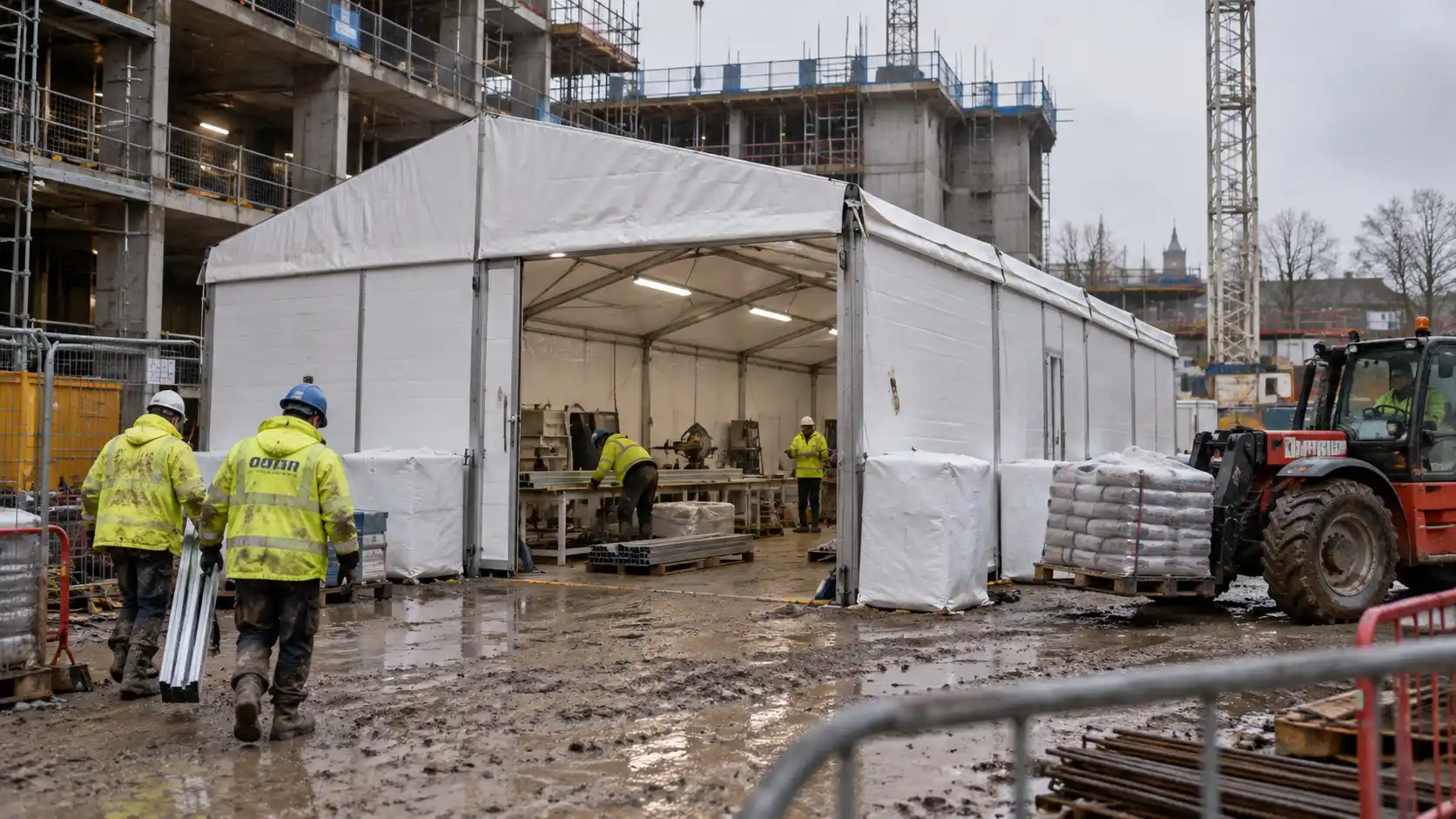
They can be used to support:
- Covered storage where stock is exposed to further weather damage
- Protected working areas where internal environments are compromised
- Dispatch or logistics zones where loading areas are affected
- Interim production or assembly space where continuity is critical
- Welfare or operational support areas where facilities are unavailable
In practice, this means temporary buildings are often used to support specific operational functions rather than acting as a general replacement. This may include maintaining dispatch capability, protecting critical stock, supporting goods handling or creating controlled workflow zones while recovery is ongoing.
Keeping these functions on or near the existing site can help maintain operational flow and reduce the complexity that comes with full relocation.
Importantly, temporary buildings should be viewed as part of a coordinated response.
Their suitability depends on access, ground conditions, available footprint, and whether installation can be carried out safely, which should be assessed against temporary building site requirements and constraints, particularly in disruption scenarios such as fire damage, flooding or storm damage. In some cases, installation may need to wait until debris is cleared or areas are stabilised.
Where feasible, they can reduce exposure to continued weather conditions and allow operations to stabilise while structural assessment, insurance processes and repair works progress. This aligns with broader business continuity guidance, which focuses on maintaining critical functions at an acceptable level rather than waiting for full reinstatement.
Constraints that can delay storm damage recovery
Storm damage recovery is rarely immediate because it is influenced by factors outside the organisation’s direct control. Understanding these constraints helps explain why a structured approach is required rather than reactive decisions.
Ongoing weather exposure
Can prevent safe access, delay inspection or limit what work can be carried out. According to the Met Office, repair activity should not be undertaken while severe weather conditions persist, which can extend the period before meaningful recovery begins.
Access limitations
Are common. Debris, unstable surfaces, damaged loading areas or restricted entry points may affect both assessment and any installation of temporary solutions. This can also affect supply chain activity if vehicles cannot access the site safely.
Structural uncertainty
Can delay decision-making. Until the condition of the building is understood, it may not be possible to confirm whether areas can be reused, partially accessed or must remain closed. High-level safety expectations reflected by the Health and Safety Executive emphasise protecting people from collapse or falling materials where integrity is uncertain.
Repair and reinstatement timelines
May be affected by material availability, contractor scheduling, insurance approvals or specialist inspections. Even relatively localised damage can create extended downtime if the affected elements are critical to the building’s function.
Operational dependencies
Such as utilities, drainage, electrical systems or adjacent infrastructure can further slow recovery, even if the main structure appears repairable.
In practice, repair and reinstatement timelines are often longer than initially expected. Material availability, contractor scheduling, access constraints and the time required for temporary building installation in real-world conditions can all extend programme duration. This means operational decisions may need to be made before there is full clarity on when the original building will be ready for use again.
These constraints reinforce why early stabilisation decisions matter. Delays at this stage can extend downtime, increase exposure to further damage, and create inefficiencies as teams attempt to work around an unsafe or restricted environment.
- Activities that must stop until the building is confirmed safe
- Activities that can continue elsewhere (relocated or off-site)
- Activities that require protected, on-site space to maintain continuity
Where operations are fragmented across unsuitable areas, inefficiencies can quickly emerge. Stock handling may become slower, dispatch processes may be disrupted, and staff may be working in suboptimal or temporary conditions that were not designed for sustained use.
A stabilisation strategy should therefore focus on:
- Restoring safe access routes and working zones
- Protecting critical operations from further weather exposure
- Reducing reliance on unsafe or partially damaged areas
- Maintaining operational flow where possible
- Avoiding repeated disruption as conditions change
Temporary structures can support this by providing consistent, weather-resistant space that does not depend on the condition of the original building. Where they are installed alongside the existing site, they can also reduce the need for full relocation, helping maintain proximity to infrastructure, stock and logistics networks.
This is particularly relevant where continued downtime would affect customer commitments, supply chains or contractual obligations. While commercial pressures should not override safety decisions, they do influence how quickly a business needs to regain controlled operational capacity.
What should your next operational priority be?
Once the immediate response has been handled and initial decisions made, the focus should shift to maintaining control over recovery, rather than reacting to each new issue as it arises.
At this stage, the key question is not just how to repair the building, but how to operate safely and consistently while that process unfolds. That means:
- Confirming which operations must be protected from disruption
- Ensuring those operations have access to safe, usable space
- Reducing exposure to ongoing weather and structural uncertainty
- Avoiding repeated shutdowns caused by partial or unstable recovery steps
A stable recovery approach does not rely on temporary fixes within an unsafe building. It is based on creating reliable working conditions that can support operations over days, weeks or longer, depending on the extent of the damage.
This is where structured decision-making becomes most valuable. By separating safety, assessment and continuity into clear stages, the organisation can move from uncertainty toward a controlled operational position.
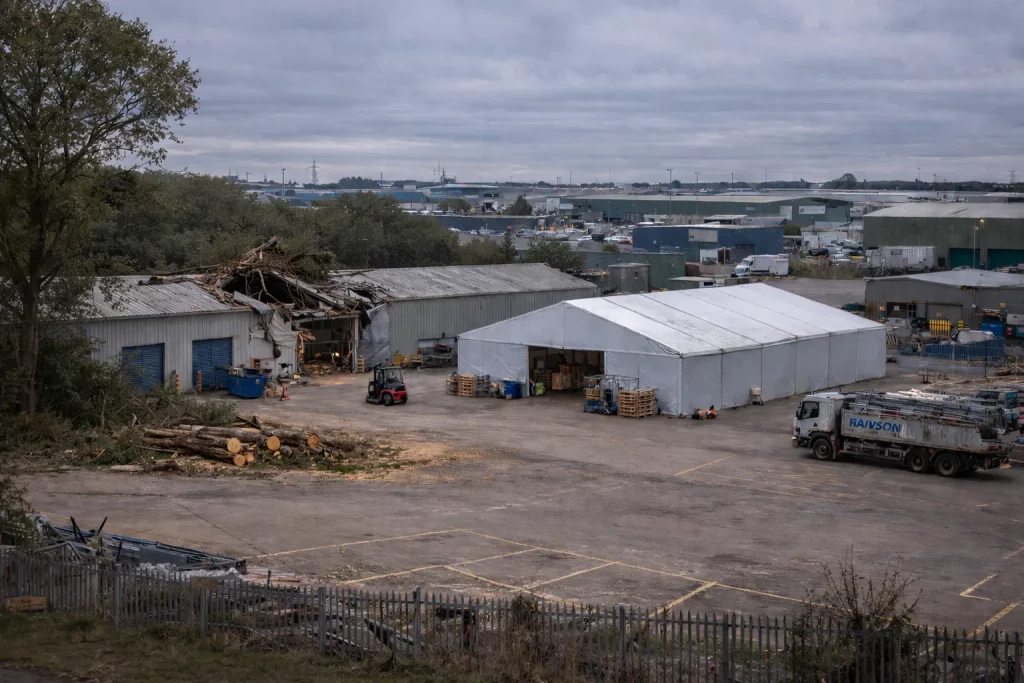
Next step
If your building has been made unsafe by storm damage, the point to act is when operations cannot continue safely within the existing structure, but cannot be paused indefinitely either.
At this stage, a temporary building may provide a practical way to restore safe operational space while repair, inspection and insurance processes are ongoing. The benefit is not simply continuity, but the ability to maintain control—protecting staff, preserving stock and keeping critical functions running in a stable environment.
LM Structures supports organisations in situations where safe operational space is needed quickly, but must still be delivered in a controlled, compliant and site-appropriate way. This includes assessing feasibility, working around site constraints, and providing structures that are suitable for ongoing commercial use rather than short-term stopgaps.
If your site is currently restricted, exposed or partially unusable, the next step is to establish whether a temporary structure can be installed safely and what form of space would best support your operations. This creates a clear pathway from disruption to controlled recovery, without relying on uncertain or unsafe working conditions.
Call 0333 358 4989 or email enquiries@lmstructures.co.uk
Photographs, inspection reports, contractor documentation, maintenance records and internal incident logs should be retained to support governance and any insurer engagement.
Where repair timelines exceed operational tolerance, or where usable floor area reduction threatens throughput stability, interim covered space may provide structured continuity.
Yes. Water may migrate across insulation layers or structural members before becoming visible. Continued monitoring following temporary repairs is advisable.
Not necessarily. Portal frames may remain structurally sound while cladding systems are compromised. However, envelope failure can still materially affect operational safety and environmental control.
Duration depends on scope. Localised panel replacement may resolve within weeks. Widespread envelope compromise or structural intervention may extend significantly longer, particularly where material procurement or regional contractor capacity affects timelines.