What to Do After a Warehouse Flood to Protect Operations
When your site has flooded, the pressure to restore operations can be immediate, but recovery depends on what is safe, accessible and physically possible.
In short
After flood damage, the first priority is to make the site safe, assess contamination and understand which areas can be used without putting people, stock or equipment at risk. Temporary buildings can support business continuity after flooding, but only once ground conditions, access and site preparation make installation viable.
Recovery Priorities at a Glance
- Control access and prevent unsafe re-entry until the site has been assessed.
- Identify contamination, standing water, saturated ground and structural concerns before planning operational recovery.
- Separate urgent decisions from actions that must wait for drying, clean-up or validation.
- Consider temporary space once access, ground stability and installation conditions are suitable.
- Plan recovery in stages: assessment, stabilisation, continuity and phased operational return
Table of contents – in this article
What should you do immediately after your site floods?
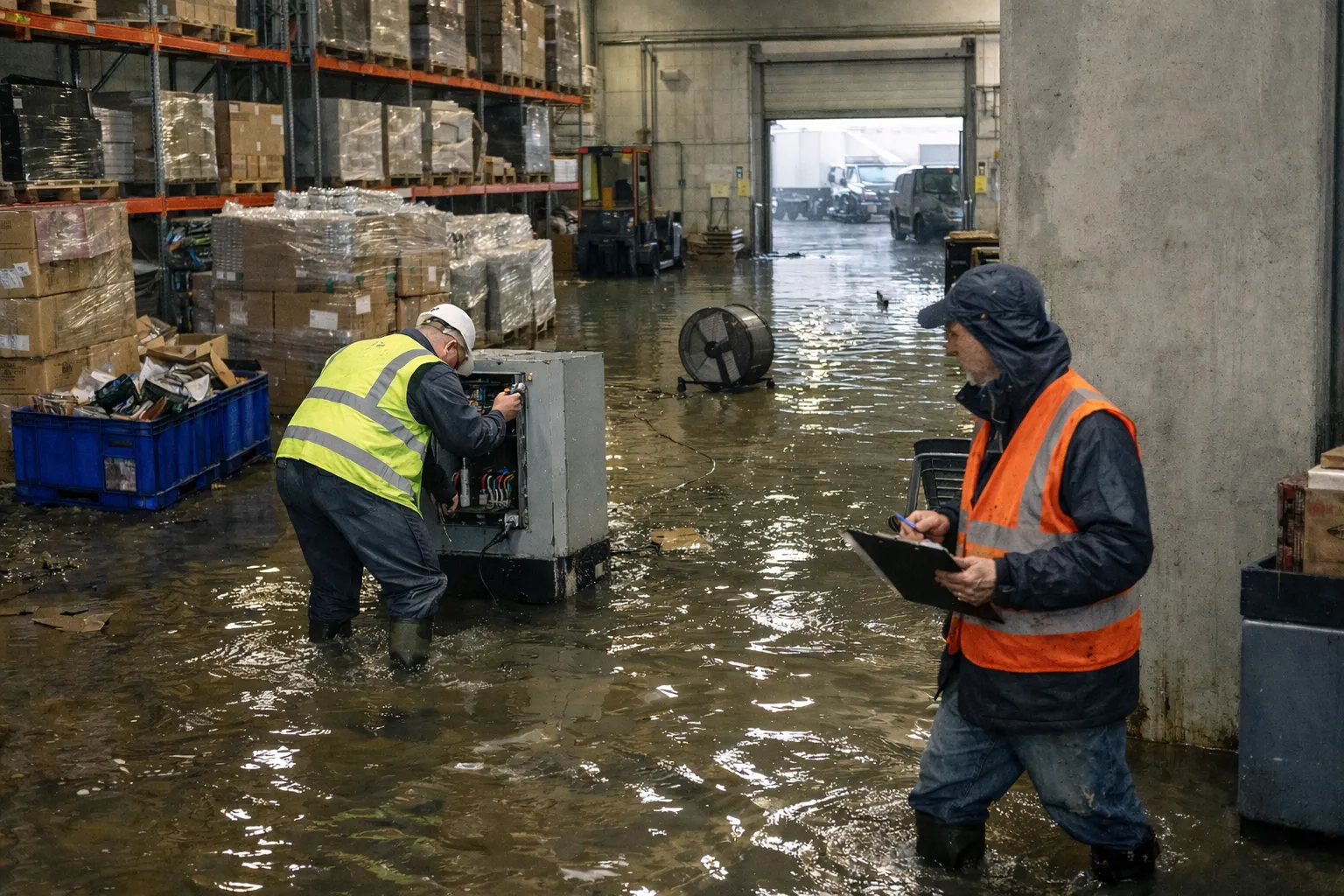
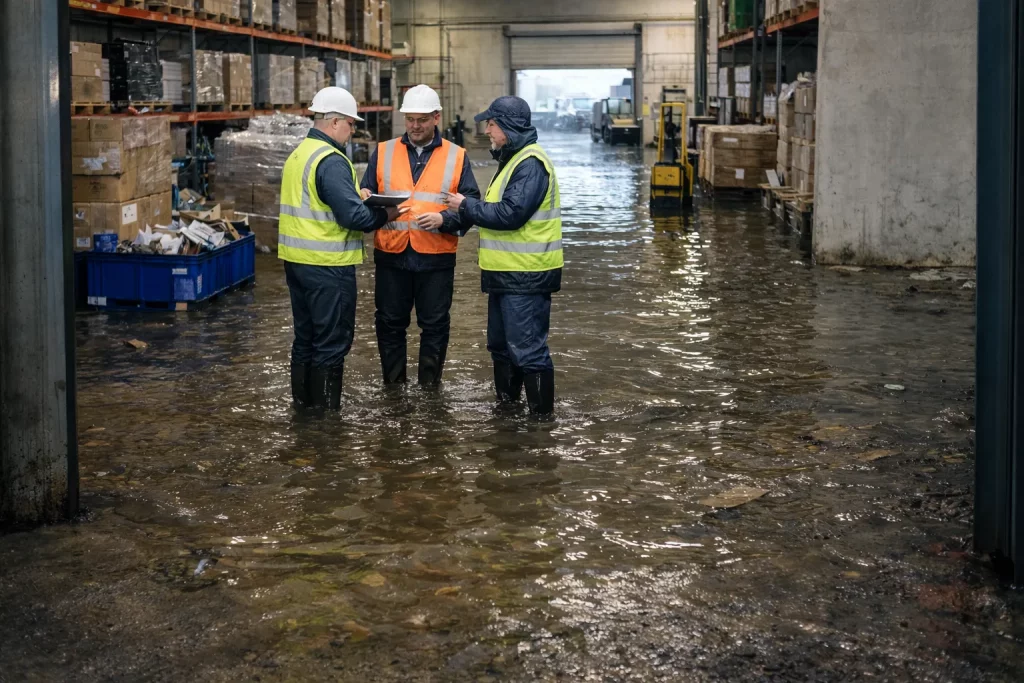
The first step after site flooding is to protect people, secure the affected area and prevent unnecessary access. Even where floodwater has started to recede, the site may still present risks from contaminated water, damaged electrics, unstable surfaces, hidden debris or weakened building fabric.
For an Operations Manager, Facilities Manager or Site Manager, the immediate task is not to restart activity at any cost. It is to establish control. That means confirming who can access the site, which areas are off limits, what services may be affected and whether specialist inspection or clean-up support is required before staff return.
Floodwater should be treated cautiously because it may contain sewage, chemicals, fuel, biological contaminants or debris. Electrical systems should be treated as high risk until they have been properly inspected. The Health and Safety Executive’s guidance on electrical safety highlights the risks associated with damaged or water-affected systems and reinforces the need for proper inspection before re-energising equipment.
Floodwater can affect distribution boards, control panels, charging points and other low-level infrastructure, even where visible damage appears limited. Re-energising systems too early can introduce safety risks and cause further damage, so verification should take place before any attempt is made to restart equipment or services.
The UK Government’s guidance on what to do after a flood advises caution around contaminated items and recommends appropriate disposal routes where pollution is present. The Environment Agency’s guidance for businesses on flood planning also reinforces the importance of early preparation, clear responsibilities and structured response planning.
From a business continuity perspective, this early stage should focus on three parallel actions: stabilising the site, protecting recoverable assets and gathering enough information to make practical decisions. Acting too quickly can create health and safety exposure. Waiting too long to plan can extend downtime unnecessarily.
The strongest recovery position is usually created by separating immediate safety actions from continuity planning. You may not yet know whether operations can resume on the same footprint, but you can begin assessing alternative working areas, temporary storage needs, customer commitments and critical operational functions.
How does flooding affect your ability to operate?
Flooding rarely affects only the space that has taken on water. It can disrupt the wider operational ecosystem around the site, including access routes, loading areas, stock movement, utilities, staff welfare, plant, equipment, IT infrastructure and customer fulfilment.
In a warehouse or industrial environment, even partial flooding can restrict usable floor space, compromise stock, interrupt despatch, reduce picking and packing capacity or limit vehicle access. In a commercial or service-led setting, the impact may be different but still significant: staff may be unable to work safely, customers may be unable to access the premises and essential equipment may be unavailable.
The commercial pressure is often immediate. Lost operational space can affect revenue, contract performance, supply chain reliability and customer service, and may also raise questions around whether insurance covers temporary buildings where continuity space is required. However, the right response depends on which functions are genuinely critical and which can be temporarily relocated, reduced or sequenced differently while the site is stabilised.
This is where flood recovery differs from many other disruption scenarios. After a fire, the primary issue may be damage to a specific building or zone. After a flood, the surrounding site conditions may be just as important as the building itself. Saturated ground, blocked drainage, contamination and access restrictions can all affect what can happen next.
That is why business continuity after flooding should not be treated as a single decision. It is a sequence of operational judgements: what must stop, what can continue safely, what can be moved, what needs temporary space and what must wait until the site is physically ready.
In practical terms, this often involves triaging stock and operational areas under time pressure. Inventory may need to be separated into confirmed loss, potentially recoverable and unaffected categories to prevent cross-contamination and unnecessary write-offs. At the same time, decisions about which stock supports critical orders, contractual obligations or production continuity may need to be made quickly, even before full assessment is complete.
Can you install temporary buildings after flood damage?
Temporary buildings can be a practical route to restoring capacity after flood damage, but they are not automatically deployable on every flooded site. Feasibility depends on the condition of the ground, access for installation, contamination risk, drainage, available space and the operational use required.
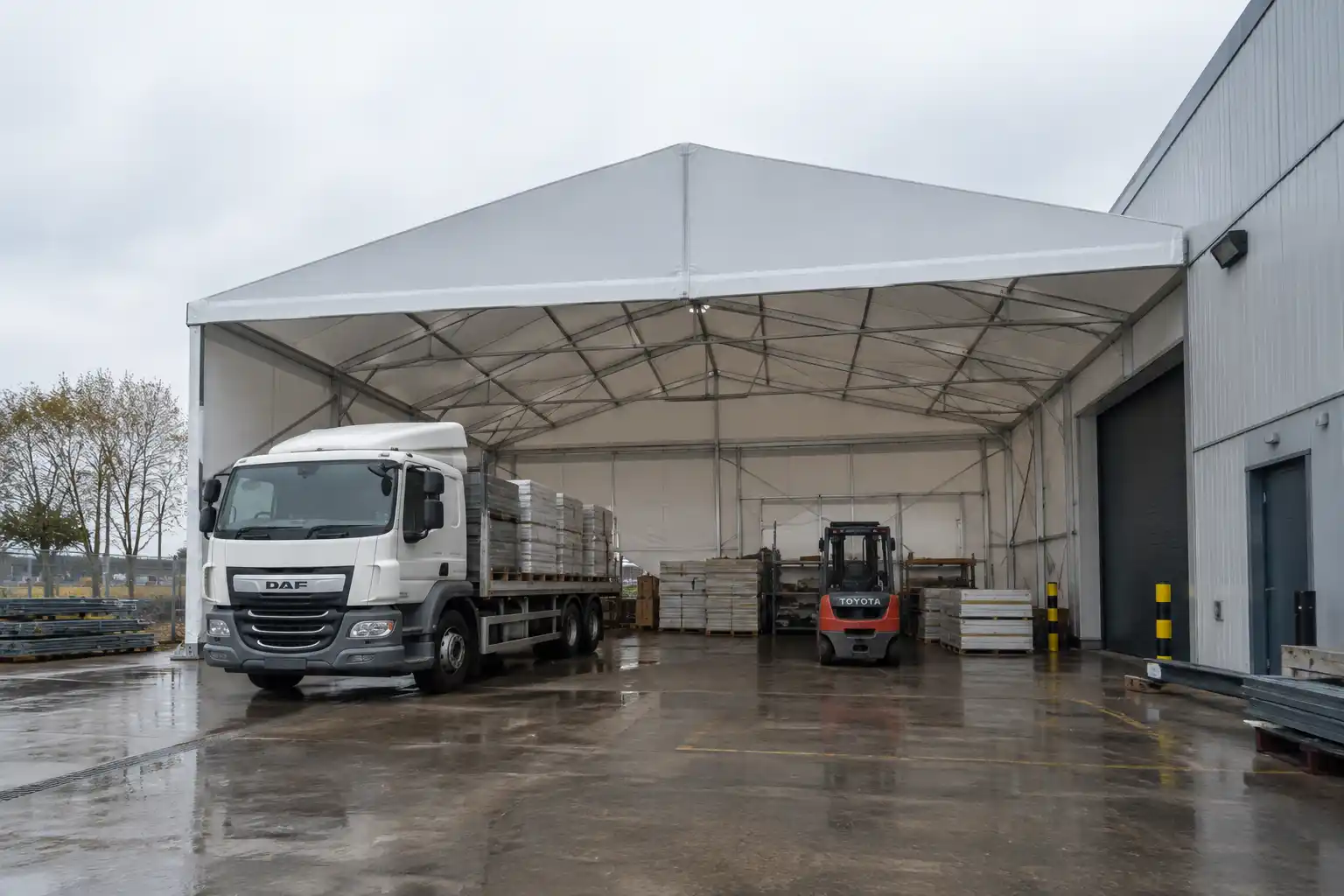
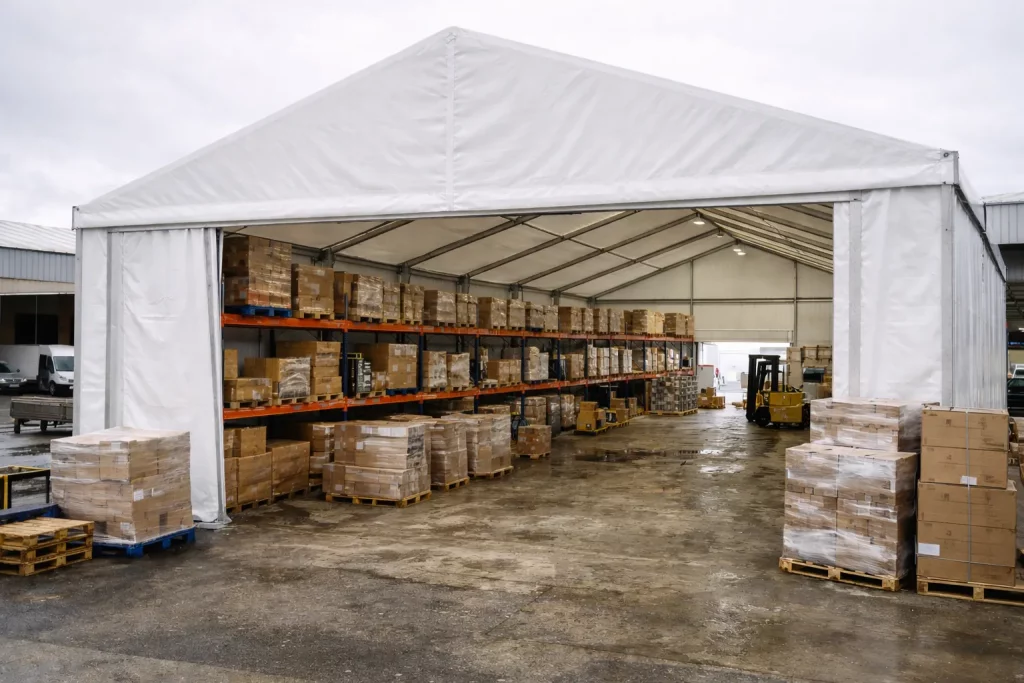
A temporary building may support continuity by providing replacement storage, operational cover, workspace or protected loading capacity, forming part of a wider approach to how temporary buildings support business continuity. In this context, LM Structures’ business continuity structures and emergency response solutions can help organisations explore temporary space options where site conditions allow.
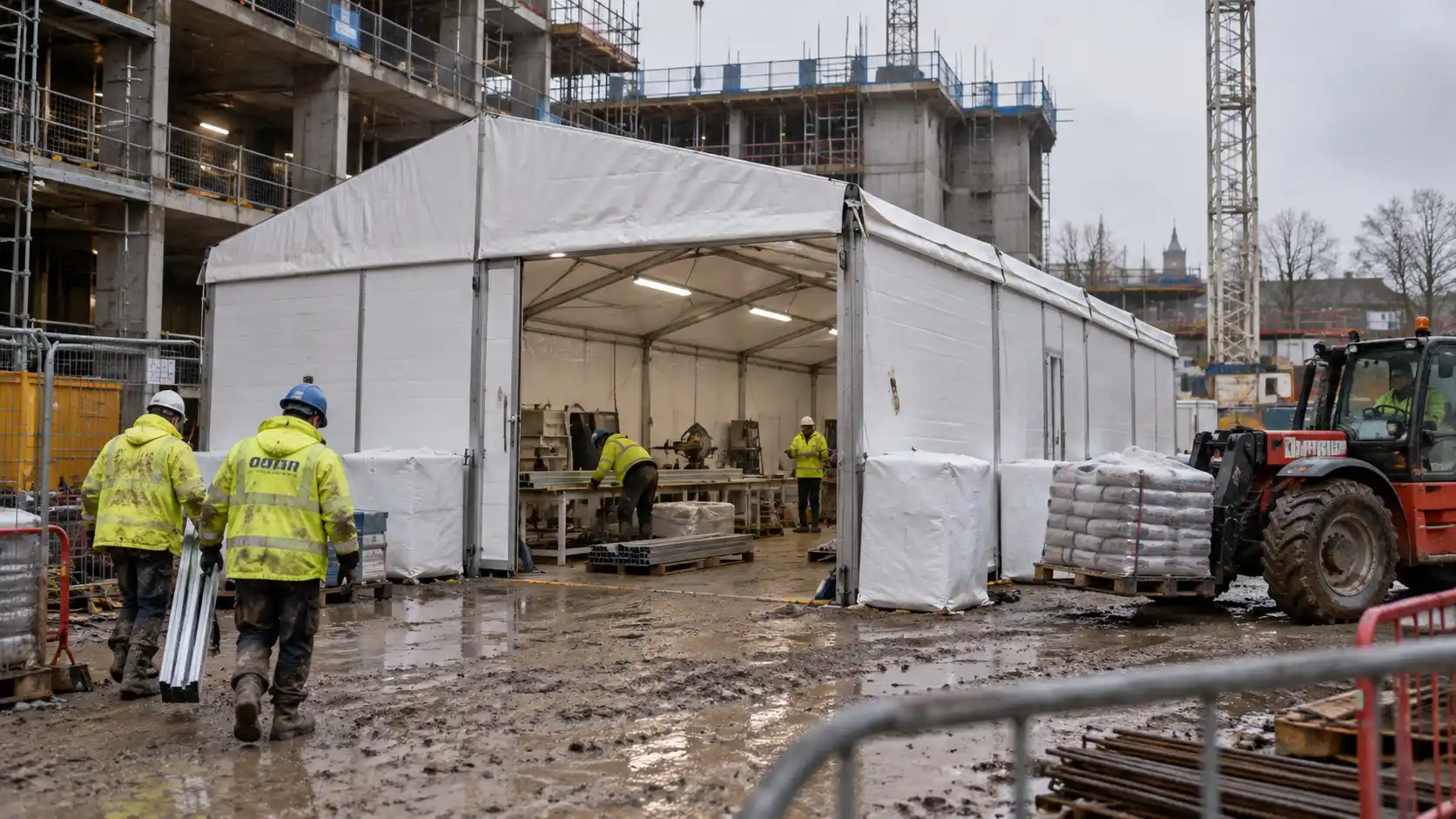
In practice, this means temporary buildings are often used to support specific operational functions rather than acting as a general replacement. This may include protecting critical stock, maintaining dispatch capability, supporting goods handling or creating controlled working zones while recovery is ongoing.
Keeping these functions on site can reduce handling complexity and help maintain operational flow, compared to fully relocating activity off-site.
The key phrase is “where site conditions allow”. If the proposed installation area is saturated, unstable, contaminated or inaccessible, this should be assessed against temporary building site requirements and constraints before installation is planned.
. This may include identifying a suitable alternative location on the site, improving access, confirming ground suitability or waiting until clean-up and drying work has progressed.
This is also where early advice can be valuable. A temporary structure may still be feasible even if the original building cannot be used, but the solution may need to be positioned away from the damaged area, phased around clean-up works or designed around specific operational priorities.
For more complex sites, it is worth considering the wider question of whether temporary buildings can be used on a damaged or restricted site. That assessment should take into account not only the structure itself, but also installation logistics, safe access, ground conditions and the activities that need to take place inside or around the temporary space.
What site conditions affect recovery speed after flooding?
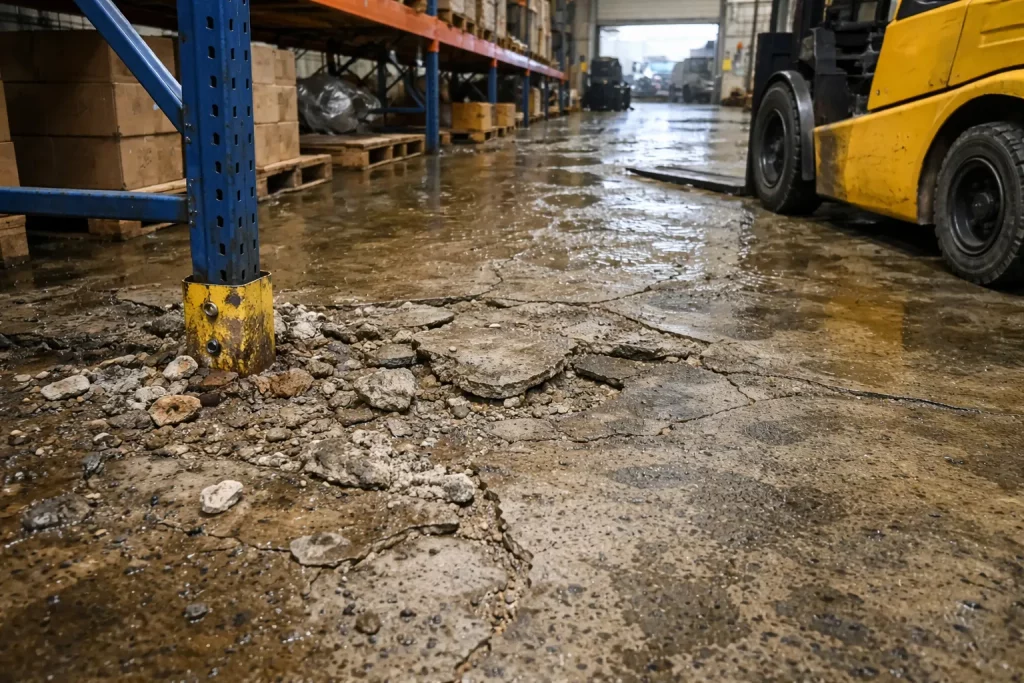
Recovery speed after flooding is shaped less by urgency and more by physical site conditions. Even where there is strong commercial pressure to resume operations, the condition of the ground, the presence of contamination and the ability to access the site safely will determine what can happen and when.
Ground saturation is often the most immediate constraint. Waterlogged surfaces can reduce load-bearing capacity, making it unsafe for vehicles, plant or installation works. Even after standing water has been removed, underlying slab conditions may remain affected. Concrete floors can retain moisture below the surface, and load-bearing capacity may not return immediately. This can delay the safe use of forklifts, racking loads or other heavy operations, even where the site appears visually dry.
Drainage is another critical factor. If water cannot be effectively removed or continues to accumulate, it will delay clean-up, drying and any preparatory work required for temporary structures or reinstatement. In some cases, temporary drainage or pumping solutions may be needed before the site becomes operationally viable.
Contamination must also be addressed before recovery progresses. Floodwater may carry pollutants that affect both safety and regulatory compliance. The UK Government’s guidance on pollution prevention for businesses highlights the importance of handling contaminated water correctly, which can influence how quickly affected areas can be cleaned, cleared and reused.
Access routes often determine whether recovery can move forward at all. If staff, delivery vehicles or installation teams cannot safely reach the site or specific working areas, operations will remain restricted regardless of internal progress. This can affect everything from stock movement to the installation of temporary infrastructure.
Taken together, these conditions explain why flood recovery is inherently variable. Two sites with similar levels of damage may experience very different recovery timelines depending on ground conditions, drainage performance, contamination levels and access constraints.
How do you restore operations while managing flood constraints?
Restoring operations after flooding is not a single step – it is a staged process that balances safety, feasibility and commercial need. The most effective approach is to move deliberately through three overlapping phases: assessment, stabilisation and continuity.
The assessment phase focuses on understanding what is usable and what is not. This includes identifying safe access points, evaluating damage, understanding contamination risks and determining which operational functions have been disrupted. At this stage, decisions should remain provisional and grounded in what is physically confirmed rather than assumed.
Stabilisation follows once the immediate risks are understood. This may involve removing water, isolating damaged areas, protecting remaining stock or equipment and establishing controlled access routes. It is also the point at which planning for continuity becomes more structured, because the business begins to understand what level of operation might be possible in the short term.
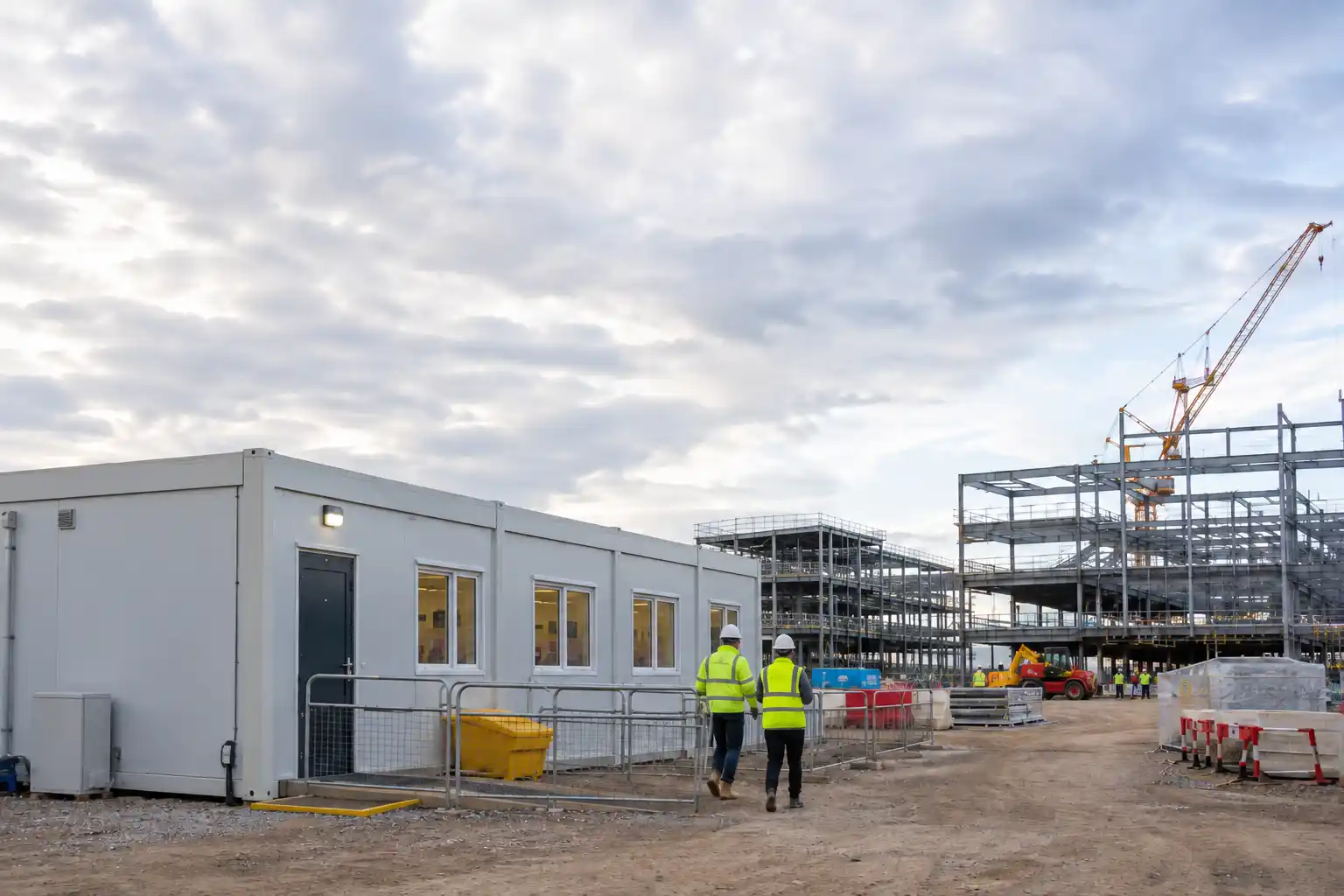
Continuity planning then moves into practical decision-making. This may include reallocating space within the site, adjusting workflows, prioritising critical operations or introducing temporary space where appropriate. For some businesses, this could mean using a different part of the site; for others, it may involve installing temporary structures once ground and access conditions allow.
The key is to recognise that recovery actions do not all happen in sequence. Assessment, stabilisation and continuity planning often run in parallel, with decisions evolving as site conditions improve. Attempting to shortcut this process can lead to rework, safety issues or further disruption.
Where temporary buildings are part of the recovery strategy, their timing and positioning should be aligned with site readiness. Understanding how long temporary building installation actually takes can help frame expectations, but those timelines must always be considered in the context of flood-specific constraints.
What are realistic timelines for recovery after flooding?
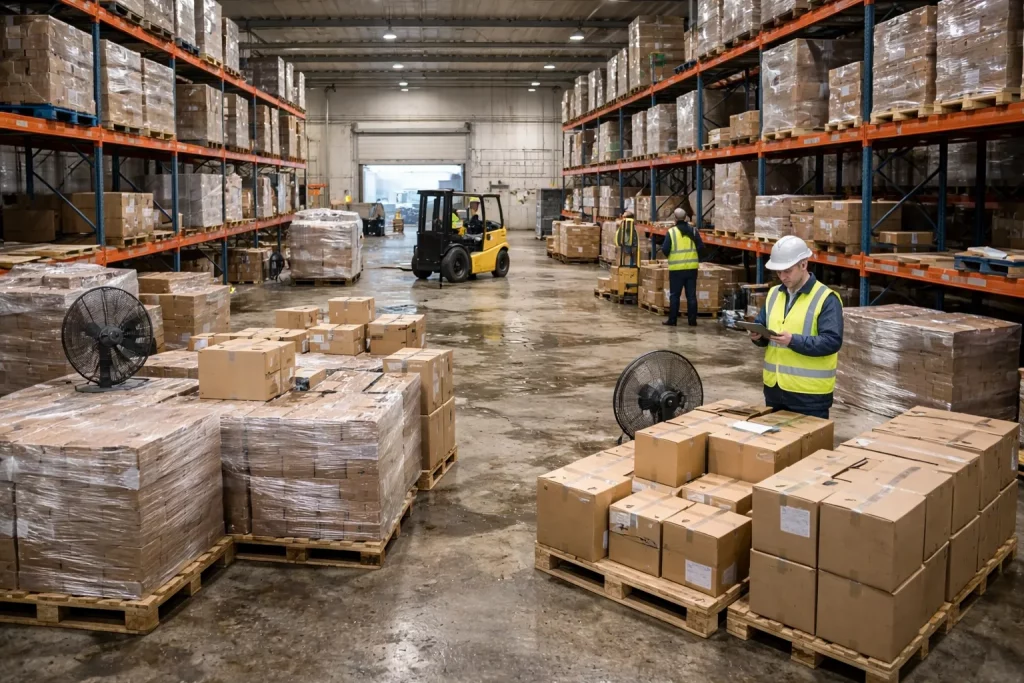
There is no single timeline for recovering operations after flooding. Timeframes are driven by site conditions, not by how quickly the business needs to restart. Drying time, contamination clearance, structural checks, access restoration and ground stabilisation all influence how long recovery will take.
In the best-case scenario, where flooding is limited, contamination is minimal and drainage is effective, parts of the site may return to use relatively quickly. However, even in these cases, full operational capacity may take longer to restore as systems, stock and workflows are re-established.
More commonly, recovery is phased. Initial access may be restored within days, but safe and efficient operation may take longer as clean-up progresses and affected areas are brought back into use. Where ground conditions are compromised, temporary or permanent solutions may need to wait until the site can support installation and ongoing use.
This variability is why it is important to avoid fixed expectations. Planning based on ideal timelines can create pressure to act before the site is ready, increasing risk and potentially extending disruption. A more effective approach is to base timelines on confirmed conditions and adjust plans as those conditions change.
In practice, drying and remediation timelines are often longer than initially expected, particularly where slab saturation, contamination or infrastructure damage is involved. This means decisions about maintaining operational capacity may need to be made before a clear end date for full recovery is known.
Temporary space can play an important role in shortening disruption once it becomes feasible. Selecting which temporary building types are suitable for business use can help ensure that continuity solutions align with both the operational need and the constraints of the site
What should your next operational priority be?
After the initial response and early stabilisation, the focus should shift toward maintaining control over the recovery process rather than reacting to pressure alone. This means continuing to base decisions on verified site conditions, while actively planning how to restore capacity in a structured and sustainable way.
At this stage, the priority is to connect what is physically possible with what the business needs to achieve. That may involve identifying which operations must resume first, where temporary capacity could be introduced and how the site can support those activities without creating additional risk.
It also means recognising that recovery is not just about returning to the previous state. In some cases, the most effective approach is to adapt operations temporarily – using alternative layouts, phased workflows or temporary infrastructure—to maintain continuity while permanent repairs are completed.
Maintaining this level of control helps reduce the risk of unnecessary delays or missteps. It allows the business to move forward confidently, even where some uncertainty remains, because decisions are grounded in practical realities rather than assumptions.
Next step
If your operation has been disrupted by flooding and you are now assessing what is realistically possible, this is the point where structured continuity planning becomes critical.
At this stage, engaging with a provider experienced in business continuity structures can help you understand whether temporary space is feasible on your site, what preparation may be required and how a solution could be aligned with your operational priorities. Acting early—before conditions are fully resolved—can help reduce downtime by ensuring that installation can proceed as soon as the site is ready.
LM Structures works with organisations to assess site constraints, identify viable temporary building solutions and support recovery where environmental conditions allow. This is not about accelerating recovery beyond what is safe—it is about ensuring that when your site is ready, the next step is already planned.
Contact us for more information 0333 358 4989 or enquiries@lmstructures.co.uk
What to do after warehouse flood – FAQs
Floodwater can compromise detection and alarm interfaces. Inspection and certification may be required before recommissioning.
Partial trading may be possible through phased zoning and controlled dispatch from unaffected areas. Full throughput restoration typically requires staged sequencing.
Insurance policies differ. Temporary infrastructure may be considered where it demonstrably mitigates business interruption, but approval pathways vary.
Operating forklifts on saturated slabs may compromise surface integrity and load-bearing stability. Moisture verification may be advisable before full recommissioning.
Timelines vary significantly. Slab drying alone may require several weeks depending on depth and construction. Electrical and fire system recommissioning may extend this further.