What Type of Temporary Building Does Your Business Need?
If fire, flood or storm damage has interrupted operations, the right temporary building is the one that supports the work you need to continue, fits the condition of the site and can remain practical for the expected recovery period.
In Short
Temporary building types for business use include framed temporary buildings, clear-span structures, modular buildings and longer-term semi-permanent options. The right choice depends on operational use, site conditions, duration, access, safety considerations and how much continuity your business needs while recovery or reinstatement work is underway.
Recovery Priorities at a Glance
- Framed temporary buildings can be suitable for warehouse, storage, production or covered operational space where a large, flexible footprint is needed.
- Clear-span structures are useful where uninterrupted internal space is important, such as storage, handling, vehicle movement or production flow.
- Modular buildings are often more appropriate where offices, welfare areas, classrooms, site accommodation or more compartmentalised internal layouts are required.
- Semi-permanent buildings may be appropriate where recovery is likely to take months or where a temporary solution must support more demanding operational use.
- The best option depends on context, including site access, ground conditions, damaged infrastructure, intended use, safety requirements and recovery timescale.
In This Article – Table of contents
What types of temporary buildings are available for business use?
Temporary buildings are not all the same. In a business continuity situation, this distinction matters because the building must support the specific activity that has been disrupted, not simply provide covered space.
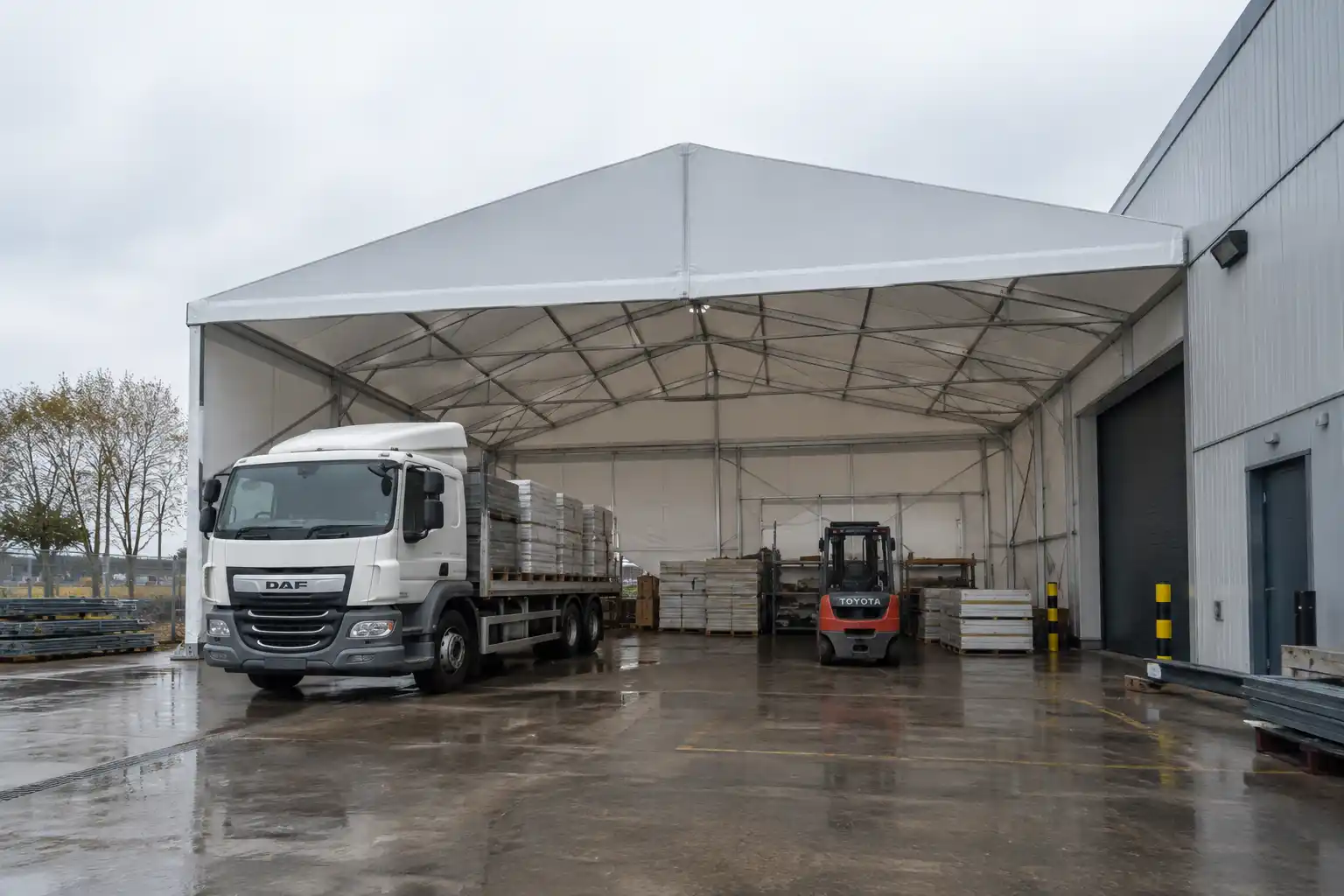
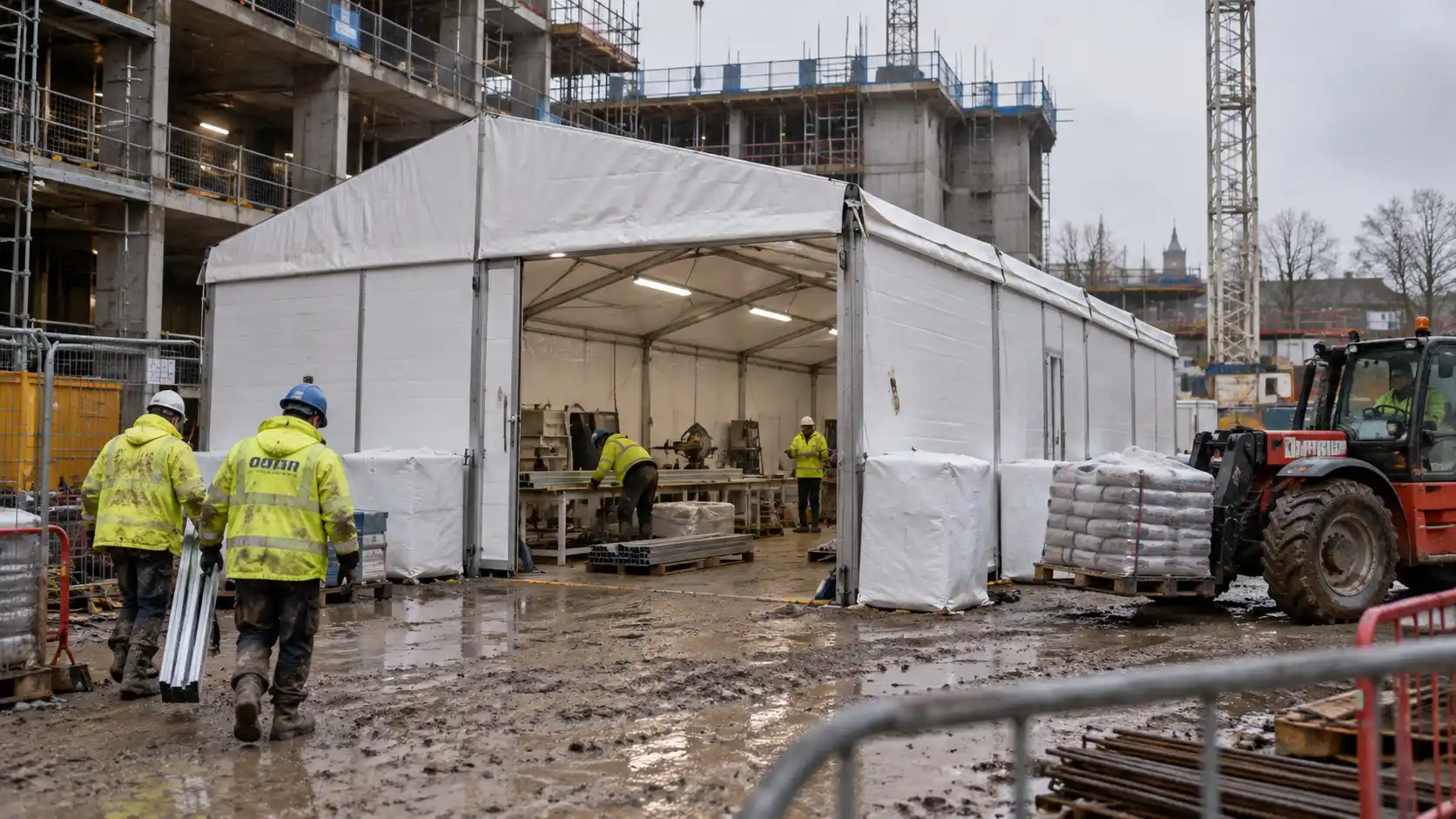
For many commercial and industrial settings, framed temporary buildings are often considered where a business needs practical covered space for storage, warehousing, light production, dispatch, stock protection or temporary operational capacity. These structures can often be configured around the scale, access and internal layout needed for the operation, which makes them relevant when continuity depends on keeping goods, people or processes moving.
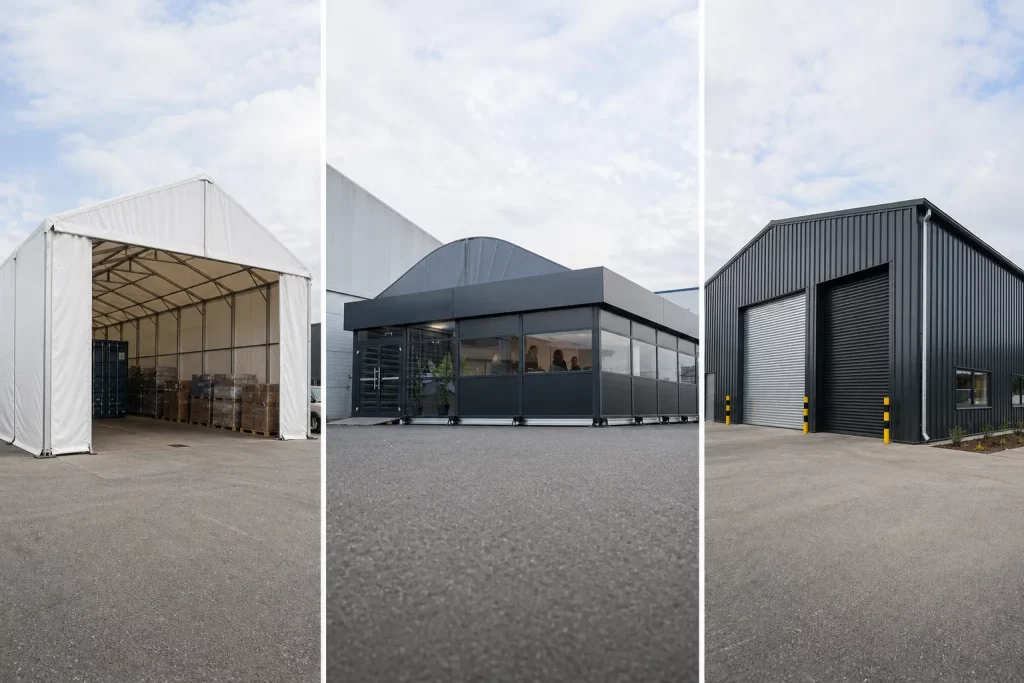
Clear-span structures are particularly useful where uninterrupted internal space is required. Because the internal area does not rely on intermediate columns, they can support layouts where racking, pallet movement, equipment, vehicles or workflow routes need to remain flexible. This can be important where the temporary building is replacing a warehouse, loading area, production zone or large covered working area.
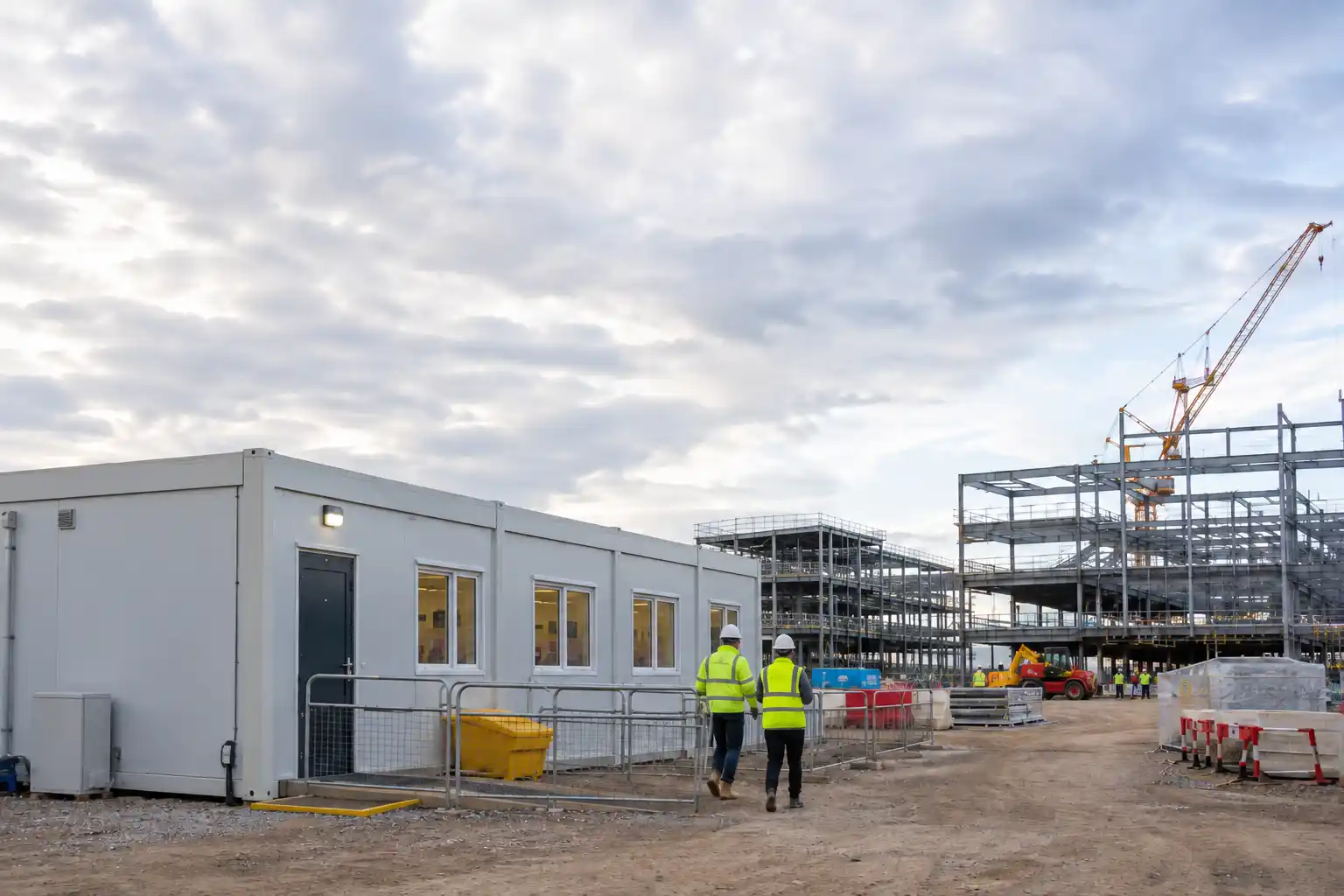
Modular buildings serve a different purpose. They are more commonly associated with offices, welfare space, classrooms, changing facilities, site accommodation or internal rooms where a more cellular layout is needed. The Modular and Portable Building Association describes itself as representing the modular and portable building industry, which reinforces that modular buildings sit within a recognised sector rather than being interchangeable with every temporary structure type.
Semi-permanent buildings usually become relevant where the requirement is more than a short-term contingency. If repair, reinstatement, insurance processes or permanent redevelopment will take months rather than weeks, a longer-term hire structure may need to provide a higher level of operational resilience, comfort, access, weather protection or internal specification.
This is why the first decision should not be “which temporary building is fastest?” It should be “which temporary building is suitable for the work we need to continue?”
For disruption-led projects, LM Structures’ Business Continuity Structures provide a route for assessing temporary building options around the site, use case and recovery requirement rather than treating the structure as a generic hire product.
Which temporary building is best after fire, flood, or storm damage?
The best temporary building after fire, flood or storm damage depends on what has been lost, what can still operate and what constraints now exist on the site. A building that works well after a warehouse fire may not be suitable for a flood-affected site with compromised ground conditions or restricted access.
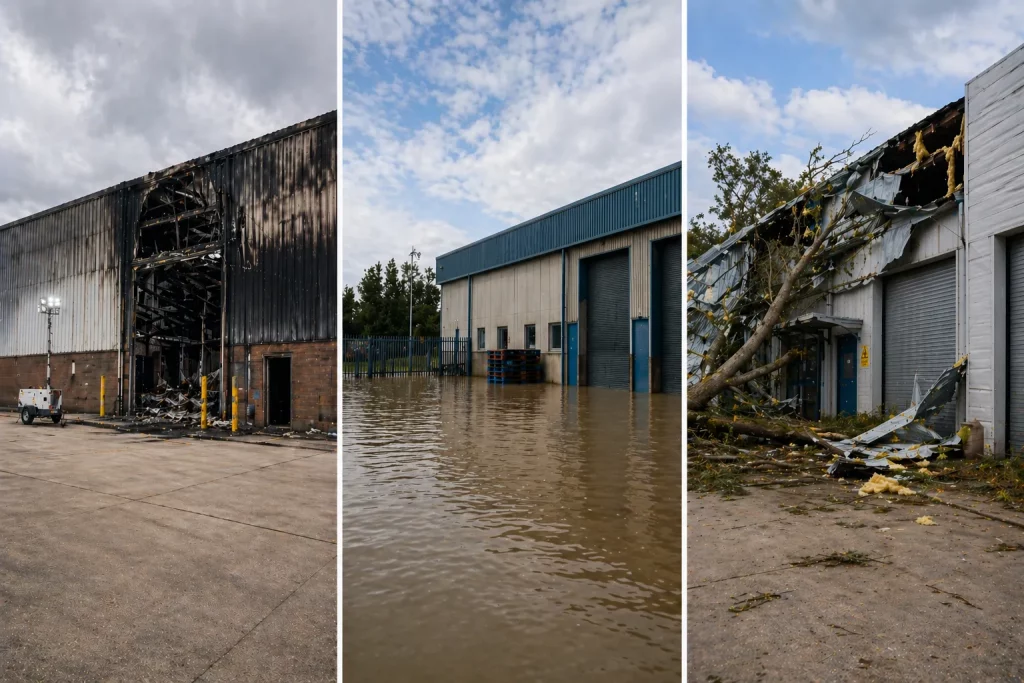
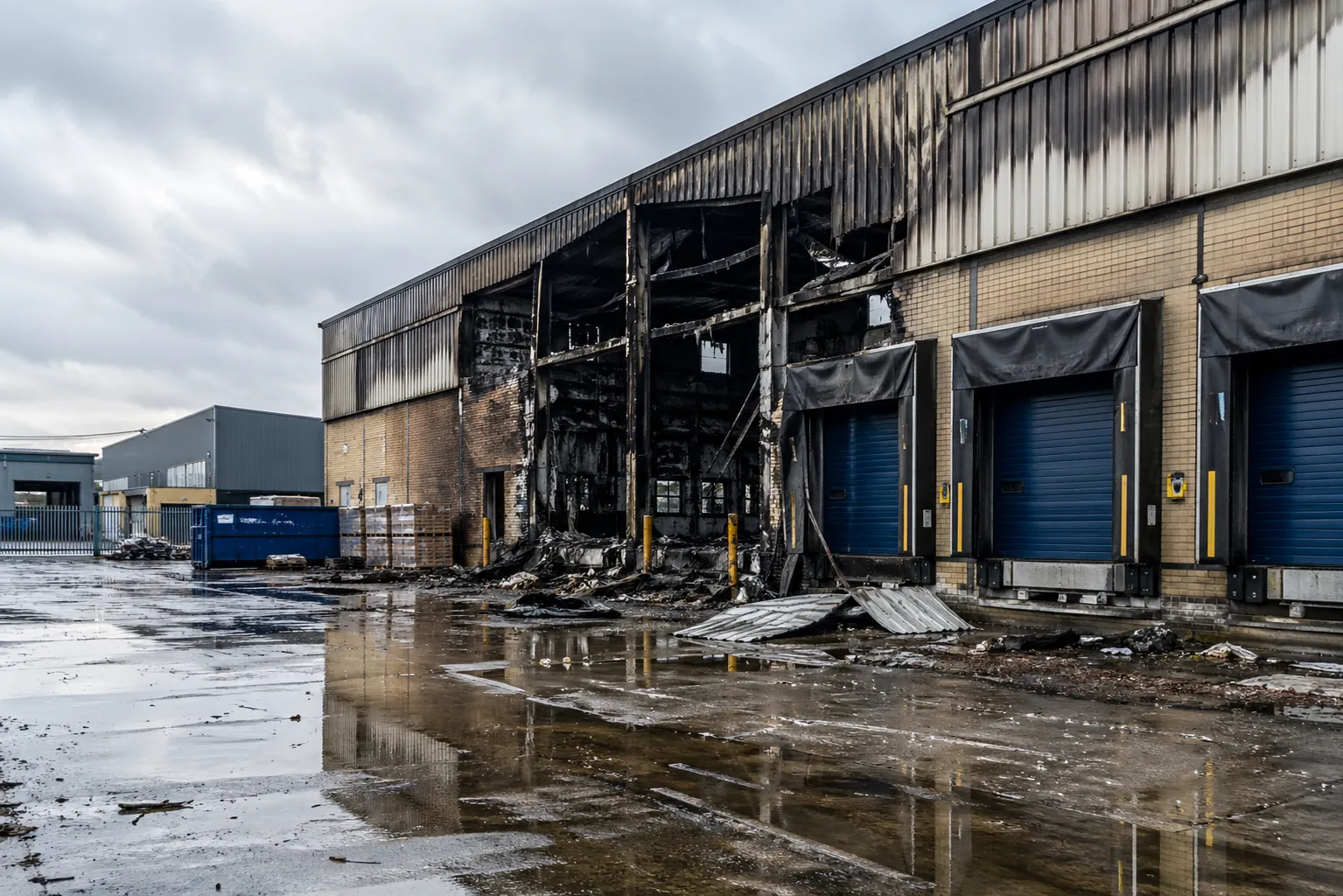
After fire damage, the priority is usually to restore usable space without interfering with investigation, clearance, repair or reinstatement activity. If a warehouse, stock area or production space has been affected, a framed or clear-span temporary building may be suitable where the business needs large, flexible space to maintain storage, handling or operational flow. However, fire safety, access, separation, emergency routes and proximity to damaged or under-repair buildings all need careful consideration. GOV.UK guidance on workplace fire safety confirms that the responsible person must carry out and regularly review a fire risk assessment, so any temporary operational space must be considered within the wider fire safety arrangements for the premises.
After flood damage, the question is often less about the building alone and more about the condition of the site. Flood recovery can involve cleaning, drying and checking health risks, and GOV.UK guidance on how to recover from flooding describes the recovery phase as including cleaning and drying properties to check for health risks after floodwater exposure. If ground conditions, drainage, utilities or access routes are affected, the temporary building type, location and installation approach may need to be assessed more carefully before a decision is made.
After storm damage, suitability may depend on whether roof damage, façade damage, structural concerns, debris, restricted access or exposed stock has created an urgent need for covered space. In this situation, a temporary structure may need to protect goods or operations while the main building is assessed and repaired. Weather exposure, wind considerations, anchoring approach, site clearance and safe working areas will all influence what is appropriate.
In all three scenarios, the structure must match the recovery environment. Selecting too quickly without understanding the site can lead to operational inefficiency, avoidable cost or a temporary building that cannot support the intended use.
What factors determine the right temporary building for your situation?
The right temporary building is determined by a combination of operational need, site condition, duration and risk. These factors should be assessed together because one can change the importance of another.
Operational use is the first filter. A temporary warehouse used for palletised stock has different requirements from a customer-facing retail space, a production area, an office, a welfare facility or a temporary loading zone. Internal height, access points, flooring, lighting, temperature control, vehicle movement and workflow all affect suitability. A structure that is adequate for dry storage may not be suitable for production, staff accommodation or customer access.
Site conditions are the second filter. After fire, flood or storm damage, the site may not behave like a normal installation environment. Access routes may be blocked. Ground may be soft or uneven. Services may be interrupted. Damaged buildings may create exclusion zones. Repair works may need to continue alongside temporary operations. HSE guidance on emergency procedures highlights that workplaces need plans for emergencies such as fire and flood, with effective action and clear responsibilities helping reduce consequences. The temporary building decision should therefore sit within the wider recovery plan, not outside it.
Duration is the third filter. A short-term need may require a different level of specification from a structure expected to remain in place for months. If the recovery programme is uncertain, a more adaptable or semi-permanent option may reduce the risk of having to revisit the decision later.
Commercial impact is the fourth filter. The wrong structure can create hidden costs through inefficient layouts, double handling, poor access, lost capacity, delayed recovery or avoidable disruption to customers and contracts. Equally, over-specifying the solution can create unnecessary cost and complexity. The aim is not to choose the most substantial option automatically; it is to choose the option that supports continuity without adding avoidable burden.
Where the damaged or restricted site itself may affect feasibility, the related question is whether a temporary building can be installed safely and practically on that site. That assessment should happen before the business commits to a structure type, because location, access and ground conditions can all change the right answer.
How do different temporary building types compare?
Comparing temporary building types is less about ranking them and more about understanding how each performs against your specific requirements. The same structure can be highly effective in one scenario and unsuitable in another.
Framed temporary buildings are typically considered where operational continuity depends on restoring usable covered space quickly, particularly for warehousing, storage, light production or handling activities. They tend to offer flexibility in footprint and layout, which can help businesses maintain throughput and workflow. However, they may require consideration around internal environment, access configuration and how they integrate with existing site operations.
Clear-span structures are often selected where uninterrupted internal space is a priority. This can support racking layouts, vehicle movement, loading operations or production processes without internal obstructions. The advantage is operational flexibility, but the decision still needs to account for access points, ground conditions, anchoring approach and how the structure performs in exposed environments.
Modular buildings provide a different type of solution. They are generally more appropriate where the requirement is for offices, welfare facilities, classrooms or compartmentalised internal spaces. They can support more defined internal environments, but they are not always suitable where large open operational areas are required. Choosing modular instead of a framed or clear-span structure can limit operational flexibility if the use case has not been clearly defined.
Semi-permanent buildings sit between short-term temporary structures and permanent construction. They may be more appropriate where the recovery period is extended, where operational demands are higher, or where the temporary solution needs to remain in place for a prolonged period. The trade-off is that they may involve a more considered planning, specification and installation approach.
The key comparison point is not which structure is “better”, but which one aligns with the operational requirement, site constraints and expected duration. Where speed is prioritised without this alignment, the result can be a structure that does not fully support the operation it is intended to replace.
What are the trade-offs between speed, cost, and performance?
In a disruption scenario, there is often pressure to act quickly. However, selecting a temporary building based on speed alone can create operational and commercial consequences that outweigh the initial benefit.
Speed can help reduce downtime, particularly where revenue, contracts or supply chains are affected. Restoring covered space quickly can protect stock, maintain production or allow partial operations to resume. But speed must be balanced with suitability. A structure that is installed quickly but does not support the required workflow, access or capacity can introduce inefficiencies that affect day-to-day operations.

Cost is often considered alongside speed, but it should be viewed in the context of total operational impact rather than initial outlay alone. Under-specifying a building to reduce cost can lead to restricted capacity, double handling, poor access or additional operational workarounds. Over-specifying can result in unnecessary expenditure where a simpler structure would have met the need.
Performance relates to how well the building supports the operation. This includes internal space, access, durability, weather protection, usability and how the structure integrates with existing processes. In many cases, performance determines whether the business can operate effectively during recovery, not just whether space is available.
There is no single correct balance between these factors. The right decision depends on the level of operational pressure, the nature of the disruption and how critical continuity is to the business. Where downtime creates significant commercial exposure, prioritising operational performance may be more appropriate than selecting the fastest or lowest-cost option.
How do you choose the right temporary building quickly and confidently?
A structured decision approach can help reduce risk and avoid unnecessary delays, even when time is limited.
The first step is to define the operational requirement clearly. This means understanding what activity must continue, what space is needed, how goods or people will move through the building and what constraints exist. Without this clarity, it is difficult to assess which structure type is appropriate.
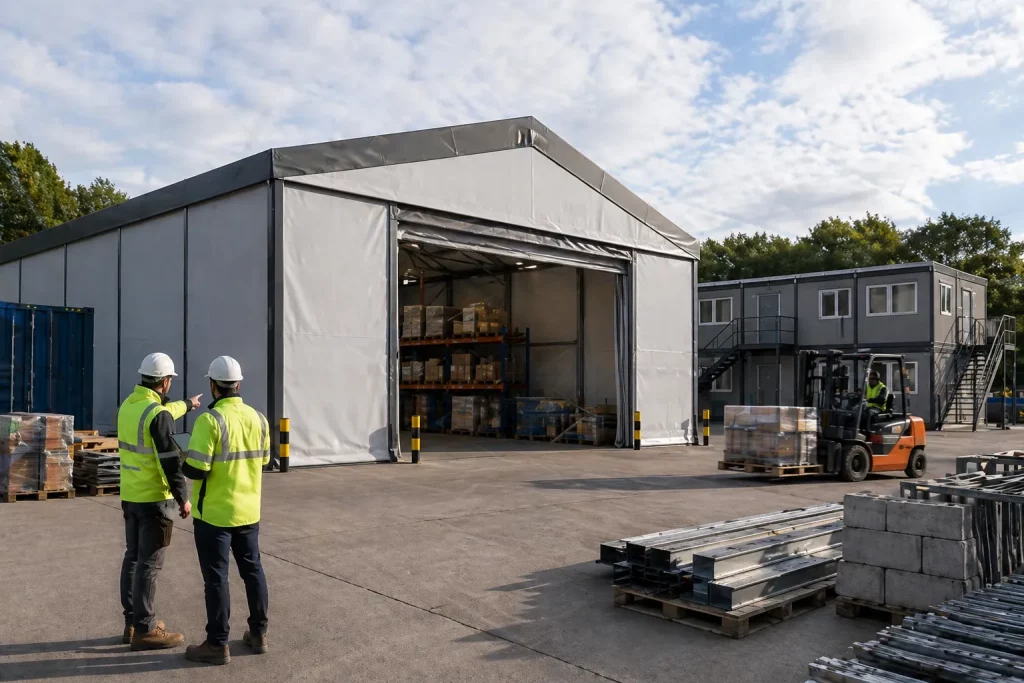
The second step is to assess site feasibility. This includes access routes, ground conditions, available footprint, proximity to damaged buildings, ongoing repair works and any restrictions that may affect installation. Where the site has been affected by fire, flood or storm damage, these factors can change quickly and may need to be reassessed before committing to a solution. In some cases, it may be necessary to consider whether temporary buildings can be installed on a damaged or restricted site before narrowing down the options.
The third step is to align the building type to the duration of use. If the requirement is likely to extend beyond the initial recovery phase, selecting a structure that can remain operational without requiring replacement can reduce disruption later.
The fourth step is to understand the risks of the decision. This includes the risk of under-specifying, over-specifying, selecting a structure that does not support operations or choosing an option that cannot be justified internally. The wider temporary building decision risks associated with acting under pressure should be considered alongside the benefits of responding quickly.
Finally, the decision should be made in the context of the overall recovery plan. A temporary building is one part of the wider process of restoring operations, and it should support – not complicate – that process. Where speed is critical, it is still possible to make a structured decision by focusing on these key criteria rather than attempting to evaluate every possible option in detail.
What matters most when choosing under operational pressure?
When time is limited, the focus should shift from exploring every possible option to identifying what will maintain control of the situation.
The most important factor is whether the temporary building will support the operation it is replacing. If the structure cannot accommodate the required activity, access, flow or capacity, it will create further disruption rather than resolve it.
The second priority is ensuring the building can be installed safely and practically within the constraints of the site. After fire, flood or storm damage, these constraints can be less predictable, and the feasibility of installation may influence which options are viable.
The third priority is aligning the solution with the likely duration of use. Selecting a building that is appropriate for the expected recovery period can reduce the need for further changes and minimise operational disruption.
Focusing on these priorities allows decision-makers to move forward with confidence, even where time is limited and information is incomplete.
What should you focus on now to maintain control?
At this stage, the objective is not to identify every possible temporary building option, but to make a clear, defensible decision that supports operational continuity.
The most effective approach is to match the structure to the situation: define the operational requirement, understand the constraints of the site and select a building type that can support both in a practical and sustainable way. Where this alignment is achieved, the temporary building becomes a stabilising factor in the recovery process rather than an additional source of risk.
Delaying the decision to gather more information can increase downtime, but moving too quickly without assessing suitability can create longer-term operational issues. Maintaining control means balancing these pressures and selecting a solution that supports both immediate recovery and ongoing operations.
Next step
If your operation has been disrupted and you are at the point of selecting a temporary building, this is the stage where a structured assessment can prevent avoidable issues later.
Where capacity has been lost, access is restricted or recovery timelines are uncertain, engaging a provider who can assess site conditions, operational requirements and suitable structure types can help ensure the solution supports continuity rather than creating further constraints.
LM Structures supports businesses in evaluating and delivering Business Continuity Structures that are aligned to operational needs, site realities and recovery timelines. At this stage, the priority is not just to install a temporary building, but to select one that works for your situation from day one.
What Type Of Temporary Building: FAQs
Focus on defining the operational requirement, assessing site feasibility and aligning the building
Semi-permanent buildings and certain modular solutions are often more suitable for longer-term use. The decision should be based on how long the temporary solution is expected to remain in place and the level of operational performance required.
Key factors include operational use, site conditions, duration of use, access, safety considerations and how the structure will support workflow. These factors should be assessed together rather than in isolation.
The most suitable type depends on what operations need to continue and the condition of the site. Fire-damaged sites may require restoring usable space quickly, while flood-damaged sites may introduce ground and access constraints that affect installation.
Temporary buildings for business use typically include framed structures, clear-span buildings, modular buildings and semi-permanent options. Each serves a different purpose, depending on whether the requirement is open operational space, compartmentalised internal areas or longer-term use.