How Do Temporary Buildings Support Business Continuity?
When fire, flood or storm damage affects a business site, the immediate concern is not simply finding more space. The real question is how to keep essential operations moving while the damaged premises are assessed, repaired or reinstated.
In Short
Temporary buildings support business continuity by creating usable operational space when existing facilities are damaged, restricted or unavailable. They can be used for storage, production, fulfilment, customer-facing activity or temporary working areas, helping businesses maintain critical functions during recovery.
Recovery Priorities at a Glance
- Temporary buildings can provide operational capability, not just additional space.
- They can support storage, production, dispatch, customer service and temporary workflows.
- Their value depends on how well they are planned around access, utilities, layout and site constraints.
- They can help reduce downtime by giving businesses a practical continuity route while longer-term recovery is underway.
- Temporary does not automatically mean short-term, lightweight or unsuitable for serious operational use.
Table of contents – In this artcle:
How do temporary buildings support business continuity?
Temporary buildings support business continuity by replacing lost or restricted operational capacity with a structured, usable environment. In a recovery scenario, the issue is rarely just the absence of floor space. It is the interruption to the processes that depended on that space.
For a warehouse, that might mean stock cannot be stored, picked or dispatched. For a manufacturer, it may mean production areas, assembly space or goods-in processes have been disrupted. For a customer-facing business, the immediate concern may be how to keep serving customers while part of the site is unsafe, inaccessible or under repair.
This is where temporary buildings for business continuity become strategically important. They can provide a practical operational base while the original premises are being inspected, repaired or reinstated. Used correctly, they help maintain a degree of control when the wider recovery picture is still uncertain. UK Government business continuity guidance emphasises the importance of maintaining critical functions during disruption, particularly where loss of premises affects operational capability.
The value is not simply that a structure can be placed on or near a site. The value lies in what that structure enables: protected storage, continued workflow, staff movement, goods handling, customer access or temporary service delivery. For decision-makers under pressure, this changes the question from “Can we find more space?” to “What functions do we need to keep running, and what type of temporary building can support them?”
That distinction matters. A temporary building should not be treated as an isolated product decision. It should be assessed as part of the wider continuity pathway, including operational priorities, site access, safety requirements, insurance involvement where relevant, and the expected duration of recovery.
What can temporary buildings actually be used for in real operations?
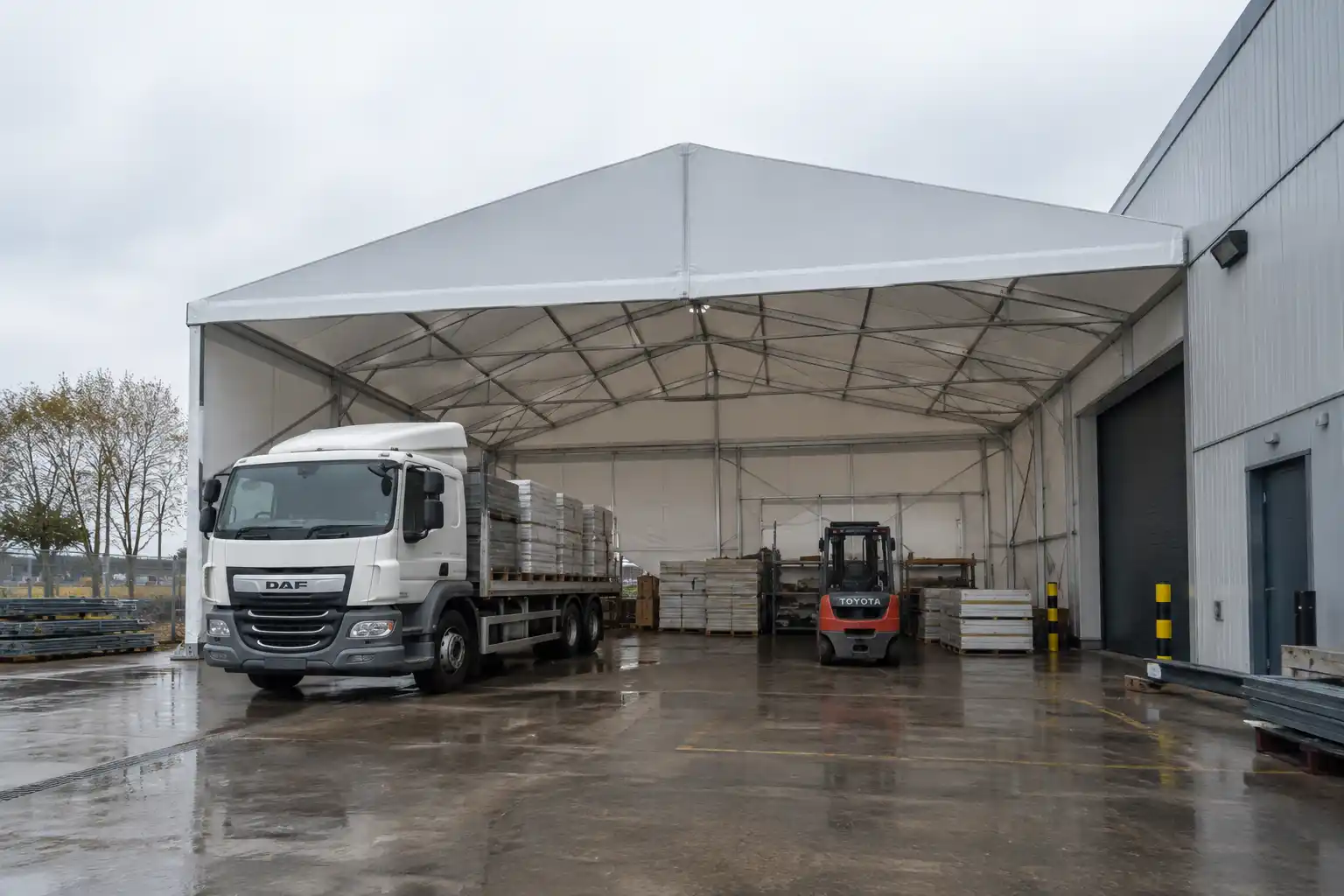
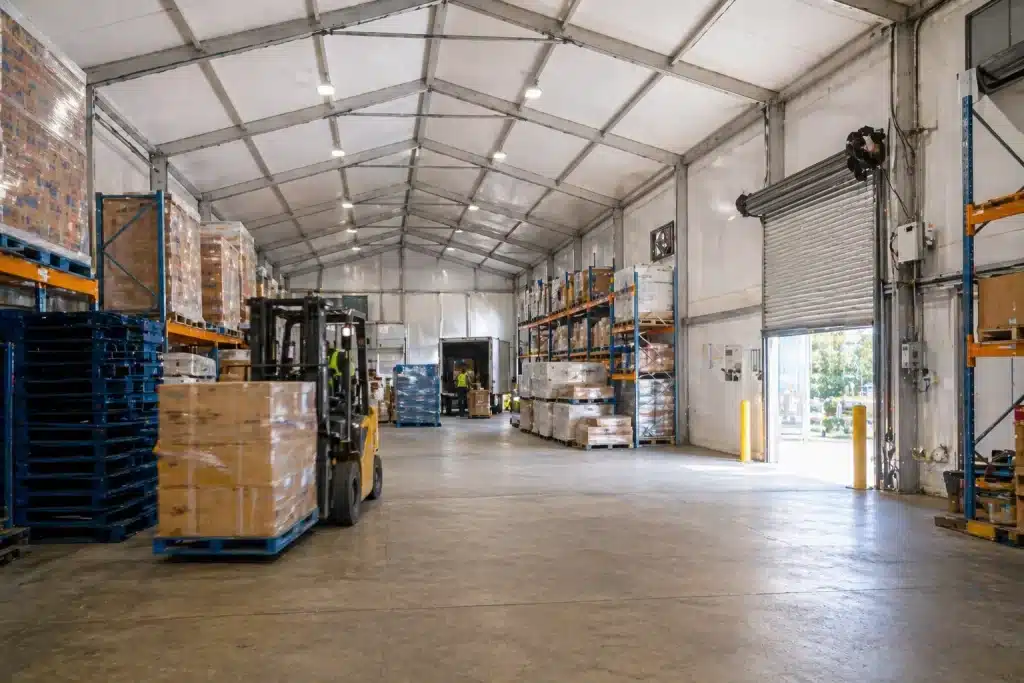
Temporary buildings can be used for a wide range of real business functions, provided the structure, layout and site conditions are suitable. In continuity scenarios, common uses include temporary warehousing, stock protection, production support, fulfilment, equipment storage, temporary staff facilities and customer-facing space.
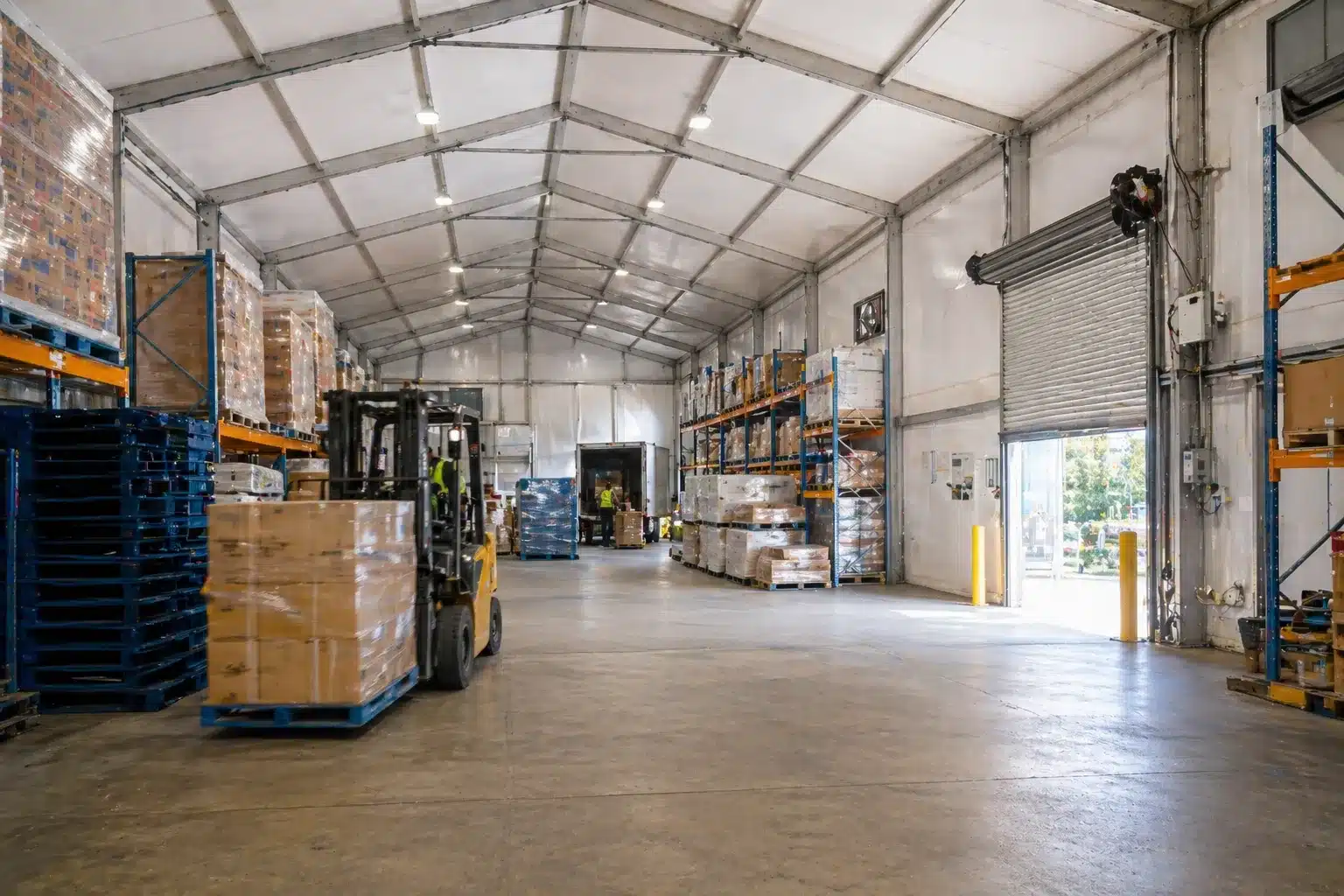
For storage-led operations, a temporary building may protect stock, materials, tools or equipment that would otherwise be exposed, displaced or difficult to access. This can be especially important after flood or storm damage, where the original building may be unsafe, contaminated, partially open to the weather or unavailable during repairs.
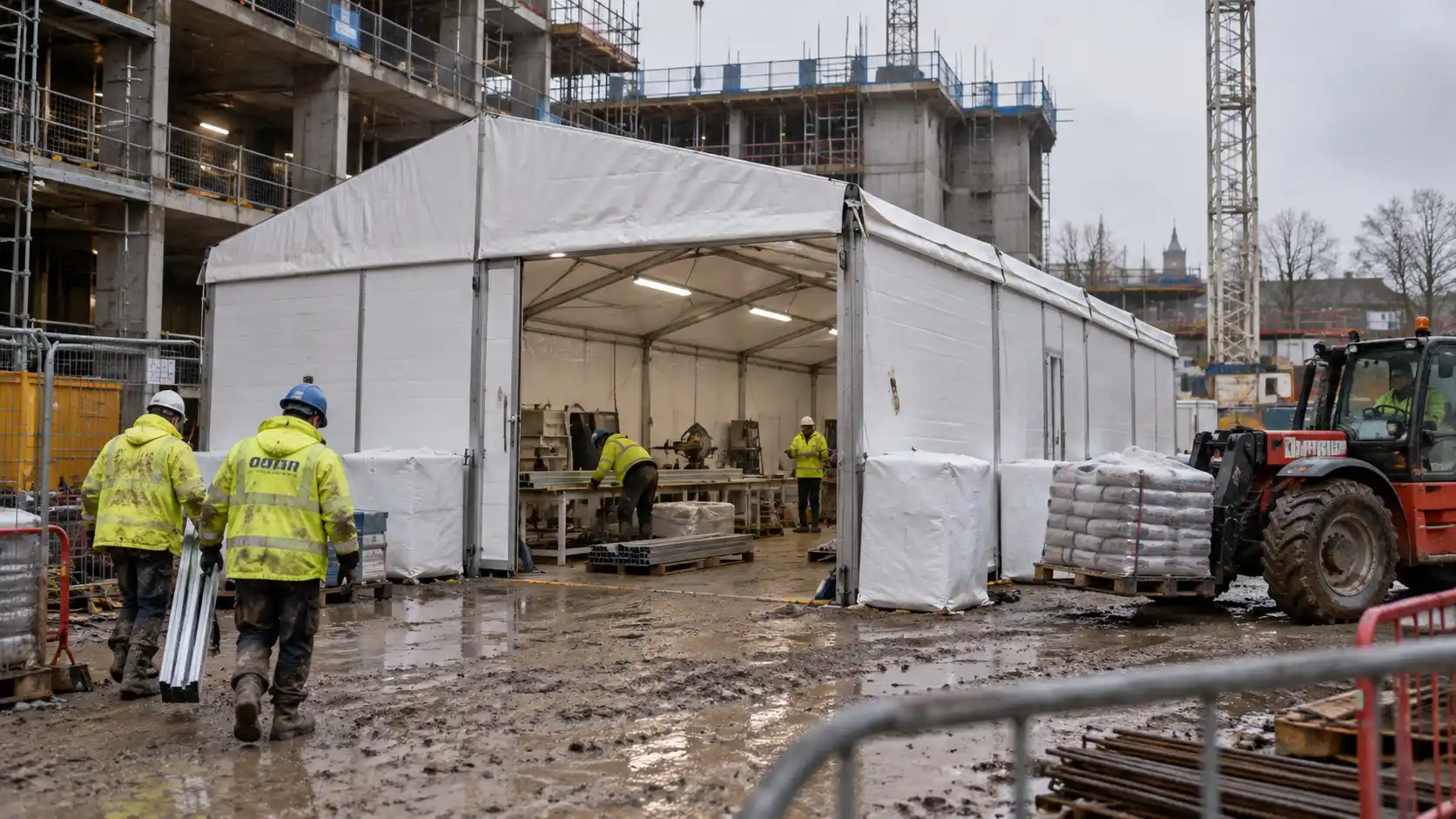
For production or processing environments, the requirement is often more complex. The building may need to support movement of goods, staff access, lighting, heating, ventilation, power requirements and safe separation between activities. In these cases, the temporary structure must be planned around the workflow, not simply placed wherever space is available.
For fulfilment and logistics operations, temporary buildings can help maintain goods-in, picking, packing or dispatch activity. Even if the arrangement is not identical to the original facility, a planned temporary environment can reduce the operational inefficiency that comes from fragmented storage, off-site overflow or improvised working areas.
Customer-facing uses may also be relevant in some sectors. Retail, leisure, hospitality or service-led businesses may need temporary trading, reception or service areas while part of a site is repaired. In these contexts, the building still needs to be commercially practical, but the emphasis may also include access, presentation, comfort and customer flow.
This is why the suitability question should always come before the product question. Different recovery scenarios call for different temporary building types, layouts and specifications. A business replacing lost warehouse capacity will not have the same requirements as a venue protecting customer access or a manufacturer maintaining partial production.

Are temporary buildings a viable solution or just a short-term fix?
Temporary buildings are a viable business continuity solution when they are specified around the operational function they need to support. They should not be dismissed as a short-term workaround simply because they are not permanent buildings.
The word “temporary” can be misleading. The Modular and Portable Building Association notes that temporary and relocatable buildings are widely used across commercial and operational environments where flexibility and continuity are required. In commercial recovery scenarios, temporary may mean weeks, months or longer, depending on the scale of damage, reinstatement timelines, insurance processes, planning considerations and operational need. The structure may be temporary in planning or contractual terms, while still being robust enough to support meaningful business use during that period.
A credible temporary building solution should be considered in relation to duration, use, site exposure, access, environmental protection and integration with the wider operation. Under pressure, one of the biggest mistakes businesses make is focusing only on speed or immediate availability without fully assessing operational suitability, site constraints or recovery requirements, which can introduce additional continuity risks later in the process.
For some businesses, a basic covered area may be sufficient. For others, the requirement may involve insulated walling, vehicle access, pedestrian routes, lighting, heating or connection to other temporary infrastructure.
This is also where commercial risk becomes important. If a business assumes temporary structures are unsuitable and delays exploring them, it may lose valuable time during the early stages of recovery. That delay can affect revenue, customer commitments, contract performance and supply chain continuity. The point is not that a temporary building solves every problem, but that it may prevent operational disruption from becoming more commercially damaging than necessary.
Temporary buildings are most effective when they are assessed as part of a structured continuity decision. That means asking what must keep running, what can be paused, what can be relocated, and what needs to remain close to the original site. Once those priorities are clear, the building can be planned around operational need rather than treated as a generic space solution.
How do temporary structures integrate into existing operations?
Integration is often the deciding factor in whether a temporary building supports continuity effectively or simply adds complexity. The structure itself is only one part of the solution. What matters is how it connects to the workflows that need to continue.
In practice, this means planning around access, movement and sequencing. For example, a temporary warehouse used for stock storage must allow goods to be received, handled and dispatched without creating bottlenecks. Vehicle access points, internal layout and proximity to existing infrastructure all influence whether operations remain efficient or become fragmented.
Utilities and services also need to be considered early. Lighting, power, heating or ventilation may be required depending on the use case. These are not add-ons, but part of making the space operationally viable. In some cases, temporary buildings can be positioned to connect with existing services on site. In others, standalone solutions may be needed.
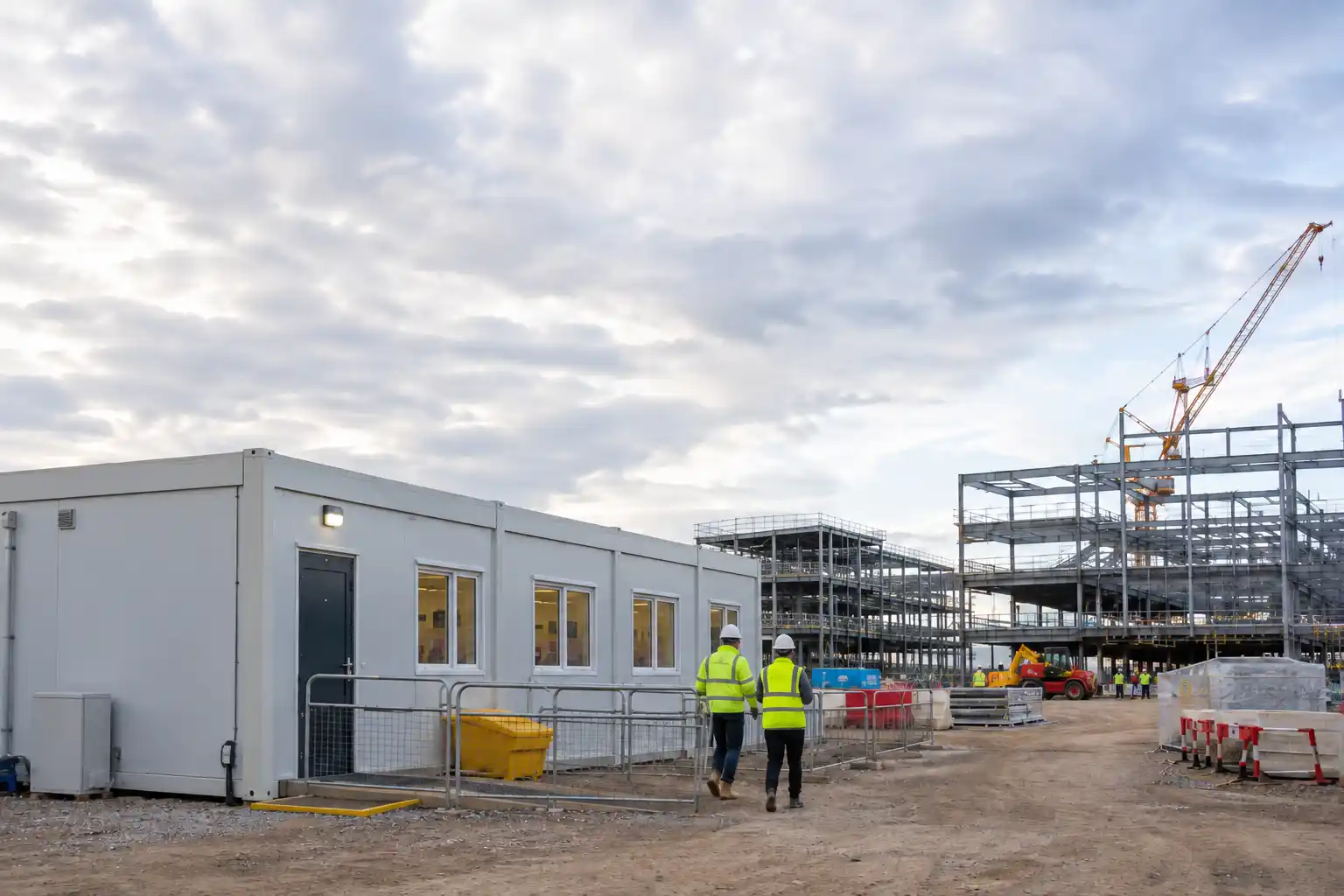
There is also a coordination layer that often sits behind the scenes. Temporary buildings may need to be installed while parts of the site are still under investigation, restricted or undergoing repair. This requires careful planning around safety, access control and sequencing with other contractors or recovery teams.
From a decision-making perspective, integration should be viewed as a practical exercise rather than a technical barrier. The question is not whether a temporary structure can be placed on site, but whether it can be planned in a way that supports the specific workflows the business needs to maintain.
What types of businesses use temporary buildings after disruption?
Temporary buildings are used across a wide range of sectors following disruption, particularly where operations depend on physical space and cannot be paused without consequence.
In warehousing and logistics, they are commonly used to protect stock, maintain dispatch operations or provide overflow capacity when part of a facility is unavailable. This helps reduce the risk of supply chain disruption and enables businesses to continue meeting delivery commitments.
In manufacturing and production environments, temporary buildings can support assembly, processing or equipment storage. While they may not fully replace a damaged facility, they can allow critical functions to continue, reducing the impact of downtime on output and contractual obligations. Across the wider commercial sector, temporary operational buildings are regularly used to maintain continuity during reinstatement works, phased redevelopment projects and infrastructure disruption.
Retail and customer-facing businesses may use temporary structures to maintain trading while repairs are carried out. Even a partial continuation of service can protect revenue streams and customer relationships that would otherwise be lost during a prolonged closure.
In public-facing or service-led environments, such as leisure venues or operational sites, temporary buildings can support reception, administration or service delivery functions. The emphasis in these scenarios is often on maintaining access and continuity rather than replicating the entire original environment.
Across all of these sectors, the common factor is not the type of building, but the need to maintain operational continuity under constraint. Temporary buildings are used where the cost of inactivity outweighs the complexity of implementing a structured interim solution.
Why are temporary buildings critical for maintaining continuity?
Temporary buildings become critical when the alternative is sustained operational disruption. In many recovery scenarios, the main site cannot be used in its original form for an extended period. Without a viable interim solution, businesses may face a combination of reduced output, lost revenue, contractual risk and internal inefficiencies.
By providing a controlled, usable environment, temporary buildings help stabilise operations at a point where uncertainty is often at its highest. They allow businesses to re-establish a degree of normality, even if the arrangement is not identical to the original setup. The timeline for achieving this depends on factors such as site condition, access, specification and infrastructure requirements, which is why understanding what affects temporary building installation timelines can help businesses plan more effectively during recovery.
This stabilisation has a direct commercial impact. Maintaining some level of activity can protect revenue, preserve customer relationships and reduce the knock-on effects of downtime across the wider operation. It can also give decision-makers more time to plan longer-term recovery without being forced into reactive or short-term decisions under pressure.
Environment Agency guidance on how to prepare your business for flooding recommends continuity planning measures that help organisations maintain operations when premises or infrastructure become unavailable.
There is also a resilience aspect to consider. Businesses that incorporate temporary buildings into their continuity planning are often better positioned to respond to disruption. Rather than treating recovery as a single event, they approach it as a phased process, where temporary infrastructure supports the transition from disruption to reinstatement.
Temporary buildings should not be seen as a replacement for permanent facilities. Their role is to bridge a gap at a critical moment. When used strategically, they provide a practical way to maintain control while the wider recovery process unfolds.

What should you focus on now to maintain control?
At the point where disruption has affected your premises, the priority is not to find a perfect replacement for what has been lost. It is to identify which parts of your operation must continue and what environment those functions require.
This means focusing on operational priorities rather than physical structures. What activities are essential to maintain revenue, fulfil obligations or keep the business functioning? What level of space, access and infrastructure is required to support those activities? And how quickly does that need to be in place to avoid further disruption?
Temporary buildings become relevant when they can be aligned to those priorities. Their effectiveness depends on how well they are planned around real operational needs, not just how quickly they can be installed or how much space they provide.
By approaching the decision in this way, businesses can move from uncertainty to structured action. Instead of asking whether a temporary building is “good enough,” the focus shifts to whether it enables the right functions to continue during recovery. That shift in perspective is often what allows decision-makers to act with more confidence and control.
Next step: aligning your continuity approach with operational reality
At this stage, if your operation has lost capacity or is at risk of disruption, the most effective next step is to assess which functions need to be maintained and how a temporary building could support them in practice.
Where timelines are uncertain or reinstatement is likely to take longer than initially expected, early planning can reduce the risk of extended downtime. A structured approach allows you to evaluate site constraints, access requirements and operational priorities before disruption begins to impact performance more significantly.
LM Structures works with businesses to translate these requirements into practical temporary building solutions that support continuity rather than simply providing space. This includes considering how the structure integrates with your workflows, what level of specification is appropriate, and how it fits into your wider recovery plan.
If your site has been affected by fire, flood or storm damage – or you are planning for potential disruption—this is the point where a continuity-focused assessment can help you make a more informed decision about your next steps.
How do temporary buildings support business continuity FAQs
They help maintain continuity by allowing key business functions to continue despite disruption to the main premises. By providing usable operational space, they reduce downtime and support a more controlled recovery process.
In many cases, temporary buildings are used for extended periods, particularly where recovery timelines are uncertain. The duration of use depends on operational need, planning considerations and the scale of reinstatement works.
Temporary structures are designed for commercial use and can provide a stable, protected environment when correctly planned. Their reliability depends on factors such as specification, site conditions and how well they are integrated into the wider operation.
In practice, they are used to replace or supplement operational space following disruption. This can include protecting stock, maintaining workflow processes, enabling dispatch operations or supporting temporary working environments while repairs are underway.
Yes, temporary buildings can support real operations when they are specified around the functions they need to accommodate. They are commonly used for storage, production support, fulfilment and customer-facing activity, depending on the sector and scenario.