What to Do After a Commercial Fire – A Structured Recovery Approach
When a warehouse fire disrupts storage, fulfilment or production, the immediate priority is to regain operational control before disruption spreads further.
In short:
After a warehouse fire, secure the site, confirm what can still operate, communicate with key stakeholders and begin business continuity planning immediately. Temporary warehouse space or business continuity structures may help maintain critical activity while damage assessment, insurance processes and longer-term reinstatement continue.
Recovery Priorities at a Glance
- Prioritise safety, site control and authorised access before operational decisions are made.
- Establish what space, stock, equipment, access routes and systems remain usable.
- Identify the minimum viable operation needed to keep orders, contracts or essential workflows moving.
- Start continuity planning in parallel with clean-up, investigation and insurance activity.
- Consider temporary operational infrastructure early, rather than waiting until the full recovery timeline is known.
Table of contents – in this article
What should you do in the first 24–72 hours after a warehouse fire?
The first 24–72 hours after a warehouse fire should be treated as a stabilisation period, not a full recovery period. At this stage, the aim is to protect people, regain visibility, preserve whatever operational capacity remains and prevent short-term disruption from becoming a longer business interruption.
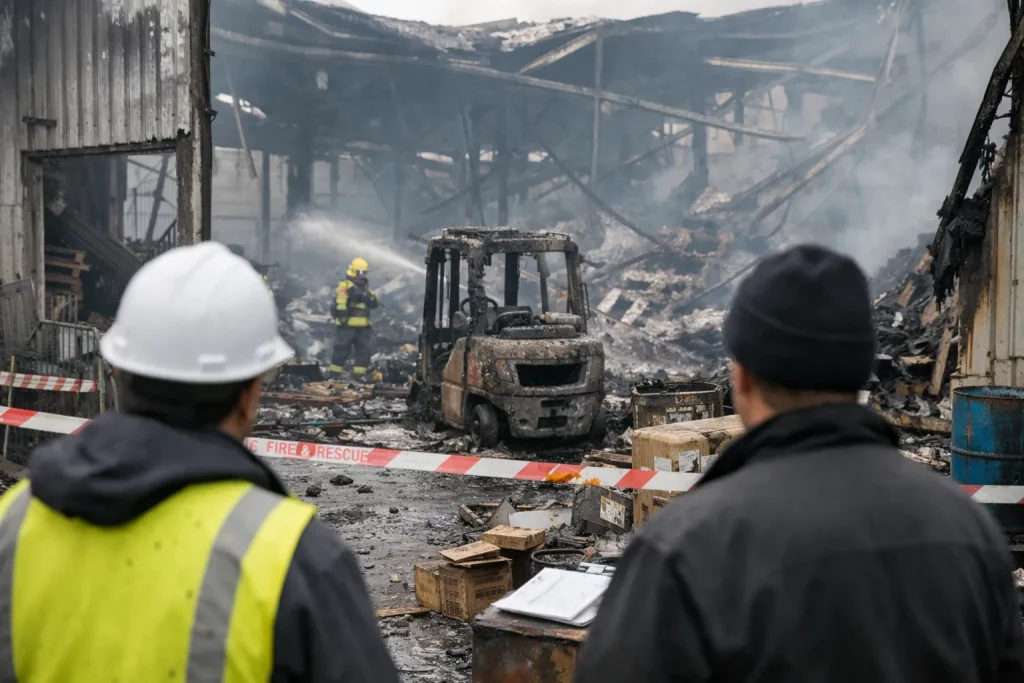
The first priority is safety and site control.
Access should only happen where it has been authorised and where the relevant safety checks, emergency service instructions and internal procedures allow it, in line with HSE workplace health and safety guidance.
Fire-damaged buildings can present continuing risks, and UK Government fire safety guidance reinforces the importance of identifying hazards, assessing who may be at risk and taking appropriate action to control those risks.
Once immediate safety and access issues are under control, the next task is to establish a clear operational picture. That does not mean waiting until every detail is known. It means gathering enough information to make controlled decisions: what areas are unusable, what functions are halted, what stock or equipment may be affected, and what activity can continue safely elsewhere.
Communication also needs to begin early. Internal teams need to know who is responsible for decisions, which areas are out of use, and what temporary working arrangements apply. Customers, suppliers and logistics partners may also need early updates, especially where orders, collections, deliveries or contractual commitments are likely to be affected.
Business continuity planning should begin at the same time as damage assessment, not after it, as outlined in the UK Government business continuity toolkit, which defines continuity planning as the procedures and information needed to deliver critical activities during disruption, which supports the need to keep essential operations moving even before full recovery is possible.
For many warehouse and logistics operations, this means creating several parallel workstreams:
- site safety and access control
- damage and stock assessment
- customer and supplier communication
- insurance notification and evidence gathering
- temporary operational planning
- longer-term reinstatement planning
This parallel approach matters because waiting for one process to finish before starting the next can extend downtime unnecessarily. The business may not yet know the full recovery timeline, but it can still begin identifying how to maintain core activity.
At this stage, the practical question is not “when will everything be back to normal?” It is “what must continue now, and what infrastructure is needed to support it?”
Assessing what operations can continue immediately
After a warehouse fire, operational assessment should focus on usable capability rather than only visible damage. A site may appear severely disrupted, but parts of the operation may still be recoverable, transferable or capable of being restarted in a limited form, once it has been confirmed safe to re-enter in line with UK Fire and Rescue Service guidance.
The first step is to separate the operation into critical functions. These may include goods-in, storage, picking, packing, dispatch, returns, production support, administration, vehicle access, loading and stock control. Each function should then be assessed against what is currently available, restricted or lost.
This helps decision-makers avoid treating the whole site as either “open” or “closed”. In practice, continuity often depends on partial functionality. A warehouse may have lost storage capacity but retained access routes. It may have damaged stock areas but still have usable office systems. It may be unable to operate at full throughput but still capable of handling priority orders if space and workflow can be reorganised.
The assessment should also consider dependencies. A loading bay may be usable, but if racking, power, IT systems or safe pedestrian routes are compromised, the function may still be limited. Equally, stock may be physically recoverable but temporarily inaccessible due to investigation, safety or insurance requirements.
Commercial impact should be reviewed alongside operational capability. Lost space is not only a facilities issue; it can quickly affect order fulfilment, customer service, production schedules and contract performance. Business interruption insurance can cover loss of income during periods when a business cannot operate as usual following an unexpected event, including damage to premises or equipment by fire, although the scope depends on the policy.
This is why the assessment should identify the minimum viable operational capability. That means the level of space, access, staffing, equipment and workflow needed to keep the most important activity moving, even if the wider operation remains disrupted.
For example, a warehouse operation may need to prioritise:
- high-value or time-sensitive stock
- customer orders with contractual deadlines
- materials required for production continuity
- temporary goods-in or dispatch capacity
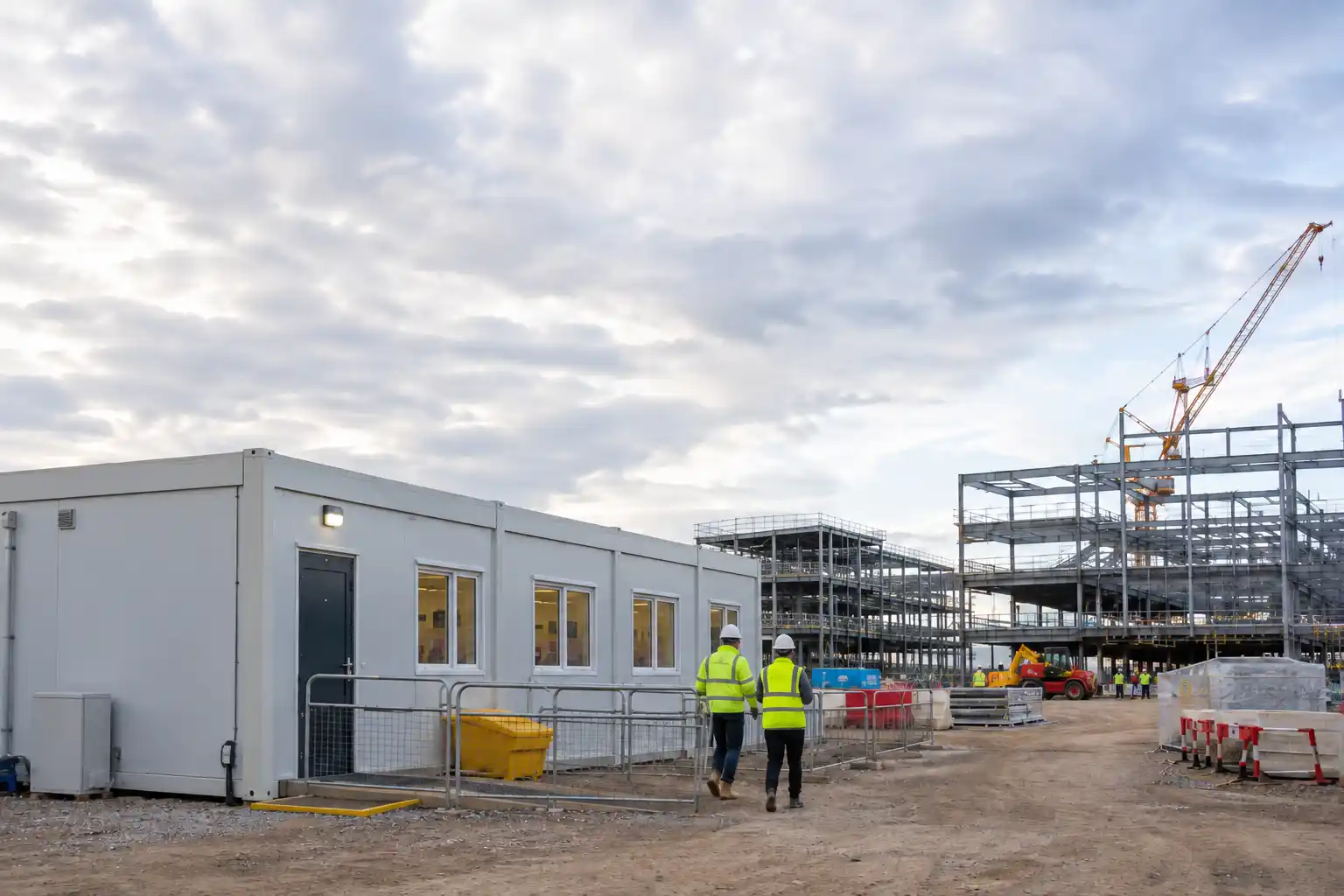
- safe staff welfare and administration space
- secure storage for unaffected or recovered stock
This assessment should be realistic. It should not assume that normal throughput can continue immediately, or that temporary arrangements will remove all disruption. The purpose is to define what can be stabilised first and what level of temporary support may be required.
How insurance and loss adjusters affect operational decisions
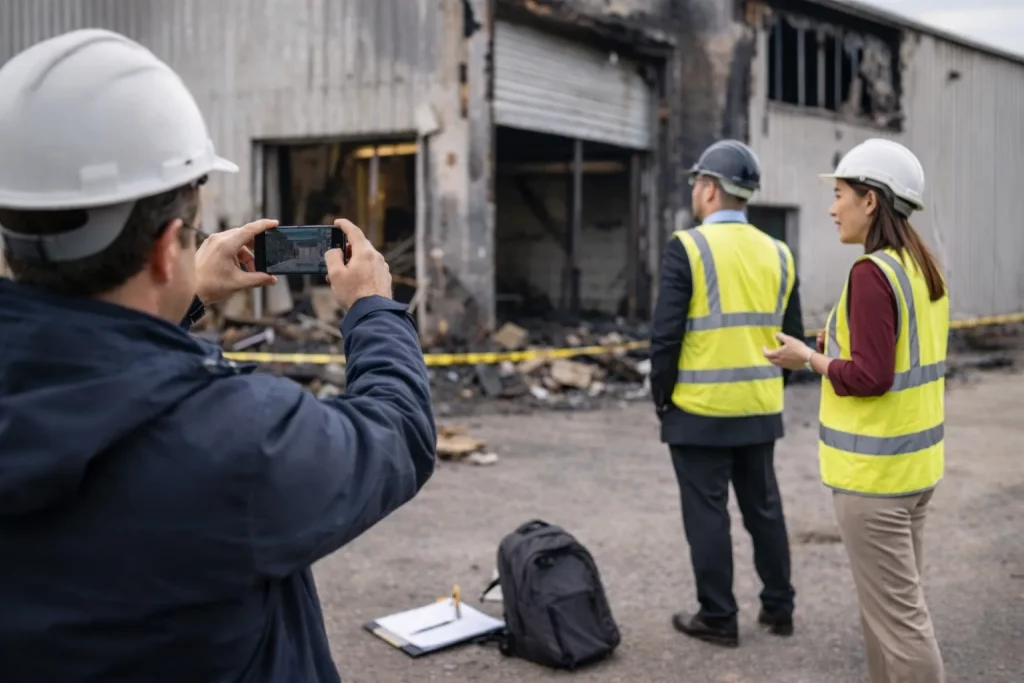
After a commercial fire, operational decisions do not happen in isolation. Insurers and loss adjusters will often need to assess the site, document damage and confirm the scope of the claim before certain actions are taken.
A loss adjuster acts on behalf of the insurer to investigate the cause of the incident, assess the extent of damage and determine how the claim will be handled. This process can influence site access, the timing of clean-up activities and when repair or reinstatement work can begin.
For operational teams, this introduces a practical constraint. it does not remove the need to maintain operational capability, including understanding whether insurance covers temporary buildings where continuity space is required. At the same time, some actions may need to be coordinated or sequenced around insurer requirements.
This is why early communication with insurers is important. It helps ensure that continuity decisions – such as relocating operations, introducing temporary space or protecting stock – are aligned with the claims process, rather than creating delays or complications later.
What are your options for maintaining operations after a fire?
Once the immediate operational picture is clearer, the business needs to decide how to maintain activity while the damaged site is assessed, cleaned, repaired or reinstated. Waiting for full reinstatement is rarely the only option, and in many cases it may expose the business to avoidable downtime.
The available options usually fall into three broad routes: relocating activity, creating temporary on-site capacity, or using a hybrid model.
Temporary relocation may be appropriate where the existing site is inaccessible, heavily damaged or unsuitable for safe interim use. This may involve moving stock, staff or specific workflows to another company site, a third-party logistics provider or a temporary external facility. The benefit is separation from the damaged environment, but relocation can also introduce transport, handling, systems and staffing challenges.
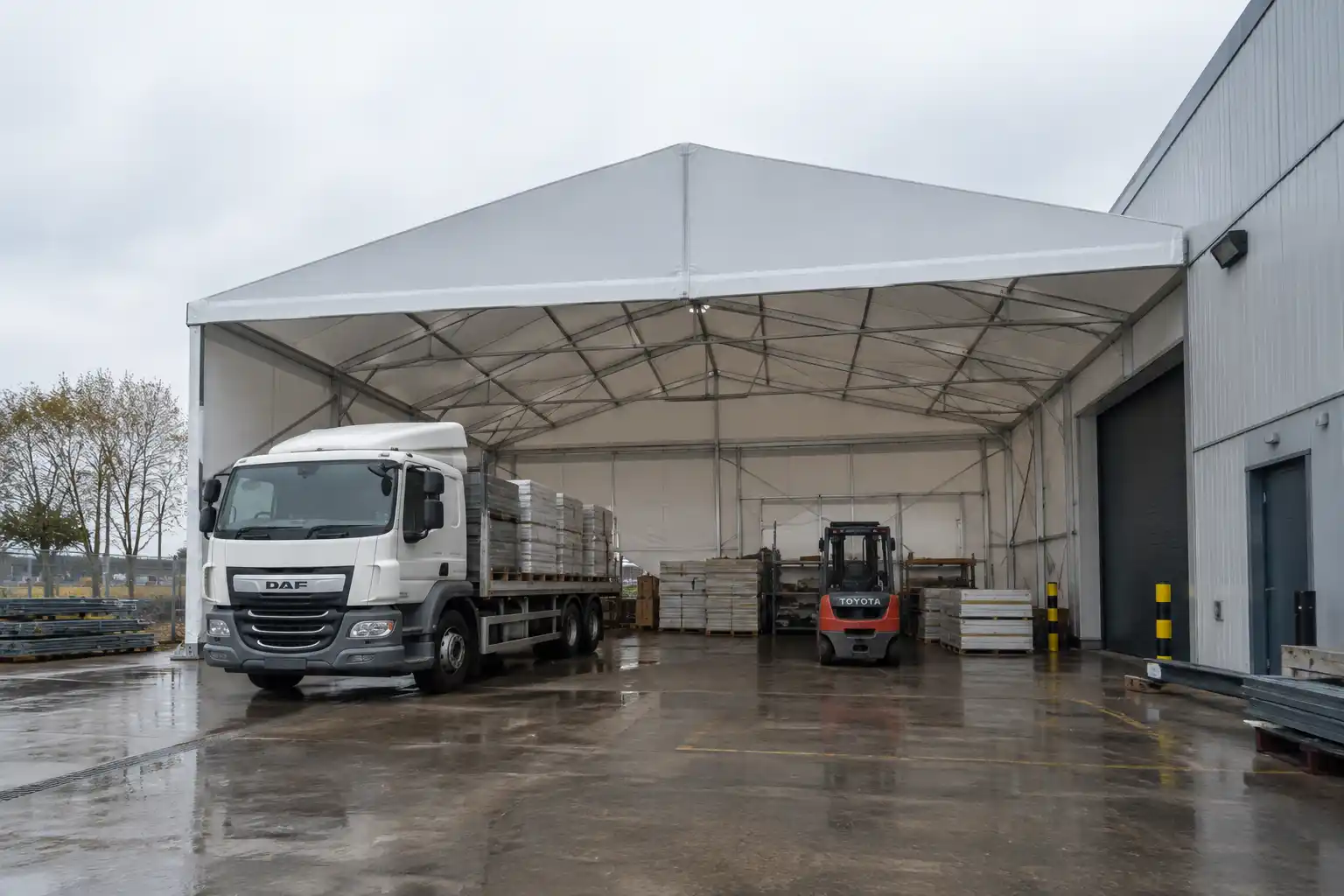
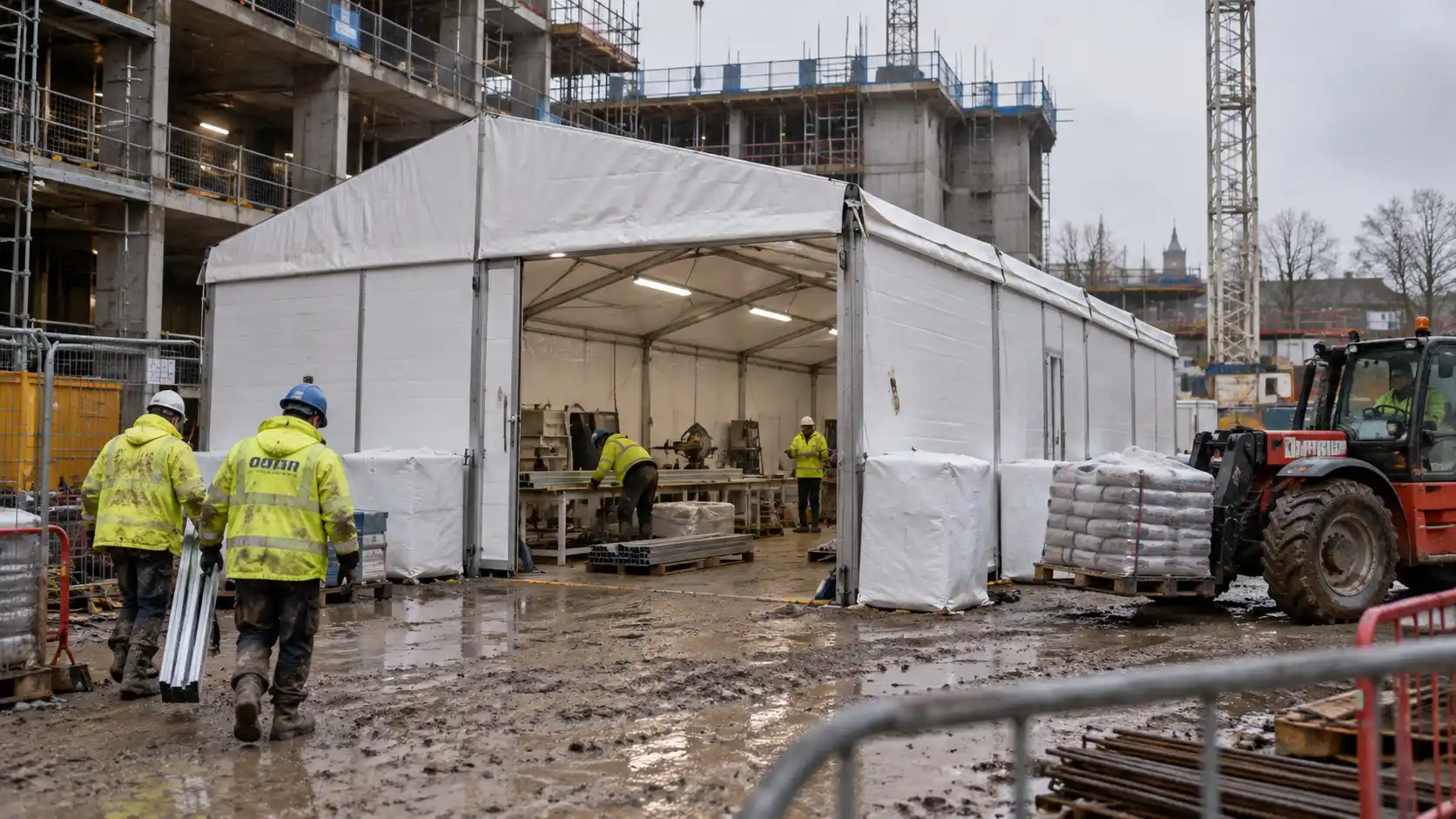
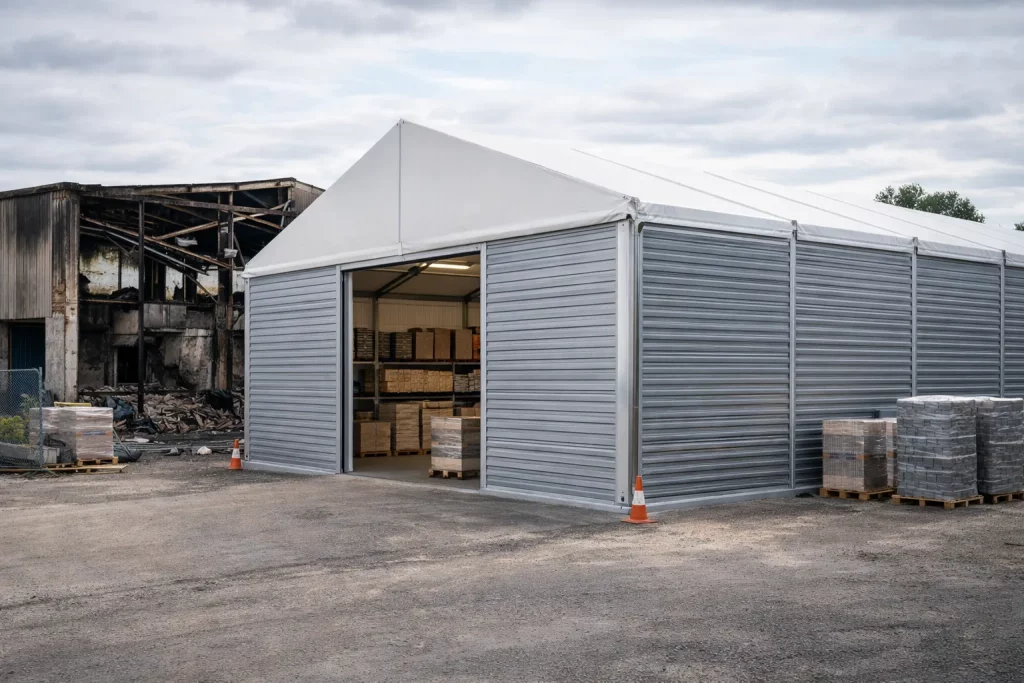
Temporary operational infrastructure may be suitable where part of the site remains usable or where adjacent land, yard space or another controlled area can support continuity. In this context, Business Continuity Structures can provide temporary warehouse space, storage cover, fulfilment areas or workspace while the main building remains unavailable.
A hybrid model may be the most realistic route for many businesses. For example, stock may be split between an unaffected area, temporary warehouse space and a third-party location. Administration or planning teams may work remotely or from temporary workspace, while critical goods movement continues through a reduced but controlled flow.
The right option depends on several decision factors:
- how much space has been lost
- whether the site can be accessed safely
- what functions must continue first
- how quickly customers or contracts will be affected
- whether yard space or adjacent land is available
- whether utilities, vehicle access and loading routes can support temporary use
- how long reinstatement may take
Temporary structures should not be viewed simply as additional space. They are often part of a wider approach to how temporary buildings support business continuity. In a fire recovery scenario, they may act as temporary operational infrastructure: a way to preserve storage, protect stock, maintain fulfilment or create working capacity while other recovery work continues.
In practical terms, this means temporary buildings are often used to support specific operational functions rather than acting as a generic replacement. This may include maintaining dispatch capability, protecting critical stock, supporting goods handling operations or creating controlled workflow zones while reinstatement is ongoing.
Unlike outsourced storage or full relocation, temporary on-site structures allow operations to remain closer to existing infrastructure, teams and logistics networks. This can reduce handling complexity, maintain operational visibility and support more consistent throughput during disruption.
This is particularly important where the business faces uncertainty. Insurance assessments, clean-up, repair works and reinstatement planning may all move at different speeds. A temporary structure can help create a more controlled operating base while those processes continue, provided the site is suitable and access, safety and practical constraints can be managed.
The decision should be guided by operational need rather than speed alone, including understanding which temporary building types are suitable for business use. A fast solution that does not support the right workflow, access pattern or stock requirement may create further inefficiency. The stronger approach is to identify the essential activity first, then choose the temporary arrangement that supports it safely and practically.
Can temporary structures be deployed immediately after fire damage?
Temporary structures can often be introduced early in the recovery process, but deployment speed depends on site conditions, access and safety clearance rather than urgency alone, which influences how long temporary building installation actually takes.
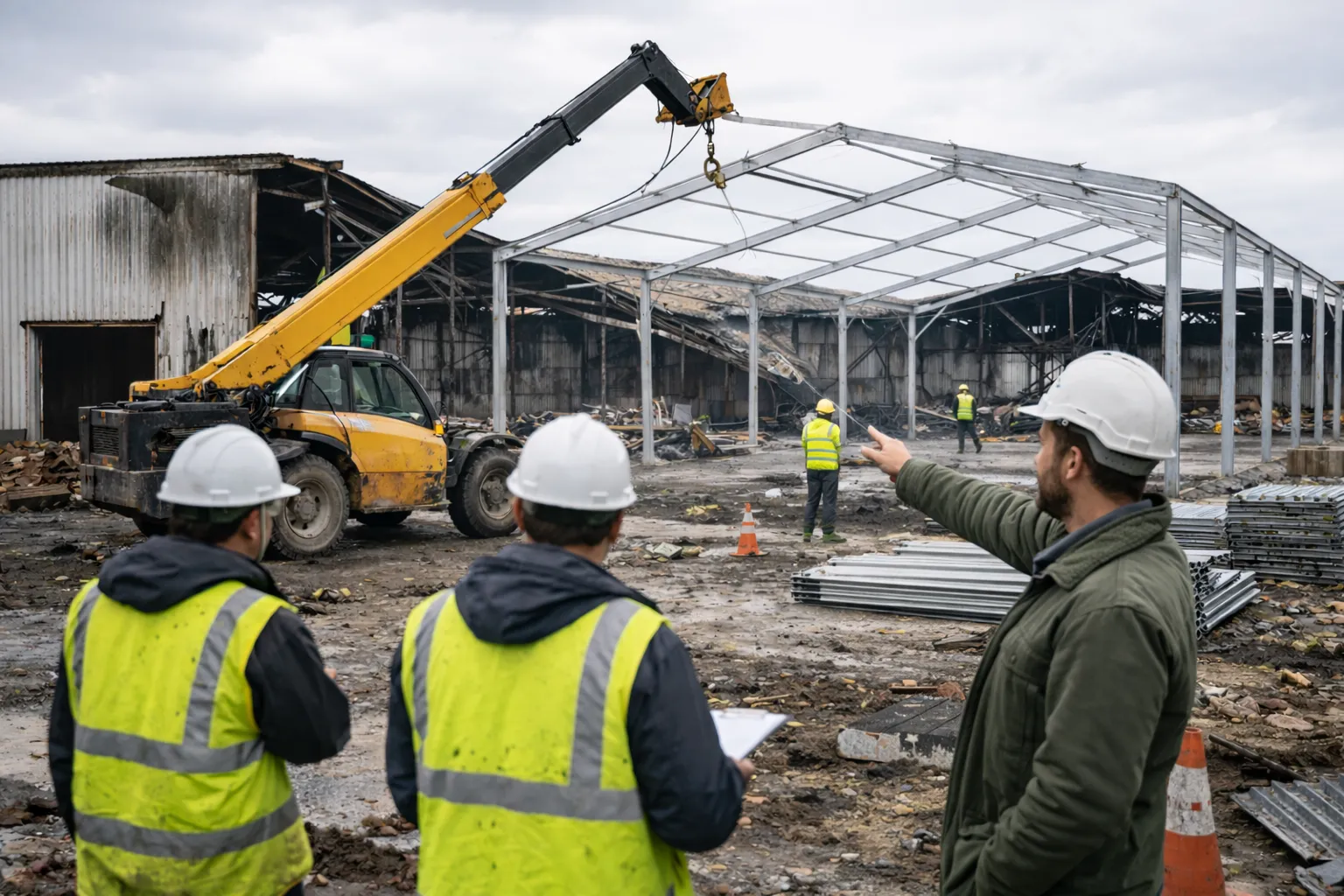
In practice, the feasibility of installing temporary warehouse space after a fire is determined by whether parts of the site—or adjacent land—can be safely accessed and prepared, which depends on temporary building site requirements and constraints. Fire-damaged environments may involve restricted zones, ongoing investigation and structural uncertainty. Fire and Rescue operational guidance highlights that damaged structures can present ongoing hazards, which reinforces the need for controlled access and coordinated decision-making. (gov.uk)
Where safe access is available, temporary buildings can provide covered storage, protected goods handling space or interim fulfilment areas. These are not designed as long-term replacements for permanent buildings, but they can restore essential operational capability while recovery work continues.
The value of introducing temporary structures early is not just speed. It is the ability to establish a controlled environment for critical functions while other processes—such as clean-up, insurance assessment and reinstatement—continue in parallel. This helps reduce reliance on fragmented or improvised arrangements, which can introduce inefficiencies or additional risk.
However, deployment must be coordinated with:
- site safety assessments and authorised access
- available ground conditions and space
- vehicle routes and logistics flow
- utilities and operational requirements
- any restrictions imposed by insurers or investigators
This is why temporary structures should be considered as part of the continuity strategy from the outset, rather than as a later-stage solution once recovery timelines are clearer.
Constraints that can delay recovery after a warehouse fire
Recovery timelines after a warehouse fire are rarely defined in the early stages. Several predictable constraints can slow progress, and these should be factored into decision-making from the beginning.
Access restrictions are one of the most immediate constraints. Parts of the site may be sealed off for investigation or deemed unsafe until structural assessments have been completed. This can limit both damage assessment and the ability to introduce temporary solutions in certain areas.
Safety and compliance requirements also influence how quickly operations can resume. Any temporary or reconfigured setup must still meet relevant health and safety expectations, including safe access routes, fire considerations and staff welfare provisions. These requirements do not disappear during disruption and must be integrated into continuity planning.
Insurance involvement can also affect timing. Loss adjusters may need to inspect the site, document damage and validate claims before certain actions are taken. While business interruption insurance is designed to support loss of income during periods when normal operations cannot continue, the process itself can introduce sequencing constraints depending on the policy and circumstances.
Operational complexity is another factor. Even where space is available, rebuilding workflows is not straightforward. Stock may need to be relocated, systems reconfigured and staff redeployed. Temporary arrangements can help, but they must align with how the operation actually functions, not just where space exists.
These constraints do not mean that action should be delayed. They reinforce the need to plan for parallel progress: stabilising operations where possible while acknowledging that some areas of recovery will take longer.
In practice, reinstatement of industrial or warehouse premises often takes longer than initially expected. Structural repairs, specialist cleaning, procurement of materials, contractor availability and regulatory approvals can all extend programme duration. For many warehouse environments, full reinstatement may take several months rather than weeks, particularly where fire has affected both the building fabric and operational infrastructure.
How do you stabilise operations while planning longer-term recovery?
Stabilisation is the point where the business moves from reactive disruption to controlled continuity. It does not mean that operations have returned to normal, but that essential activity is functioning within a defined and manageable structure.
This typically involves consolidating the minimum viable operation identified earlier and supporting it with appropriate space, processes and communication. Temporary warehouse space, adjusted workflows or hybrid operating models may all contribute to this.
Consistency is critical at this stage. Stop-start operations—where activity repeatedly begins and halts due to changing conditions—can increase inefficiency, create confusion and extend disruption. A slightly reduced but stable operation is often more effective than attempting to resume full capacity too quickly.
This is where the distinction between activity and control becomes important. Activity alone does not restore operations. Without structure, it can increase risk, create inefficiencies and make it harder to maintain consistent output. Stabilisation requires deliberate sequencing, where decisions about space, workflow and capacity are made in a controlled and repeatable way.
Commercial considerations remain closely linked to operational decisions. Maintaining even partial throughput can help protect customer relationships, meet priority obligations and reduce backlog pressure. It also provides a clearer platform for scaling back up as recovery progresses.
At the same time, longer-term recovery planning should continue in parallel. This may include repair or rebuild decisions, insurance discussions, supplier coordination and internal planning. The stabilised operation provides the breathing space needed to make these decisions more effectively.
Temporary structures can play a role in this phase by providing continuity without committing to permanent change too early. They allow the business to maintain control of its operations while retaining flexibility as the full recovery plan develops.
What should you focus on now to maintain control?
At this stage, the focus should be on maintaining control rather than chasing full recovery. The most effective response to a warehouse fire is not defined by how quickly everything returns to normal, but by how well the business manages disruption in the interim.
This means continuing to prioritise:
- clear operational structure and decision ownership
- stable, repeatable workflows for essential activity
- realistic use of available and temporary space
- ongoing communication with customers, suppliers and teams
- alignment between operational decisions and commercial priorities
Delays, constraints and uncertainty are part of the recovery process. What matters is how these are managed. Businesses that establish control early—by structuring their response and supporting it with practical continuity solutions—are typically better positioned to protect revenue, maintain relationships and scale operations back up as conditions improve.
Next step
Where capacity has been lost and recovery timelines remain uncertain, the decision to introduce temporary operational infrastructure becomes time-sensitive.
At this stage, the priority is not to replace the damaged facility, but to protect continuity while recovery progresses. Temporary warehouse space or business continuity structures can provide a controlled environment for storage, fulfilment or workspace, helping to reduce downtime and maintain essential activity.
If your operation is currently dealing with restricted access, reduced capacity or uncertainty around reinstatement, this is typically the point where continuity decisions become time-sensitive rather than optional. Delaying this decision can extend disruption if suitable operational space is not available when recovery work progresses.
Understanding what can be installed, how it would integrate with your site and what constraints may apply can help you move from reactive disruption to a more stable operating position.
LM Structures supports businesses in planning and delivering temporary and semi-permanent buildings that align with operational needs and site conditions, helping maintain continuity while longer-term recovery is still evolving.
Call 0333 358 4989 or email enquiries@lmstructures.co.uk
What to do after a commercial fire – FAQs
The following questions reflect common concerns raised by warehouse operators and facilities managers after a fire incident.
Yes, subject to regulatory considerations. Many temporary commercial buildings are installed for medium-term use during reinstatement works.
Planning requirements depend on location, duration and intended use. Consultation with the local planning authority is advisable.
A loss adjuster assesses damage, investigates cause and determines the insurer’s liability under the policy.
Timelines vary depending on structural impact and rebuild requirements. Full reinstatement may take several months.
Ensure the site is declared safe, secure the perimeter, document visible damage and notify your insurer without delay.