How Long Can a Venue Keep a Temporary Event Structure?
Venues often begin by asking what type of structure they need. For hotels, wedding venues, golf clubs, estates and commercial venues, the more important early question is usually how long the structure needs to perform.
In Short
A temporary event structure duration may be short-term, seasonal, medium-term or semi-permanent, depending on the venue’s event calendar, site conditions, planning position and commercial objective. The longer the structure remains in place, the more important it becomes to consider specification, guest comfort, maintenance, inspections, weather exposure and operational integration.
Duration Decisions at a Glance
- Temporary event structure duration should be defined before specification, cost or installation decisions are made.
- Short-term, seasonal, medium-term and semi-permanent use all create different operational, planning and maintenance considerations.
- Seasonal structures may suit Christmas party programmes, summer wedding seasons or recurring peak event windows.
- Longer-duration use usually places more emphasis on guest-ready fit-out, weather performance, access, safety checks and maintenance planning.
The right duration depends on demand, site conditions, guest expectations, disruption risk and the commercial return the additional space is expected to support.
Table of Contents – in this article
How long can a venue keep a temporary event structure in place?
A venue can keep a temporary event structure in place for a short event period, a full season, several months or longer-term semi-permanent use, provided the structure, site conditions, planning position and operational requirements are suitable for that duration.
There is no single answer that applies to every venue. A temporary structure used for a weekend wedding is not the same decision as a structure retained for a full summer season or used as a semi-permanent event building for recurring venue capacity. Duration must be considered alongside site suitability, guest access, weather exposure, maintenance requirements and the way the space will be used commercially.
For a one-off event or short booking period, the venue may be able to plan around a clearly defined installation and removal window. The commercial case is usually tied to a specific event, guest number or short-term programme. The key question is whether the structure can support the event safely, comfortably and without disproportionate disruption to the wider venue.
For a full season, the structure is likely to face a wider range of operational demands. A Christmas party venue space may need to support heating, guest flow, service access and evening presentation across repeated bookings. A summer wedding structure may need to support guest comfort, circulation, ventilation, access and visual integration across several months of peak trading.
For longer-term or semi-permanent use, the structure may become part of the venue’s commercial capacity. At that point, the decision is not simply how long it can stay in place physically. It is whether the structure can support the venue’s guest standards, event calendar, maintenance expectations, planning position and return on investment over that period.
Planning should also be considered early where a structure remains in place for longer periods, is repeated seasonally, is highly visible, affects land use, sits within a heritage or conservation setting, or may influence access, parking or neighbouring properties. The Planning Portal guidance on temporary buildings confirms that some temporary buildings may fall within permitted development criteria, but venues should check with the local planning authority where there is uncertainty.
The underlying legislation on temporary use of land is also often referenced in relation to short-duration event use. However, the 28-day provision under the Town and Country Planning General Permitted Development Order 2015 should not be treated as a simple rule for every venue structure. Site context, use, duration, repetition and local interpretation all matter.
For venues considering additional capacity across a season, several months or a longer-term programme, temporary event buildings for seasonal and longer-term venue use should be assessed around the actual use period rather than a generic structure type.
The practical question is not only “how long can a temporary event structure stay in place?” It is “how long does the venue need the space to perform commercially, safely and comfortably?”
What is the difference between short-term, seasonal and semi-permanent use?
The difference between short-term, seasonal and semi-permanent use lies in how the structure supports the venue’s operating model.
A short-term structure may support one event. A seasonal structure may support a peak trading period. A semi-permanent event building may function as part of the venue for months or years. Each option can be appropriate, but each carries different requirements.
Short-term venue use
Short-term use usually applies where the structure is needed for one event, a limited booking period or a short run of linked events.
This may suit a venue that has a specific capacity requirement but no clear need for ongoing additional space. For example, a hotel may need extra covered dining or reception space for a particular event. A wedding venue may need additional guest space for a defined booking. A golf club may need a short-term structure for a limited hospitality programme.
The advantage of short-term use is lower commitment. The venue can support a defined requirement without committing to a full season or longer-term structure. Maintenance exposure is usually more limited because the structure is in place for a shorter period, although safe installation, use and removal still need to be properly managed.
The limitation is that short-term installation may become inefficient if the same requirement keeps returning. If a venue repeatedly installs and removes a structure across the year, the disruption, coordination time and operational reset may start to outweigh the benefit of treating each use as isolated.
Short-term use is often most suitable when demand is limited, occasional or still unproven.
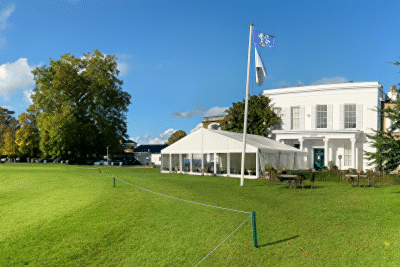
Seasonal venue use
Seasonal use applies where the structure supports a defined event window, such as a Christmas party programme, summer wedding season, outdoor dining period or recurring peak event calendar.
This is where duration starts to influence specification more clearly. A seasonal venue structure must support repeated guest use across different days, weather conditions and operational pressures. It is not simply a cover for one event; it becomes part of the venue’s trading environment for that period.
For winter use, heating, entrance management, flooring, lighting, access and weather protection may become more important. Christmas party programmes often depend on consistent presentation, guest comfort and smooth arrivals across multiple bookings. Readers focused on winter trading may need to consider dedicated Christmas party venue space as part of their seasonal planning.
For summer wedding use, the focus may shift toward ventilation, visual integration, guest circulation, external access, service routes and the ability to maintain a high-quality experience across repeated events. Wedding venues evaluating seasonal expansion should consider how summer wedding venue capacity affects both revenue opportunity and operational delivery.
Seasonal use can be commercially sensible where the structure supports enough events, covers a recognised peak period and reduces the need to turn away suitable bookings. It can also help venues test whether recurring demand justifies a more permanent or semi-permanent approach later.
However, seasonal use still needs discipline. The venue should understand how long the structure will remain in place, how often it will be used, what weather exposure it may face, and what level of maintenance or inspection may be required during the season.

Medium-term venue use
Medium-term use usually means the structure is retained for several months to support a defined programme, operational pressure or trial expansion.
This may suit a venue testing a new event format, increasing capacity during refurbishment, responding to a strong booking pipeline or creating additional space while longer-term investment decisions are reviewed. It can also be useful where the venue wants to understand demand before committing to semi-permanent use or permanent construction.
Compared with short-term or seasonal use, medium-term use usually requires more operational integration. The structure may need to work around staff movement, service access, guest arrivals, cleaning routines, deliveries and maintenance checks over a longer period. Flooring, lighting, heating, ventilation and entrances may need to be specified for repeated use rather than occasional use.
Commercially, medium-term use should be tied to a clear objective. The venue should understand whether the structure is supporting confirmed bookings, testing demand, protecting capacity during works, or enabling a specific programme. Without that clarity, it becomes harder to judge whether the duration and specification are proportionate.
Semi-permanent venue use
Semi-permanent use applies where the structure becomes part of the venue’s operating model for months or years.
This may suit venues with proven demand for larger events, recurring seasonal programmes, limited internal capacity or a desire to expand without committing immediately to permanent construction. A semi-permanent event building for venues can act as a longer-term venue extension, provided the site, planning context, guest standards and commercial case support that level of commitment.
The requirements are usually higher. A semi-permanent structure may need a more complete guest-ready fit-out, more robust flooring, stronger operational integration, defined maintenance arrangements, planned servicing, safety management and early planning awareness. Visual integration can also matter more because the structure is likely to become a visible part of the venue environment.
The benefit is that semi-permanent use can reduce repeated installation disruption and support a more stable event sales strategy. If the venue knows it needs additional space every Christmas, every wedding season or across a recurring programme, a longer-duration approach may provide more operational continuity than repeated short-term installations.
The risk is over-commitment. Semi-permanent use is not automatically the best answer. It is only commercially sensible where demand is understood, the site can support the structure, planning issues have been considered, and the expected use justifies the level of specification and ongoing management.
A useful way to frame the decision is this: short-term use supports a specific need, seasonal use supports a defined revenue window, medium-term use supports a programme or trial, and semi-permanent use supports a longer-term venue capacity strategy.
What changes if a structure stays up for months rather than weeks?
When a temporary event structure stays in place for months rather than weeks, it begins to operate as part of the venue environment. That changes the level of planning required.
A structure used for a single event may only need to support a defined guest arrival pattern, a limited service period and a clear removal date. A structure used across a season or several months must continue to perform through repeated events, changing weather, cleaning cycles, guest movement, supplier access and operational wear.
Weather exposure is one of the first differences. A short-term structure may be installed around a known forecast window, although weather risk still has to be considered. A seasonal or medium-term event structure may need to remain suitable through rain, wind, cold periods, heat, damp ground conditions and repeated use of entrances and service routes.
Guest comfort also becomes more important over time. If guests are using the space once, the venue may be able to plan around a specific event format. If the structure is being used every weekend, across a Christmas party programme or throughout a summer wedding season, heating, ventilation, lighting, flooring, access and presentation all need to support consistent guest experience.
This is particularly important for venues where the structure sits close to the main building or forms part of the guest journey. A temporary event building used repeatedly should not feel disconnected from the venue’s wider standards. Flooring, entrance points, lighting, internal finishes, circulation space and service access all need to be considered as part of the guest-ready environment. More detailed decisions around guest ready temporary event buildings become more relevant as the duration increases.
Longer duration also affects operational routines. Cleaning, waste movement, staff routes, catering access, deliveries, guest toilets, cloakroom arrangements and emergency access may all need to be planned around repeated use. If the structure is being used as part of the venue’s trading model, these details cannot be left to event-by-event improvisation.
Maintenance and inspection requirements also become more prominent. A structure used for several months may need periodic checks on fabric, frame, flooring, access points, anchorage, heating, ventilation, lighting and power arrangements. These checks should be proportionate to the structure, site and use, but the principle is straightforward: the longer the structure remains in operation, the more important ongoing oversight becomes.
The Health and Safety Executive’s guidance on temporary demountable structures reinforces the importance of competent planning, management and safe use of temporary structures. For venue operators, this supports the need to treat longer-duration event structures as managed operating spaces, not just temporary additions.
Commercially, a longer-duration structure also needs clearer justification. If a venue keeps a structure in place for several months, it should understand what the space is expected to support. That may include additional weddings, Christmas parties, corporate events, private dining, awards evenings, hospitality programmes or recurring venue hire. The more clearly the duration is linked to use and revenue opportunity, the easier it becomes to judge the right specification.
The key shift is that a structure used for months rather than weeks needs to be planned around continuity of use. It must remain practical for the team, comfortable for guests and proportionate to the venue’s commercial objective throughout the full use period.
How does duration affect planning, maintenance and inspections?
Duration can affect planning, maintenance and inspection responsibilities because the structure becomes more visible, more operationally embedded and more exposed to change over time.
For planning, the article should not be reduced to a fixed number of days. A venue’s planning position may depend on several factors, including how long the structure remains in place, whether it is repeated seasonally, how large it is, where it sits on the site, whether the venue is in a heritage or conservation setting, and whether access, parking, neighbours or land use may be affected.
The Planning Portal guidance on temporary buildings confirms that some temporary buildings may fall within permitted development criteria, but it also recommends checking with the local planning authority where the position is unclear. This is why venues should avoid assuming that “temporary” automatically means planning is irrelevant.
The temporary use of land provisions under the Town and Country Planning General Permitted Development Order 2015 are often referenced in relation to short-term use. However, this should not be treated as a universal answer for every temporary event building. Repeated seasonal use, longer duration, sensitive settings and the nature of the venue site can all make early planning checks more important.
Where venues need more detail on this specific issue, seasonal marquee planning permission should be considered as a separate planning-focused step. This article remains focused on duration, but planning awareness is part of making the duration decision responsibly.
Maintenance also changes with duration. A structure used for one event may need a clear installation check, event-period management and removal. A structure used for a whole season or several months may need a more structured approach to checks, servicing and ongoing condition monitoring.
This may include checks on:
- Structure condition
- Flooring and thresholds
- Access routes
- Weather-related movement or wear
- Heating and ventilation equipment
- Lighting and power
- Entrances and exits
- Internal presentation
- Cleaning and drainage around high-use areas
- Safety documentation and site management records
The purpose is not to make the decision feel unnecessarily complex. It is to recognise that a longer-duration structure must remain suitable throughout its period of use, including during poor weather, repeated guest movement and regular operational turnover.
Local authority event guidance can also support this principle. Hastings Borough Council’s guidance on temporary structures notes the importance of competent installation, sign-off and regular checks, particularly where windy or inclement weather may affect temporary structures. Requirements vary by authority and site, but the underlying principle is useful for venues planning seasonal or longer-term use.
The same applies to guest movement and site design. HSE guidance on venue and site design and venue/site suitability for crowd management highlights the importance of safe access, movement, exit and evacuation. For a venue-side temporary event building, this means duration decisions should account for how guests, staff, suppliers and vehicles will move around the structure over time.
Where a venue is considering seasonal or semi-permanent use, Maintenance & Servicing and Compliance & Safety should be part of the project conversation. Longer use does not automatically make a structure unsuitable, but it does make planned management more important.
When is semi-permanent venue space commercially sensible?
Semi-permanent venue space is commercially sensible when the venue has a clear, recurring need for additional capacity and the structure can be justified by the way it will be used.
This may apply where a venue has proven demand for larger weddings, recurring Christmas party programmes, regular corporate bookings, seasonal dining, awards evenings or hospitality events. It may also apply where the venue wants to test an expansion concept before considering permanent construction, or where permanent construction is not the right immediate step.
A semi-permanent event building for venues should not be treated as simply “a marquee left up for longer”. It is a different level of decision. The structure is expected to support guest experience, operational routines, maintenance, servicing and commercial use across a longer period. It may need more robust flooring, better environmental control, stronger visual integration, more considered access and a clearer maintenance plan.
The commercial case should be based on realistic use. A venue should consider how many events the structure will support, what type of bookings it may unlock, whether demand is confirmed or speculative, and how often the additional space will be used. A semi-permanent structure may be a strong option where the venue has repeat demand and wants to reduce the operational disruption of installing and removing a structure every season.
It may be less suitable where demand is uncertain, the site is difficult, planning risk is unresolved, or the venue only needs occasional extra capacity. In those cases, short-term, seasonal or medium-term use may offer a better way to test demand before making a longer commitment.
Semi-permanent space can also help venues avoid moving too quickly into permanent construction. It can provide additional capacity while the venue tests demand, refines its event offer or assesses whether a more permanent building would be commercially justified later. In that sense, it can sit between lightweight short-term structures and permanent construction.
The distinction between temporary and semi-permanent use is broader than duration alone. The existing article on temporary vs semi-permanent buildings may help readers understand the wider difference, while this article focuses specifically on venue-side duration decisions.
The most important point is balance. Semi-permanent use can be commercially sensible where the venue has recurring demand, suitable space, an appropriate planning position and enough event activity to justify the structure. It is not automatically better than seasonal use. It is better only when the commercial and operational case supports it.
How should venues choose the right duration?
Venues should choose the right duration by working backwards from the event calendar, commercial objective and operational reality of the site.
The starting question is not “What structure can we install?” It is “What does the venue need the space to do, and for how long?”
A venue considering temporary event structure duration should assess the requirement across several practical questions:
- Is the need linked to one event, a defined season, several months or ongoing demand?
- Is demand already proven, or is the venue testing a new opportunity?
- What revenue or booking opportunity could the structure support?
- How often will the structure be used during the period it is in place?
- What guest standards must the space maintain?
- What weather conditions will it face?
- How visible will the structure be within the venue environment?
- How disruptive would repeated installation and removal be?
- Are planning checks likely to be needed?
- What maintenance or servicing will be required?
- How will guests, staff and suppliers move around the structure?
- Does the duration justify the level of fit-out and specification?
- Does the structure need to integrate visually with the existing venue?
- Is the venue trying to solve a short-term need, a seasonal opportunity or a longer-term capacity issue?
These questions help prevent two common mistakes. The first is choosing a structure that is too basic for the way it will actually be used. The second is committing to a longer-duration structure before the venue has enough confidence in demand, site suitability or commercial return.
For example, a wedding venue that only needs additional space for one large booking may not need the same approach as a venue that expects to host weddings every weekend across the summer season. A hotel planning a December party programme may need to think differently from a venue testing occasional corporate dining. A stately home venue considering semi-permanent expansion may need to assess visibility, planning, access, guest standards and long-term commercial value before committing.
Installation disruption should also be part of the duration decision. Repeatedly installing and removing a structure may be acceptable for occasional use, but it can become inefficient where the same need returns across a season or year after year. Venues concerned about live-site disruption should consider installing temporary event space without disrupting venue operations as part of the implementation decision.
Site feasibility matters too. Access for installation, servicing, guest movement, emergency routes, catering support, power, heating, drainage and ground conditions can all influence whether a short-term, seasonal, medium-term or semi-permanent approach is more suitable. Early coordination through Planning & Installation can help venues assess what is practical before specification decisions are made.
The right duration is not always the longest one. It is the duration that matches the venue’s use case, protects guest experience, supports commercial return and avoids unnecessary disruption or commitment.
What matters most when deciding structure duration?
The right temporary event structure duration depends on how the venue plans to use the space, not simply how long the structure can physically remain in place.
A short-term structure may be right where the need is limited or demand is unproven. A seasonal structure may be more appropriate where the venue has a clear Christmas, summer or peak event window. A medium-term structure may support a programme, refurbishment period or trial expansion. A semi-permanent structure may be suitable where additional capacity is recurring, commercially proven and operationally practical.
The most important decision is to match duration to purpose. If the venue needs the structure to support repeated guest use, the specification, maintenance, access, comfort and planning considerations should reflect that. If the requirement is genuinely short-term, the venue should avoid unnecessary complexity or cost exposure.
This is where duration becomes a control point. Defining it early helps the venue make clearer decisions about budget, specification, installation timing, maintenance, guest-ready fit-out and return on investment. It also helps avoid late-stage changes that can create pressure around planning, operations or commercial approval.
For venue operators, the strongest approach is usually to decide the duration before deciding the structure. That keeps the project aligned with the event calendar, guest expectations, site constraints and the commercial value the additional space is expected to create.
How LM Structures supports venue duration planning
At this stage, if your venue is weighing up short-term, seasonal, medium-term or semi-permanent event space, the next step is to define the duration before finalising the specification.
That matters because the right structure for one event may not be the right structure for a full Christmas party season, a summer wedding programme or a longer-term venue extension. Early duration planning helps reduce the risk of under-specification, unnecessary cost exposure, repeated installation disruption or overlooked planning and maintenance considerations.
Structures supports venues with Venue Marquees & Temporary Event Buildings designed around the actual use period, commercial objective and operational setting. That may mean a seasonal venue structure for a defined event window, a medium-term event building for several months of use, or a semi-permanent venue space where demand, site conditions and planning context support longer-term capacity.
Contact us on 0333 3584989 or email enquiries@lmstructures.co.uk
Written by LM Structures, specialists in temporary buildings, venue marquees and semi-permanent structures for commercial, hospitality and event environments.
Temporary event structure duration FAQs
This depends on demand, disruption, cost, planning and how often the venue will use the space. Repeated installation may be practical for occasional use, while seasonal or semi-permanent installation may be more efficient where demand is recurring and commercially proven.
Planning requirements depend on the site, duration, use, structure size and local authority context. Venues should investigate planning early where a structure remains in place for a full season, is repeated annually, is highly visible or sits within a sensitive setting.
A semi-permanent event building may be suitable where the venue has recurring demand, a clear commercial opportunity and a site that can support longer-term use. It should be planned around planning awareness, maintenance, guest experience, access, visual integration and commercial return.
Longer use increases the importance of durable flooring, weather protection, heating or ventilation, cleaning, access management and inspection routines. The structure becomes part of the venue’s operating environment, so it needs to support repeated events rather than a single occasion.
Yes, a temporary event building may be suitable for full-season use if it is specified for the duration, weather conditions and guest activity involved. Venues should also consider planning checks, maintenance, access, heating or ventilation, safety management and guest presentation before committing to a full season.