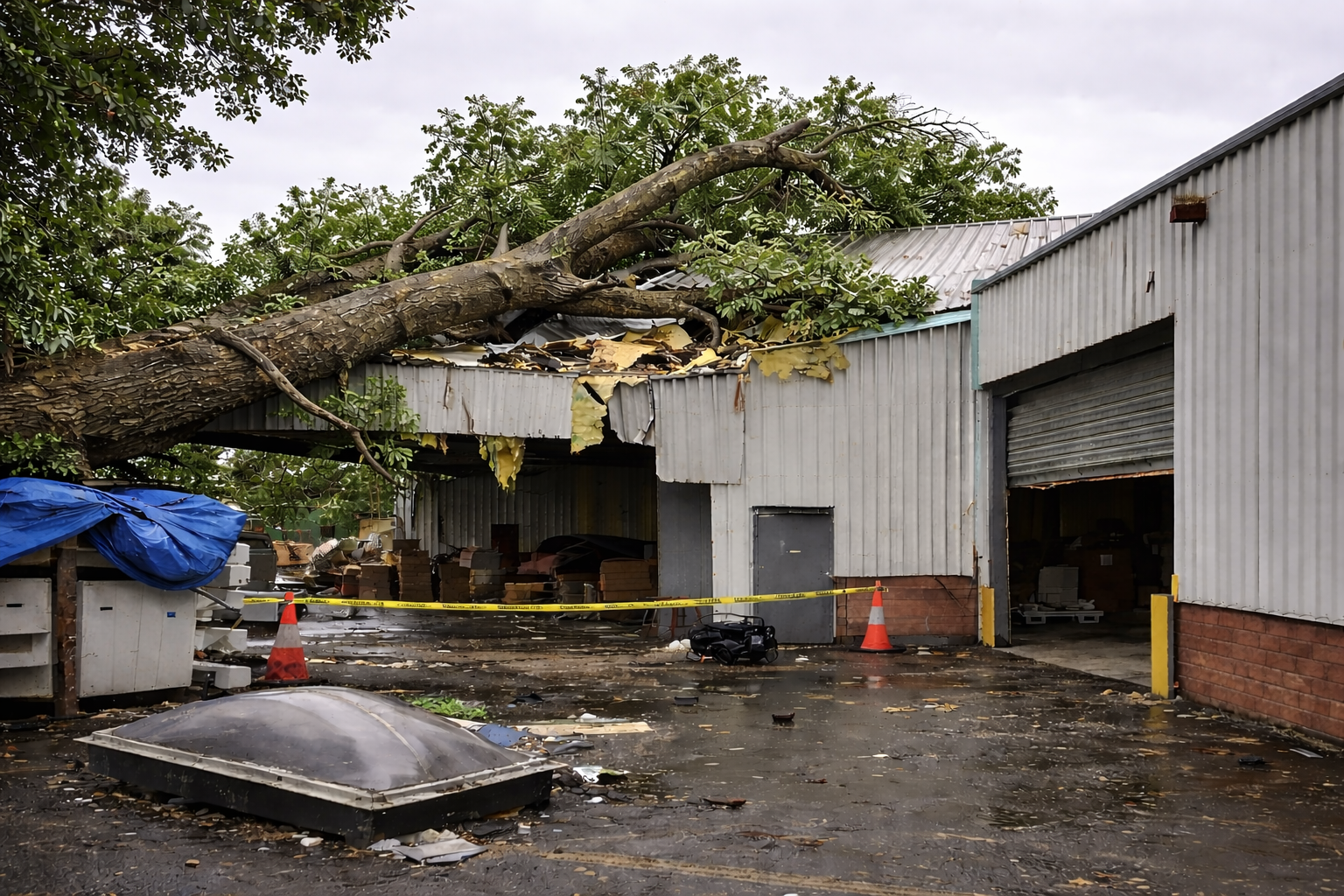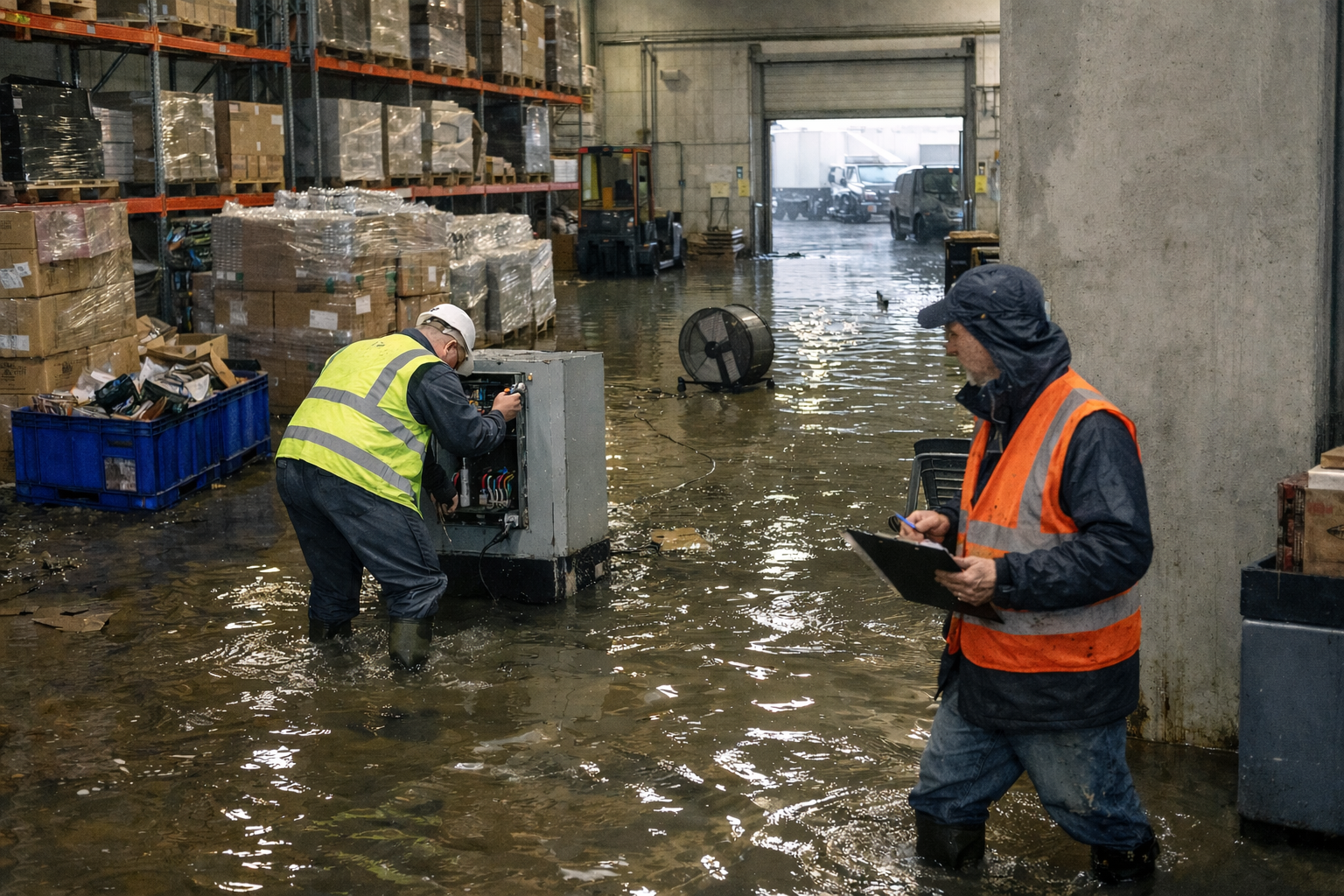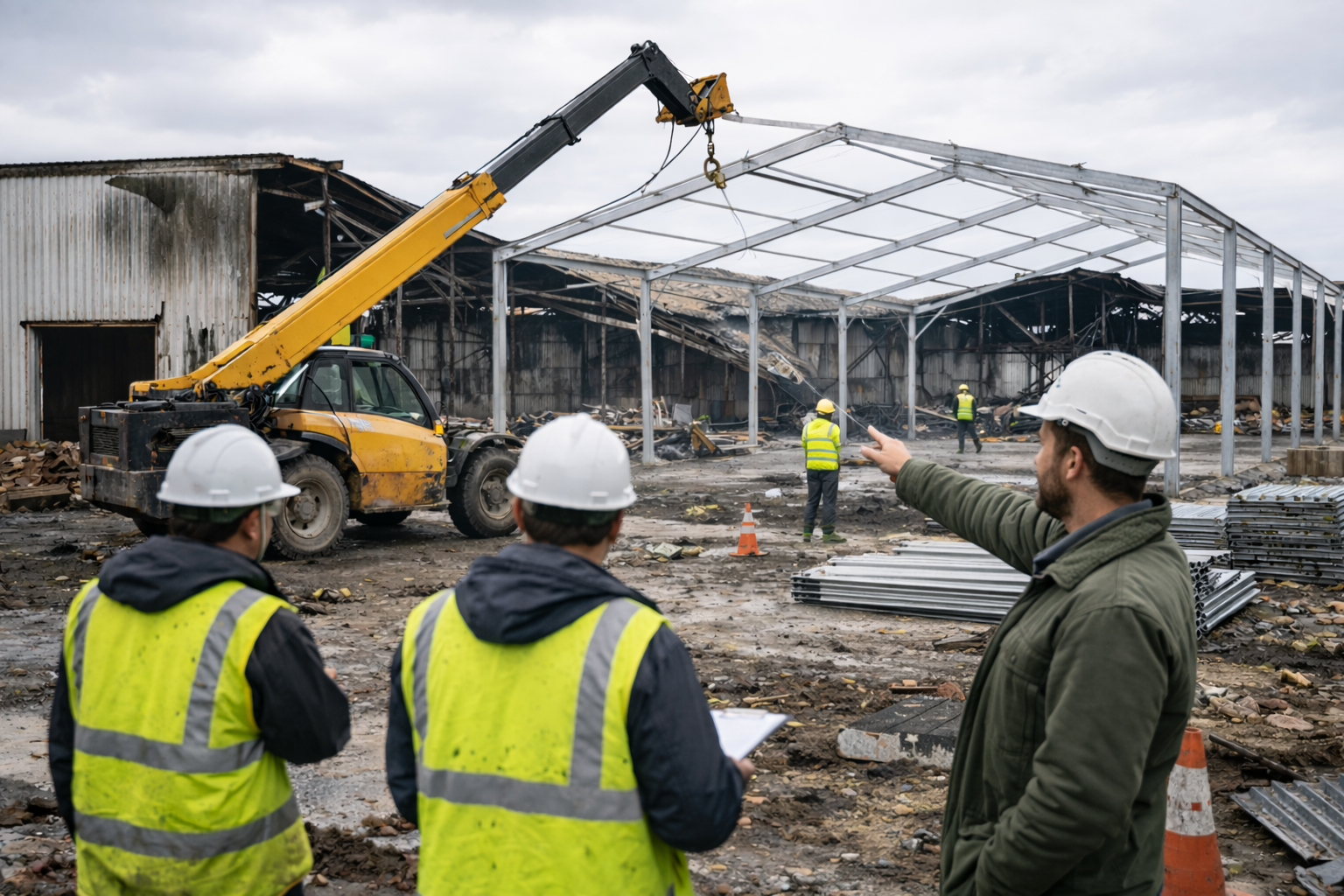
What to Do After a Commercial Fire – A Structured Recovery Approach
If your warehouse or commercial premises has been affected by fire, the immediate questions are practical. When will the site be safe to enter? How long will reinstatement take? How can operations continue in the meantime?
For warehouse operators in particular, the loss of covered storage and handling space can immediately disrupt stock management, distribution schedules and contractual obligations. Maintaining continuity quickly becomes the primary commercial concern.
Under UK fire safety legislation, the “Responsible Person” must assess and manage fire risk within commercial premises and ensure appropriate precautions are in place.
While prevention remains essential, structured recovery is equally important. ISO 22301, the international standard for business continuity management, defines continuity as the capability of an organisation to continue delivering products or services within acceptable timeframes during disruption.
This guide outlines what typically happens after a commercial fire, how the insurance and loss adjuster process progresses, and how temporary buildings can support operational continuity while permanent reinstatement is undertaken.
Recovery Priorities at a Glance
For decision-makers under operational pressure, the initial focus should be structured and sequential:
- Confirm site safety and secure the premises.
- Notify insurers and prepare supporting documentation.
- Understand the role of the loss adjuster and assessment timelines.
- Evaluate the likely duration of reinstatement works.
- Assess whether interim warehousing or temporary building solutions are required to maintain trading.
The sections below explore each of these in more detail:
- Immediate Actions Following a Warehouse or Commercial Premises Fire
- The Insurance and Assessment Process – What Happens Next?
- Operational Impact – How Long Could Your Premises Be Unusable?
- Temporary Buildings as Part of Business Continuity Planning
- Reducing Downtime – Early Engagement and Structured Recovery Planning
- Supporting Longer-Term Business Continuity Strategy
Immediate Actions Following a Warehouse or Commercial Premises Fire
The first phase after a commercial fire focuses on safety, containment and formal notification. Decisions made within the first few days will influence both insurance progression and operational timelines.
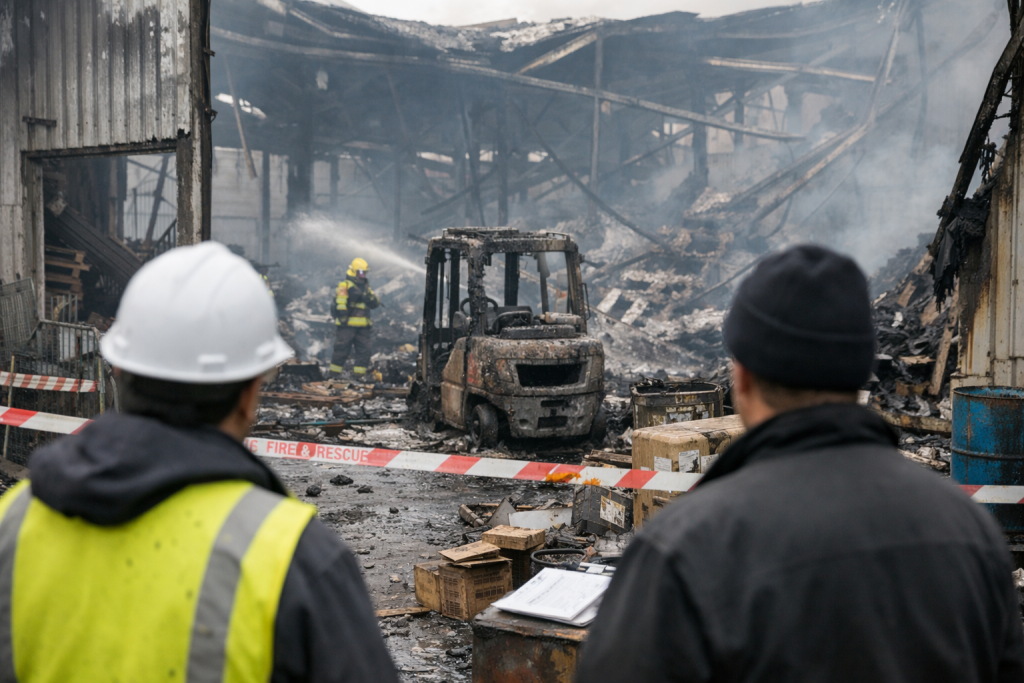
Ensuring Site Safety and Securing the Premises
Access to the site will remain restricted until fire services and structural assessments confirm it is safe. During this stage:
- Secure the perimeter.
- Prevent unauthorised access.
- Protect undamaged stock where possible.
- Document visible loss and structural impact.
Photographs, stock records and maintenance logs support a clearer claims process and reduce ambiguity later.
Notifying Insurers and Brokers
Insurers should be notified as soon as practicable. Early engagement enables appointment of a loss adjuster and establishes a structured claims pathway.
The Financial Conduct Authority has previously reviewed the handling of SME insurance claims, highlighting the importance of transparent communication and structured assessment during business interruption scenarios.
Understanding the Role of the Loss Adjuster
A loss adjuster acts on behalf of the insurer to assess damage, investigate cause and evaluate the claim.
The Chartered Institute of Loss Adjusters notes that adjusters coordinate investigation and quantify loss beyond administrative processing.
Insert external link on “Chartered Institute of Loss Adjusters” to:
Understanding this role helps warehouse operators plan realistically for programme length and site access constraints.
The Insurance and Assessment Process – What Happens Next?
After initial containment, formal surveys and scope definition begin. This stage often introduces uncertainty around how long premises may remain unusable.

Damage Surveys and Scope of Works
Structural engineers and contractors assess:
- Frame integrity
- Roof systems
- Services infrastructure
- Contamination and smoke damage
For warehouse environments, racking systems, floor slabs and mechanical handling equipment may also require review.
Business Interruption Considerations
Business interruption insurance is designed to address loss of income during operational disruption, subject to policy terms. However, insurance cannot replace the physical requirement for operational space.
The UK Government’s Business Continuity Management Toolkit recognises loss of premises as a core disruption scenario and emphasises the importance of defined alternative arrangements.
Realistic Reinstatement Timelines
Reinstatement of industrial premises often extends beyond initial assumptions. Structural repairs, procurement of materials, contractor availability and regulatory approvals all influence programme duration.
For warehouse buildings in particular, full reinstatement can take several months.
Operational Impact – How Long Could Your Premises Be Unusable?
Beyond the insurance process lies the operational question: how long can core warehousing, storage and distribution functions pause without commercial consequence?
For many UK commercial premises, particularly warehouse and distribution facilities, physical space is directly linked to revenue continuity. For distribution-led businesses, downtime quickly translates into contract pressure and revenue risk.
Warehouse and Storage DisruptionLoss of warehouse space directly affects:
- Stock holding capacity
- Picking and packing operations
- Loading bay functionality
- Supply chain continuity
Even partial damage can restrict safe access to racking systems and mechanical handling zones.
Manufacturing and Industrial Interruption
Where manufacturing and warehousing functions overlap, disruption may extend to production output and inbound materials management.
Office and Administrative Relocation
Administrative teams may relocate more readily, but operational coordination often depends on proximity to warehousing and logistics infrastructure.
Consider a regional distribution warehouse supplying multiple retail sites.
If structural repairs extend to six or nine months, supplier contracts continue and service expectations remain unchanged. Without interim warehousing capacity, trading may stall entirely.
Temporary Buildings as Part of Business Continuity Planning
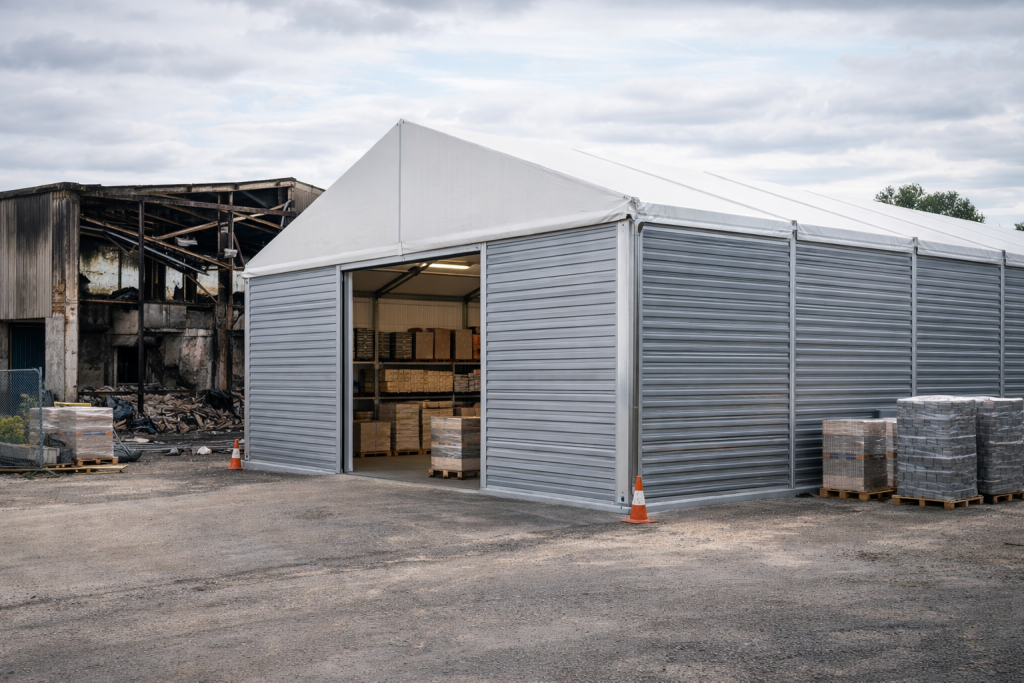
Where reinstatement timelines exceed acceptable downtime, interim spatial solutions become operationally necessary. Temporary buildings can provide covered, secure warehousing and industrial space while permanent works progress.
In many cases, a temporary warehouse after fire damage enables stock retention and distribution continuity while structural reinstatement is undertaken.
These are not lightweight event structures. Modern temporary warehouse buildings are engineered for commercial use, capable of supporting racking systems, goods handling operations and controlled access environments.
When Temporary Warehousing Is Appropriate
Temporary buildings may be appropriate where:
-
- Stock must remain on site.
- Distribution networks must continue.
- Storage capacity cannot be outsourced.
- Reinstatement exceeds short-term tolerance.
For some operators, securing emergency warehouse space is less about speed alone and more about maintaining contractual obligations and supply chain stability.
Coordination With Insurers and Project Teams
In insurance-backed recovery scenarios, temporary building provision requires coordination between insurers, loss adjusters, engineers and site management.
LM Structures works within this framework, providing site assessments, layout proposals and installation sequencing aligned with operational requirements and insurance processes.
LM Structures does not act as an insurance adviser or claims handler. However, where temporary buildings form part of a recovery strategy, technical information and specifications can be provided to support insurer discussions.
Planning and Regulatory Considerations
Planning requirements depend on site context, duration and intended use.
The Planning Portal confirms that temporary buildings may fall within permitted development in certain circumstances, subject to conditions.
Building Regulations considerations may also apply depending on use and duration.
LM Structures provides high-level regulatory awareness and supporting documentation but does not replace formal planning or building control consultation.
Reducing Downtime – Early Engagement and Structured Recovery Planning
Extended downtime is often the most significant commercial risk following a warehouse fire.
Engaging a temporary building provider early in the assessment phase allows:
- Site feasibility review
- Ground condition evaluation
- Services coordination planning
- Installation sequencing alongside clean-up works
Structured disaster recovery warehouse space planning ensures that interim solutions are aligned with reinstatement timelines rather than implemented reactively. Temporary buildings are not a substitute for permanent reinstatement. They operate as a continuity bridge – more flexible than traditional construction and more robust than short-term structures.
Supporting Longer-Term Business Continuity Strategy
A fire incident frequently prompts a broader resilience review.
If your organisation is reassessing continuity measures following warehouse or industrial disruption, you may wish to explore how temporary buildings for business continuity can form part of a structured response framework.
Where commercial or warehouse premises have been affected by fire damage, LM Structures can provide measured guidance on interim building solutions aligned with operational timelines.
Call 0333 358 4989 or email enquiries@lmstructures.co.uk
What to do after a commercial fire – FAQs
The following questions reflect common concerns raised by warehouse operators and facilities managers after a fire incident.
Yes, subject to regulatory considerations. Many temporary commercial buildings are installed for medium-term use during reinstatement works.
Planning requirements depend on location, duration and intended use. Consultation with the local planning authority is advisable.
A loss adjuster assesses damage, investigates cause and determines the insurer’s liability under the policy.
Timelines vary depending on structural impact and rebuild requirements. Full reinstatement may take several months.
Ensure the site is declared safe, secure the perimeter, document visible damage and notify your insurer without delay.