What to Do After a Warehouse Flood to Protect Operations
If your warehouse has flooded, the immediate concern is not simply water removal. It is how quickly operational control can be re-established before disruption becomes commercially damaging. As an Operations Director, you are likely managing multiple pressures at once: safeguarding staff, containing stock exposure, maintaining customer commitments, responding to insurer enquiries and reporting internally to senior leadership.
After a warehouse flood, the first priority is stabilising the site while assessing operational and infrastructure impact.
Flood damage in a warehouse environment rarely affects a single element in isolation. Electrical infrastructure, floor slabs, racking systems, dock interfaces, yard access and welfare facilities can all be compromised simultaneously.
Understanding what to do after a warehouse flood requires disciplined sequencing. Acting without structure risks secondary damage. Acting too slowly risks extended operational downtime. In many flood damage warehouse UK scenarios, the complexity arises not from the volume of water alone, but from the interaction between infrastructure systems and live operations.
This guidance sets out a structured framework for warehouse flood recovery in the UK, focused on stabilisation first, phased recovery second and continuity throughout.
Recovery Priorities at a Glance
- Establish controlled site access immediately
Restrict movement and assume electrical and contamination risk until verified otherwise. - Isolate utilities before inspection begins
Do not re-energise electrical systems, plant or dock equipment prematurely. - Document conditions before disturbance
Photographic and written records protect operational clarity and support insurer alignment. - Triage stock and infrastructure in defined zones
Segregate confirmed loss, recoverable stock and unaffected inventory to prevent escalation. - Prioritise core throughput over full reinstatement
Restore limited dispatch capability before pursuing complete recovery. - Model drying and remediation timelines realistically
Programme optimism often extends disruption rather than shortening it. - Assess whether interim infrastructure is required
Where reinstatement exceeds operational tolerance, alternative space may be necessary.
Flood recovery in industrial environments is rarely linear. Structured decision-making reduces secondary disruption.
Explore the sections below for more detailed information:
Immediate Site Control and Risk Stabilisation
The first hours following a flood set the direction for the entire recovery programme.
Before clean-up teams mobilise, before stock is moved, before equipment is restarted, operational control must be established. Floodwater introduces instability into what is normally a controlled industrial environment. Even shallow ingress can compromise floor surfaces, destabilise pallet loads, affect dock leveller pits and create slip hazards.
Access should be restricted to essential personnel only. Movement through the building should be deliberate and, where necessary, logged. Well-intentioned internal activity can spread contamination, disturb evidence of impact or reactivate compromised systems.
Secondary loss frequently occurs during uncontrolled clean-up. For example, relocating unaffected stock through contaminated zones may escalate exposure unnecessarily. Similarly, allowing forklift traffic across saturated slabs may create surface damage that extends drying and repair timelines.
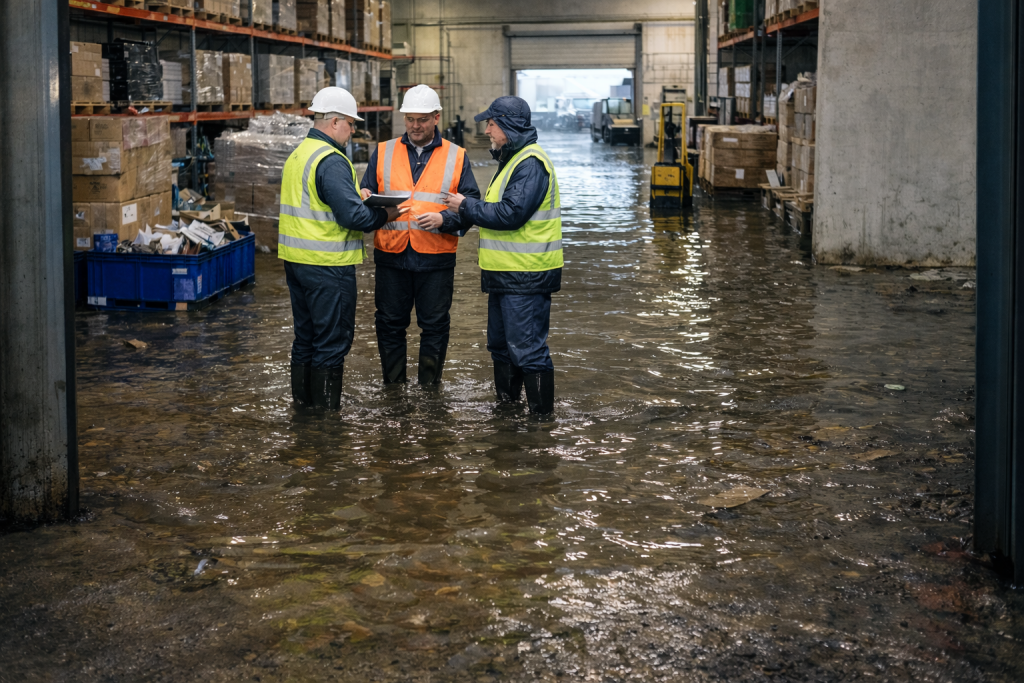
Floodwater should be treated as potentially contaminated until assessment confirms otherwise. UK Government business flood planning guidance advises caution when re-entering flooded premises, particularly where utilities or drainage systems may have been affected.
During this phase, the focus should be on preventing injury, containing damage, preserving evidence and establishing structured sequencing. These are the first essential industrial flood recovery steps in any controlled response.
Stabilisation is not passive. It is controlled containment.
Electrical Systems, Utilities and Contamination Exposure
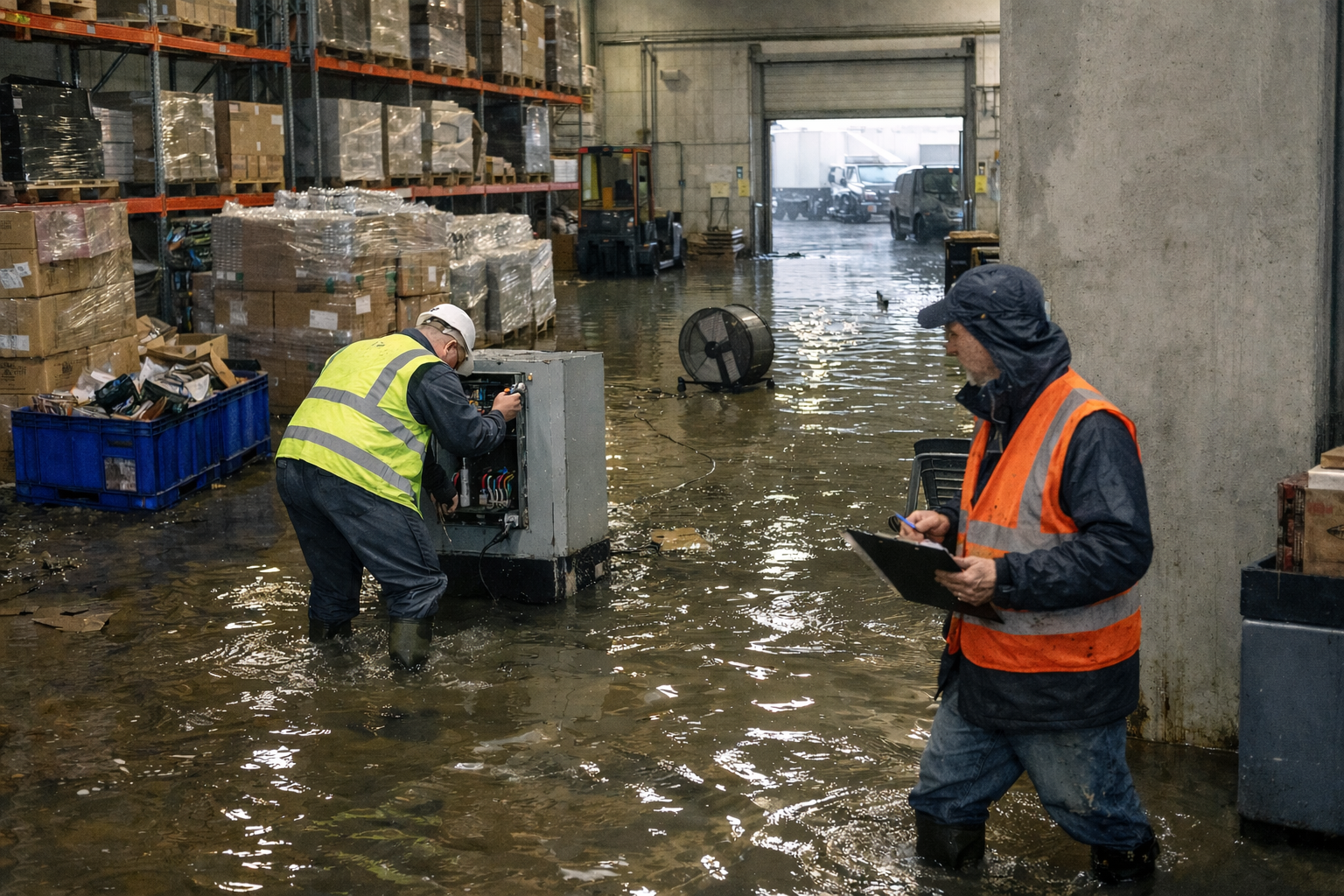
Electrical infrastructure is frequently one of the most sensitive components affected by flood damage in a warehouse.
Systems at particular risk include low-level distribution boards, conveyor control panels, forklift charging stations, dock leveller control units, fire alarm interfaces and security access control systems.
Electrical Safety First flooding advice states that flooded electrical installations should not be re-energised until they have been inspected and deemed safe.
It is important to recognise that systems may appear visually dry while retaining internal moisture. Control panels and junction points can trap water even after surface drying has begun. Recommissioning should therefore follow inspection, not visual assessment alone.
Utilities coordination often becomes a programme bottleneck. Electrical contractors, fire alarm specialists and dock equipment engineers may require phased access to the site. Their availability can materially influence the warehouse flood recovery timeline.
Contamination exposure must also be addressed early. UK public health guidance advises that floodwater may contain sewage, chemical residues and biological contaminants. Hygiene planning should be integrated into early recovery sequencing rather than deferred. Segregating contaminated zones prevents cross-exposure and protects salvageable stock.
At this stage, the priority is not speed. It is controlled verification before recommissioning.
Structural Impact: Slabs, Drainage and Building Fabric
Flood events often affect structural components beyond visible water removal.
Concrete slabs retain moisture. Even after standing water has been removed, sub-surface saturation can persist. In high-bay warehouses, airflow patterns may dry upper areas faster than floor level, creating the illusion of recovery while moisture remains trapped within the slab. Extended saturation can affect surface integrity, expansion joints, sub-surface insulation layers, dock leveller pits and drainage channels.
Where insulated slabs are present, drying programmes may be prolonged. Moisture trapped beneath floor finishes can delay recommissioning of forklift traffic.
Attempting to accelerate drying through uncontrolled heating can introduce secondary stresses within the slab.
Drainage systems should also be inspected carefully. Backflow or blockage may have contributed to the flood event. If not addressed, residual drainage issues can reintroduce water ingress during subsequent rainfall.
For Operations Directors, slab readiness often determines when full load-bearing activity can safely resume.
Racking, Load Distribution and Forklift Operations
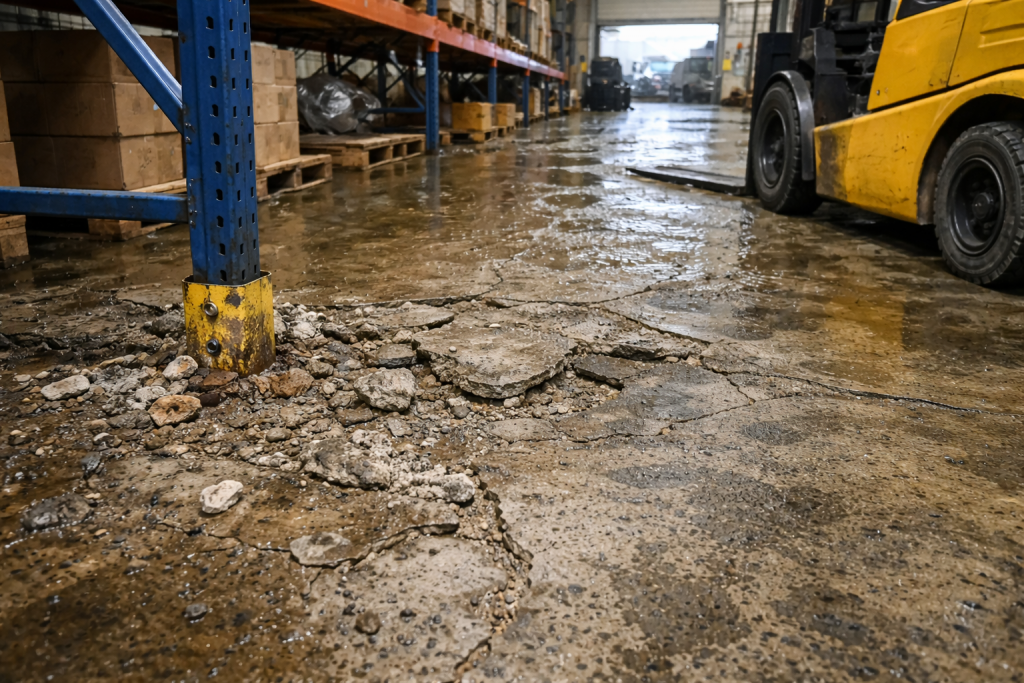
Racking systems are typically anchored directly into the floor slab. Where floodwater reached baseplates or anchor bolts, structured review may be appropriate before recommissioning.
Risks include anchor instability due to slab softening, corrosion exposure at base connections, altered load distribution and increased dynamic loading from forklift traffic. While racking may appear intact, the interface between upright and slab is critical. Reintroducing full pallet loads without staged assessment can introduce avoidable exposure.
Forklift operations require particular care. Operating heavy plant across partially dried slabs may increase surface stress and prolong recovery. In some cases, staged reopening of warehouse zones may be advisable, allowing unaffected areas to operate while others continue drying.
Warehouse flood recovery is not only about restoring storage capacity; it is about ensuring that load-bearing systems remain reliable under operational conditions.
Stock Triage and Commercial Exposure Management
Inventory management following a flood is commercially sensitive.
Stock should be segregated into clearly defined categories: confirmed loss, potentially recoverable and unaffected.
Preventing cross-contamination is essential. Relocating unaffected goods through contaminated zones can escalate exposure unnecessarily.
Where floodwater reached pallet height, packaging integrity must be assessed carefully. In sectors such as food-grade warehousing or pharmaceuticals, even minor exposure may require batch-level review.
Cold chain environments present additional complexity. Power interruption during the flood event may compromise temperature control. Temperature logs should be reviewed alongside physical inspection.
Throughput modelling should begin during triage rather than after. Consider high-priority SKUs, contractually critical deliveries, margin-sensitive stock and third-party logistics commitments.
There is often internal pressure to accelerate write-off decisions in order to move forward. However, premature disposal may increase financial exposure. Structured inspection and segregation help preserve salvageable inventory.
Clear zoning within the warehouse supports hygiene management and operational clarity.
Documenting Flood Damage in a UK Industrial Context
Comprehensive documentation should occur before major disturbance.
Record maximum water depth, affected floor areas, racking exposure, equipment status, electrical isolation timing and drying programme initiation. UK Government guidance on business flood planning emphasises structured documentation during incidents.
LM Structures does not provide insurance consultancy or claims handling. However, clear documentation supports effective engagement with insurers and loss adjusters where applicable.
Documentation is a risk management tool, not an administrative exercise.
Phased Operational Recovery and Throughput Strategy
Full reinstatement rarely aligns with initial expectations. Instead, adopt phased sequencing.
Stabilise unaffected zones. Establish limited dispatch capability from dry areas. Reintroduce storage and operational zones sequentially as slab moisture levels reduce and electrical systems are verified.
Throughput modelling should assess labour reallocation, shift pattern adjustments, temporary workflow redesign and external overflow support.
Business continuity frameworks emphasise restoring critical functions first. See the UK Cabinet Office Business Continuity Management Toolkit
For Operations Directors, the key question is often not “When will we be fully operational?” but “What minimum throughput must we protect this week?”
That shift in focus supports disciplined recovery.
Yard Flow, Dock Interfaces and Logistics Pressure Points
Flood recovery extends beyond the warehouse interior.
Yard circulation may be compromised by standing water, softened ground and blocked drainage.
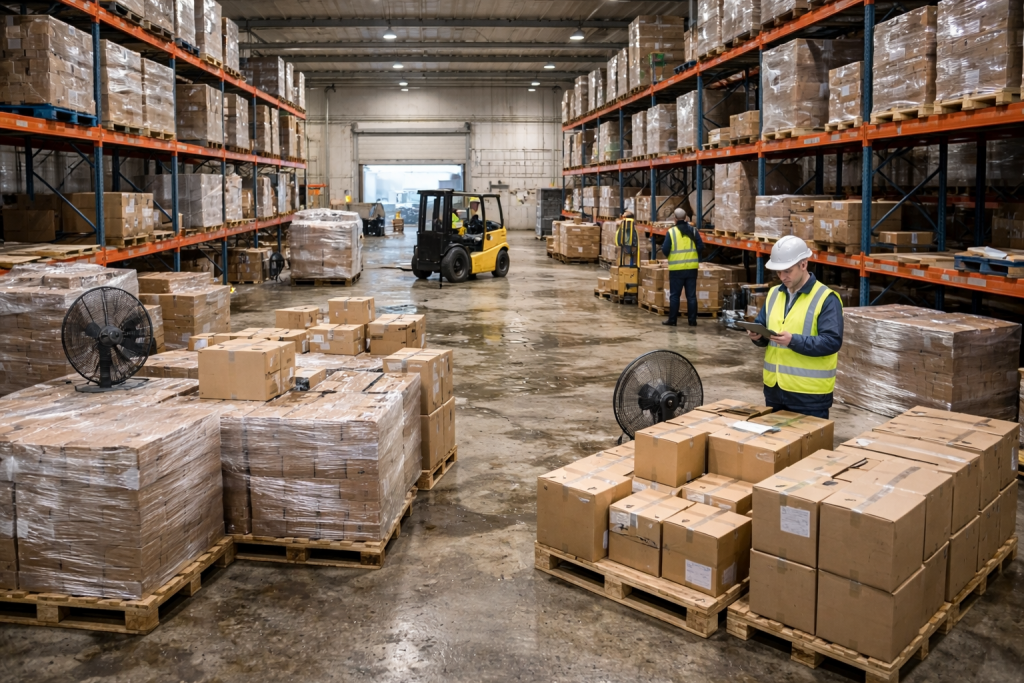
Dock levellers often become bottlenecks. Even where internal storage areas are functional, compromised dock controls can restrict outbound dispatch.
Assess which docks remain operational, whether temporary loading arrangements are viable and whether delivery windows require redistribution.
Backlog accumulation can escalate quickly once outbound flow slows.
Protecting throughput requires coordination across storage, dispatch and yard operations simultaneously.
Programme Risk, Drying Timelines and Reinstatement Sequencing
Programme assumptions made in the first 48 hours often prove optimistic.
Drying timelines depend on water depth, slab construction, contamination severity and specialist contractor availability.
Even where visible water has been removed, slab moisture content can delay full load-bearing activity.
Insurance inspection sequencing can influence reinstatement pace. While LM Structures does not advise on claims processes, approval pathways may not align perfectly with operational urgency.
Warehouse flood recovery timelines should therefore be modelled conservatively.
Structured planning reduces repeated disruption.
When Temporary Infrastructure Becomes Operationally Necessary
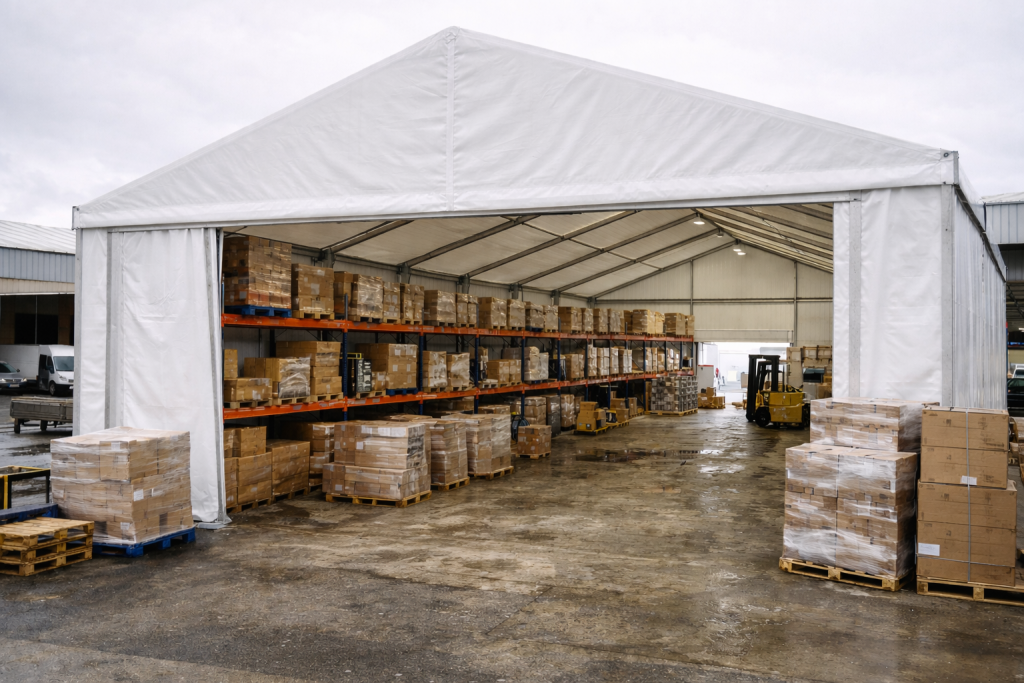
Temporary buildings are not required in every scenario. However, a temporary warehouse after a flood may become necessary where reinstatement exceeds acceptable operational tolerance.
Temporary infrastructure forms part of structured business continuity planning particularly where permanent reinstatement extends beyond acceptable thresholds.
Further sequencing detail can be found within the warehouse flood recovery timeline.
Temporary infrastructure should mitigate operational disruption after flood without introducing unnecessary complexity.
Regulatory and Compliance Considerations
Flood recovery intersects with Health & Safety reassessment, electrical certification, fire detection recommissioning, CDM awareness and waste disposal routing.
Planning considerations may apply to temporary structures depending on configuration and duration.
Compliance should be addressed early in the programme. Regulatory delay can extend recovery more than drying programmes.
Maintaining Operational Control During Recovery
Flood damage introduces operational uncertainty.
The objective is structured stabilisation that protects people, assets and throughput while permanent reinstatement progresses.
Warehouse flood recovery demands disciplined sequencing, programme realism and infrastructure awareness.
Temporary buildings are not a default reaction. However, where operational disruption after flood damage exceeds acceptable limits, they provide structured continuity support aligned to site realities and commercial constraints.
Restoring operational control requires measured decision-making rather than reactive acceleration.
Maintaining Warehouse Operations During Flood Recovery
In some cases, flood damage can leave warehouse facilities partially or fully unusable for weeks while remediation, safety checks and infrastructure repairs take place.
During this period, maintaining storage, distribution and fulfilment capacity often becomes the immediate operational priority. Temporary infrastructure can provide a practical way to stabilise operations while permanent repairs are completed. Businesses experiencing operational disruption after flood may find that reviewing their business continuity planning helps identify whether a temporary warehouse after flood could support logistics continuity during the recovery period.
Contact us for more information 0333 358 4989 or enquiries@lmstructures.co.uk
What to do after warehouse flood – FAQs
Floodwater can compromise detection and alarm interfaces. Inspection and certification may be required before recommissioning.
Partial trading may be possible through phased zoning and controlled dispatch from unaffected areas. Full throughput restoration typically requires staged sequencing.
Insurance policies differ. Temporary infrastructure may be considered where it demonstrably mitigates business interruption, but approval pathways vary.
Operating forklifts on saturated slabs may compromise surface integrity and load-bearing stability. Moisture verification may be advisable before full recommissioning.
Timelines vary significantly. Slab drying alone may require several weeks depending on depth and construction. Electrical and fire system recommissioning may extend this further.