How Can Construction Sites Keep Work Moving in Bad Weather?
When rain, wind or winter conditions repeatedly stop one part of a construction programme, the issue is no longer simply that the site is exposed to bad weather. The question is whether one defined activity has become unreliable enough to justify intervention.
In Short
Temporary weather protection is most useful when recurring weather is materially disrupting a specific programme-critical activity rather than the site generally. Before adding cover, establish what is being interrupted, consider whether an operational alternative would work, and define how any protected area must accommodate access, plant, drainage, clearances and changing site conditions.
Weather-Protection Priorities at a Glance
- Protect a defined operation rather than trying to weatherproof the whole construction site.
- Establish the programme consequence before deciding that physical protection is justified.
- Consider resequencing, rescheduling, relocation, storage improvements or delivery changes before specifying a structure.
- Define the working footprint around people, materials, equipment and plant, not simply the area exposed to rain.
- Test any protected work zone against access, drainage, wind exposure and future phases of the project.
Table of Contents
When Does Bad Weather Become an Operational Problem Rather Than an Inconvenience?
Bad weather is part of managing a construction programme in the UK. A period of rain, a windy day or a short spell of difficult winter conditions does not automatically mean that a project needs additional physical protection. Construction programmes already have to accommodate a degree of weather variability, and many short interruptions can be managed through sequencing, temporary changes to activity or ordinary site controls.
The decision begins to change when the same operation becomes unreliable repeatedly.
For example, a preparation area may remain usable in light rain but regularly have to stop during heavier periods. An exposed assembly process may lose productive time each time materials, tools or partially completed work need to be moved. A specialist trade may repeatedly wait for a working area to become usable again before it can continue.
At that point, the useful question is not simply:
How bad is the weather?
It is:
What is the weather preventing us from doing reliably, and what happens elsewhere in the programme each time that activity stops?
That distinction is central to assessing construction site weather protection properly.
Look for repetition, not isolated disruption
One interruption may be inconvenient without being commercially significant. Repeated interruptions can behave differently because the effects accumulate.
A Project Manager or Site Manager should therefore look at the pattern surrounding the affected activity. Relevant questions include:
- How often is the work stopping?
- How long does it take before the area can be used productively again?
- Does the activity have to be restarted, reset or reorganised after each interruption?
- Are labour or plant being moved elsewhere?
- Are dependent activities having to wait?
- Are deliveries or material movements being changed around the disruption?
- Is programme contingency being consumed?
This does not require the project team to create an artificial numerical threshold. There is no universal point at which a certain number of wet days automatically makes a temporary canopy commercially worthwhile.
The significance depends on what is being disrupted.
An exposed activity with substantial float may tolerate repeated interruptions without materially affecting the wider project. A relatively short task may be much more important if several later trades depend on its completion.
The assessment therefore needs to connect frequency with consequence.
The programme consequence matters more than the weather event itself
A short interruption can have a disproportionate operational effect if the activity sits on or close to a critical sequence.
Consider a preparation process that needs to be completed before installation can begin. Rain stops the preparation work. The installation team cannot start as planned. Plant booked for the next stage is no longer required at the expected time, and a delivery may need to be moved.
The commercial issue is not simply the duration of the rain.
It is the chain of operational adjustments that follows.
That may include inefficient labour deployment, altered delivery timing, plant rescheduling or pressure on later programme milestones. Those consequences should be assessed realistically rather than exaggerated. Temporary protection cannot guarantee that delays will be avoided, because weather is only one of many variables affecting a live construction programme.
What targeted protection may be able to do is remove one recurring operational variable where that variable has become materially important.
Programme pressure often develops gradually
The requirement for a protected work area may not begin as an urgent one.
An exposed activity may have been expected to last for only a short phase. Poorer weather then persists. The programme changes. A preceding package takes longer than expected. The exposed work moves further into autumn or winter. Float that initially made interruption manageable starts to reduce.
The same weather event can therefore have a different significance at different points in the programme.
Early in the project, losing a working area for several hours may be absorbed through resequencing. Later, when downstream activities are waiting and programme contingency is smaller, repeated interruptions may be much harder to accommodate.
That is why the decision should be reviewed against the current programme rather than based on the assumptions made when the activity first began.
Safety requirements and commercial continuity are related, but they are not the same decision
Weather also has a legitimate health-and-safety context.
The HSE guidance on managing health and safety in construction explains the CDM 2015 requirements relating to stability and, where necessary for health or safety, protection from adverse weather.
That regulatory context should not be interpreted as meaning that every exposed activity needs a temporary building or canopy. The commercial decision addressed here is narrower: whether recurring weather exposure is making one operation sufficiently unreliable that creating a protected working environment is justified.
The two considerations can overlap, but they should not be blurred.
The project team remains responsible for its own health-and-safety and temporary-works arrangements. LM Structures’ role is not to determine whether the project is legally compliant, but to help define and deliver suitable temporary space where a genuine operational requirement has been established.
A useful intervention threshold
A practical threshold is reached when three conditions start to align:
- the same defined activity is being disrupted repeatedly;
- those interruptions are having a meaningful operational or programme consequence; and
- ordinary programme controls are no longer resolving the problem satisfactorily.
That does not yet mean physical protection is automatically the right solution.
It means the problem is now defined well enough to investigate.
The next step is to identify exactly which activity is being affected, because different weather problems lead to very different solutions.
Which Construction Activity Is Actually Being Disrupted?
“Protect the site from the weather” is too broad to be a useful requirement.
A construction site may contain dozens of exposed activities operating under different conditions at the same time. Some may tolerate rain or wind with ordinary controls. Others may need to stop temporarily. One particular process may be repeatedly disrupted even while the rest of the project continues normally.
Before considering a temporary covered work area for a construction site, the project team therefore needs to isolate the operation that is actually creating the programme problem.
Define the activity, not the general area
Start by describing what needs to happen in the affected space.
It might be:
- an active construction process;
- component preparation;
- assembly work;
- a specialist trade operation;
- short-term staging before installation;
- an equipment-sensitive process;
- material preparation;
- material transfer;
- inspection or testing;
- a temporary production or fabrication activity.
The definition should be specific enough that another person could understand what must continue when the weather deteriorates.
For example:
“We need an eight-person preparation team to cut, assemble and stage components before they move to the installation area.”
is much more useful than:
“We need to cover this part of the site.”
The first statement begins to define people, workflow, materials, space and movement. The second only identifies a location.
This distinction becomes important later when determining the protected footprint. A weather-protected work zone has to support the operation that takes place beneath it, not simply keep rain off a patch of ground.
Separate active work from material storage
One of the easiest ways for this decision to become confused is to treat all material exposure as the same problem.
There is an important distinction between materials being exposed while work is being carried out on or around them and materials simply being kept on site awaiting use.
If components need to remain dry while they are being prepared, assembled, processed or moved through an active work sequence, that can form part of the weather-protection decision.
If the main concern is that materials are becoming wet while sitting in storage, the problem is different. In that situation, temporary storage for construction sites provides the more relevant decision pathway.
This distinction prevents a project from designing an oversized working environment when the actual requirement is better storage control.
Separate active work from the loading interface
The same principle applies to unloading.
A team may initially describe the problem as “weather affecting material handling”, but closer examination might show that the active construction process is working adequately and the real disruption occurs when vehicles arrive.
For example:
- loads cannot be unloaded efficiently during heavy rain;
- a forklift transfer route is exposed;
- materials get wet between the vehicle and temporary storage;
- vehicle movements are being delayed while conditions improve.
That is primarily a logistics and unloading problem rather than a protected-working-area problem.
Where the weather issue is centred on the delivery interface, the more specific framework is what a covered loading area on a construction site should include.
Identify everything the activity depends on
Once the activity is clear, consider what it needs in order to function.
That may include:
People
How many people work in the area at the same time? Do they need circulation space around the task?
Materials
Are materials brought into the work zone continuously, periodically or in batches? Do they need short-term staging before or after processing?
Tools and equipment
Are fixed benches, powered equipment or specialist tools required?
Plant
Does a forklift, telehandler or other plant need to enter or operate close to the working area?
Movement
How do finished components leave the space? Where do incoming materials enter?
Clearance
Does the activity require height above the immediate working level, lifting clearance or room around larger components?
These questions are deliberately operational.
The project does not yet need to decide what structure it wants. It needs to define how the operation works when it is working properly.
That is what allows the eventual protected environment to be assessed against a real requirement rather than an assumed building size.
Look at the process before deciding where the structure goes
The current location of an affected activity may not necessarily be the best place to protect it.
If the operation could move temporarily into an existing covered area without disrupting something else, relocation may be simpler than introducing new infrastructure.
Similarly, an activity occupying a large external footprint may actually contain only one weather-sensitive stage. Protecting that particular stage could require far less space than covering the whole process.
For example, a fabrication sequence might involve:
- materials arriving externally;
- preparation at a bench;
- assembly;
- short-term staging;
- movement to the permanent works.
If only preparation and assembly are weather-sensitive, the requirement should be built around those stages rather than automatically enclosing the entire sequence.
This is where the diagnostic approach begins to reduce unnecessary complexity.
The better the activity definition, the better the eventual solution
By the end of this stage, the project team should be able to complete a sentence such as:
“Weather is repeatedly interrupting this specific operation, involving these people, materials and items of equipment, in this part of the process.”
If that cannot yet be stated clearly, it is too early to specify temporary construction cover.
Once the activity has been defined, the next question is whether its disruption is sufficiently important to the programme to justify further intervention.
How Much Programme Impact Is the Weather Causing?
An activity can be disrupted frequently without being programme-critical.
Equally, an activity that only stops occasionally may carry significant consequences if other work depends on it.
The purpose of assessing programme impact is therefore not to create a theoretical cost for every hour of rain. It is to understand whether weather disruption is materially affecting the way the project is being delivered.
Start with what happens when the activity stops
Consider the immediate response each time poor weather makes the area unusable.
Do workers:
- wait for conditions to improve;
- move to another productive task;
- leave the area entirely;
- protect or move materials;
- dismantle temporary arrangements;
- return later and restart the work?
Does plant remain idle or move elsewhere? Do materials need to be relocated? Does the work area require preparation before activity can resume?
The recovery period can matter almost as much as the weather interruption itself.
A 30-minute rain event does not necessarily represent only 30 minutes of lost productive time if the operation also needs to be stopped safely, materials moved, the area checked and the process restarted afterwards.
That does not justify attaching a standard cost or productivity percentage to the disruption. It does mean that the project should assess the full operational consequence rather than only the duration of the weather event.
Identify dependent work
The next question is:
What cannot happen until this activity is complete?
This is where a relatively small exposed working area can become commercially significant.
An interrupted operation may affect:
- the next trade in the sequence;
- a planned installation;
- booked plant;
- scheduled deliveries;
- access required by another contractor;
- testing or inspection;
- release of another work area;
- programme milestone.
If nothing else depends on the work immediately, repeated disruption may remain manageable.
If several activities depend on it, the same level of weather interruption may justify much closer attention.
The assessment should therefore follow the programme downstream.
Consider whether labour remains productive
Weather-related labour inefficiency should be treated carefully.
It would be misleading to assume that everyone affected by an interruption becomes entirely unproductive. On a well-managed project, people may be moved to another task or work may be resequenced.
The more useful question is whether suitable alternative productive work consistently exists.
If the answer is yes, the commercial consequence of weather interruption may remain limited.
If the same team repeatedly has to wait, relocate, stop and restart because no useful alternative work is available, the operational case for intervention becomes stronger.
Again, this should remain qualitative unless the project has its own reliable cost and productivity data.
Check whether programme contingency is being consumed
Weather risk may already have been allowed for within the programme.
The existence of some weather disruption does not therefore mean the original plan was inadequate or that physical protection is required.
What matters is whether the pattern of disruption is beginning to exceed the project’s ability to absorb it.
Warning signs may include:
- an activity remaining exposed for longer than originally planned;
- float reducing;
- later trades moving closer to the affected work;
- seasonal conditions worsening;
- repeated attempts to resequence producing diminishing options;
- completion of the activity becoming increasingly important to later packages.
- This is where the timing of the decision matters.
A project that identifies the pattern while several alternatives remain available has more flexibility than one that waits until the activity is already driving immediate downstream delay.
Early assessment does not mean early procurement. It means recognising that the weather problem has become a programme-management question while there is still time to compare responses properly.
Weather evidence can support planning, but it cannot make the decision for you
Forecast information is useful when considering whether work can be moved into a more favourable period.
The Met Office infrastructure weather and climate guidance explains how weather information can support project planning, resource management and construction operations.
That can make forecast-informed rescheduling a legitimate alternative to physical protection in some situations.
But forecasting has limits.
If the affected operation must remain active over several weeks or months, the project may still face repeated exposure even when individual periods of poor weather can be anticipated.
The question therefore remains operational rather than meteorological:
Can the programme manage around the weather reliably, or has weather become a recurring constraint on this activity?
Do not confuse programme significance with contractual entitlement
Adverse weather can also have contractual implications on construction projects, and the Met Office provides a specific Downtime Report for weather delays in construction to support assessment of weather conditions against relevant contract mechanisms.
That is useful context, but it is not the purpose of this article.
Whether weather justifies an extension of time, compensation or another contractual remedy depends on the relevant contract and project circumstances. LM Structures does not assess contractual entitlement.
The decision here is narrower:
Is recurring weather disruption creating enough operational consequence that the project should consider changing how this activity is protected or organised?
A practical programme-impact test
Before progressing to physical protection, the project team should be able to answer four questions clearly:
- How often is this activity being interrupted?
- What happens operationally each time it stops?
- Which dependent activities, people, plant or deliveries are affected?
- Can the programme continue to absorb the disruption without creating unacceptable pressure elsewhere?
If the answer to the fourth question is still yes, physical protection may not be necessary.
If the answer is increasingly no, then the project has reached the point where alternative interventions should be compared properly.
That is the next stage of the decision: determining whether temporary physical protection is actually the right response, or whether the problem can still be solved more simply through programme adjustment, relocation, storage changes or delivery planning.
Is Temporary Physical Protection the Right Intervention?
Once recurring weather disruption is materially affecting a defined activity, the next question is not immediately what structure should we install?
It is:
Can the problem be resolved more simply without introducing new temporary infrastructure?
That question matters because physical protection adds its own requirements. It occupies space, needs access for installation, has to coexist with plant and traffic, affects drainage, and may need to remain useful as the project changes.
A temporary covered work area is therefore most credible when it solves a problem that cannot be managed satisfactorily through simpler operational changes.
Can the activity be rescheduled?
If the affected task is short and there is sufficient programme flexibility, moving it into a more favourable weather window may be the simplest option.
That approach is most realistic where:
- the activity is relatively brief;
- there is usable programme float;
- downstream trades are not immediately dependent on completion;
- labour and plant can be reassigned productively;
- postponement does not create a more difficult constraint later.
The limitation is that repeated rescheduling can eventually move rather than solve the problem.
An exposed activity initially expected to finish in early autumn, for example, may become harder to deliver if repeated postponement pushes it further into poorer seasonal conditions.
The project therefore needs to consider not only whether the work can move, but whether moving it improves the overall programme position.
Can the sequence change?
Resequencing can be effective where another activity can genuinely progress in the meantime.
The key word is genuinely.
Moving people to lower-priority tasks may keep them occupied without necessarily protecting the wider programme. If the disrupted activity continues to block several dependent packages, repeated resequencing may eventually exhaust the available alternatives.
A useful test is:
Does resequencing remove the programme constraint, or simply postpone the point at which it has to be resolved?
If another sequence gives the project meaningful flexibility, temporary protection may be unnecessary.
If the affected operation remains a persistent dependency, physical protection becomes more relevant.
Could the activity move into existing covered space?
Relocation may be preferable where suitable space already exists on or near the site.
That could include an existing building, another temporary facility or a covered area that can accommodate the activity without compromising its current function.
However, relocation needs to be assessed operationally.
Moving a process can create:
- longer material movements;
- additional forklift journeys;
- increased handling;
- conflict with existing users;
- separation between related activities;
- new pedestrian or vehicle interfaces.
The fact that covered space exists does not automatically mean it is operationally suitable.
The question is whether the activity can be moved without transferring the disruption somewhere else.
Is storage actually the underlying problem?
Sometimes weather appears to be interrupting work when the underlying weakness is how materials are being protected before use.
If materials arrive wet, need repeated covering and uncovering, or cannot be prepared because they have been stored in unsuitable conditions, improving storage may solve the issue without creating a new work enclosure.
The distinction remains:
stored material exposure → storage problem;
weather interrupting active preparation, processing or assembly → potential protected-work-zone problem.
Keeping that distinction clear prevents unnecessary over-specification.
Is the problem actually at the delivery interface?
The same diagnostic approach applies to deliveries.
If an active process is operating reliably once materials reach it, but weather repeatedly affects unloading or transfer from vehicles, a covered loading solution may be more appropriate than enclosing the working area.
This is why weather protection should always be specified around the exact point of operational failure.
When temporary protection becomes the stronger option
Physical protection becomes more credible when several conditions align:
- the same activity is being interrupted repeatedly;
- the activity has meaningful programme consequences;
- reasonable resequencing or rescheduling options are limited;
- suitable existing covered space is unavailable;
- storage or unloading is not the primary problem;
- the activity can physically be protected without creating unacceptable site conflicts;
- the likely duration makes repeated operational workarounds increasingly inefficient.
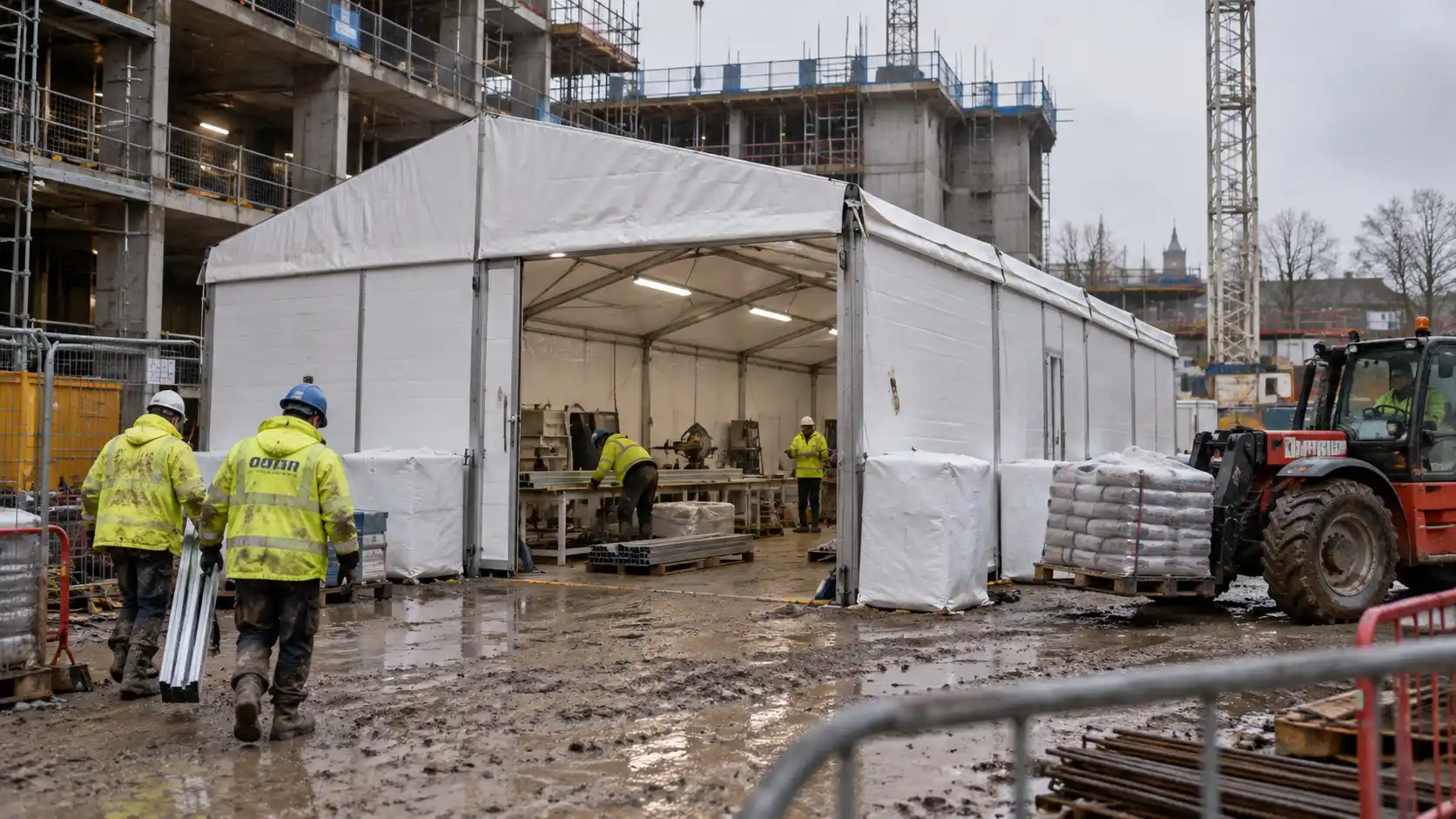
At this stage, covered work zones designed around active construction-site constraints (Temporary Buildings for Construction & Infrastructure) provide the relevant solution pathway.
That does not mean the project should start by choosing a canopy size.
The next task is to define what the protected environment actually has to support.
Defining the Protected Work Zone Around the Activity
A protected work zone should be sized around the operation, not simply around the item being kept dry.
That distinction sounds straightforward, but it has significant consequences for specification.
If a team needs to assemble a component measuring six metres by three metres, for example, a six-by-three-metre roof does not necessarily provide a usable six-by-three-metre working environment.
The process may also require:
- people around multiple sides;
- benches or equipment;
- staging areas;
- material preparation;
- forklift access;
- temporary storage of work in progress;
- safe circulation;
- clearance for lifting or handling;
- entry and exit routes.
The useful operational footprint can therefore be substantially different from the object’s physical footprint.
People
Start with the people performing the work.
Consider:
how many people occupy the space concurrently;
whether they remain in fixed positions or move around the task;
whether two trades may use the area at different times;
whether supervision or inspection requires additional access;
whether people need to pass behind equipment or materials safely.
The aim is not simply to fit workers beneath a roof. It is to preserve the normal working pattern of the activity.
A protected area that forces the team into tighter or more awkward working conditions may remove weather disruption while reducing operational effectiveness in another way.
Materials
Next, consider how materials enter, move through and leave the work zone.
Relevant questions include:
- Are materials delivered directly into the protected area?
- Are they staged outside before being brought in?
- How much work-in-progress accumulates?
- Do prepared materials need temporary protection before moving to the next activity?
- Can materials be handled manually, or is plant required?
- Does the operation generate waste or packaging that also needs managing?
This is particularly important for a covered area for construction material preparation.
The protected zone may need to support both the activity and a controlled flow of materials through it.
Equipment and workstations
Some activities require very little fixed infrastructure.
Others rely on:
- benches;
- cutting equipment;
- extraction equipment;
- powered tools;
- temporary power distribution;
- lighting;
- specialist machinery.
The specification needs to consider the space around this equipment as well as the equipment itself.
If equipment is sensitive to water or environmental conditions, the level of enclosure may also become more important.
Plant and vehicle access
Where forklifts, telehandlers or other plant must enter the work zone, the requirement changes considerably.
The project may need to establish:
- vehicle dimensions;
- turning requirements;
- clear openings;
- clear height;
- visibility;
- pedestrian separation;
- whether plant remains inside or only enters periodically.
A structure that provides sufficient floor area but insufficient access height will not support the operation.
Similarly, an opening large enough for a forklift may create different weather-exposure and enclosure considerations.
Operational clearance
Clearance is easily underestimated.
Space may be required:
- around components;
- between workstations;
- above equipment;
- around moving plant;
- for lifting;
- for temporary staging;
- for emergency movement.
This means the protected footprint should be thought of as a usable operational envelope, not a nominal floor area.
Use the workflow to define the space
One practical approach is to map the operation from entry to exit.
For example:
- materials arrive at the work zone;
- they are staged temporarily;
- preparation takes place;
- assembly follows;
- completed items wait briefly;
- plant removes them;
- the next batch enters.
That sequence reveals where congestion may occur and which parts genuinely need weather protection.
It may also show that the operation needs several functional zones rather than one undifferentiated covered area.
The clearer this workflow becomes, the easier it is to establish how much enclosure the activity actually requires.
Do You Need Overhead Cover or Greater Enclosure?
“Covered” and “enclosed” are not the same operational requirement.
The appropriate level of weather protection depends on what is actually interrupting the work.
Providing more enclosure than necessary can reduce flexibility, complicate access and introduce additional design considerations. Providing too little may leave the activity vulnerable to the same weather conditions that prompted the intervention.
The objective is therefore to match the environment to the problem.
Overhead cover
A roof-only or largely open-sided arrangement may be appropriate where rainfall is the principal constraint.
Potential advantages include:
- easy pedestrian access;
- straightforward vehicle or plant movement;
- good natural ventilation;
- minimal separation from surrounding work;
- visibility across the site.
For some preparation or assembly activities, keeping direct rainfall away from the working area may be sufficient.
However, overhead cover does not eliminate all weather exposure.
Wind-driven rain can enter from the sides, and exposed edges may remain affected during more severe conditions.
Partial side protection
Partial enclosure may be more suitable where the site experiences directional rain or where the activity needs some additional shielding without becoming fully enclosed.
This might involve protecting one or more exposed elevations while maintaining access through others.
The decision should be driven by:
- prevailing exposure;
- activity location;
- access requirements;
- plant movement;
- ventilation;
- working visibility.
It should not be based on the assumption that additional side sheeting is always an uncomplicated improvement.
Greater enclosure
Some processes may require more separation from external conditions.
Examples could include work involving:
- sensitive equipment;
- preparation processes needing a more stable environment;
- components particularly vulnerable during active processing;
- prolonged work through colder or wetter periods.
Greater enclosure may improve environmental protection, but it changes the way the space functions.
The project may then need to consider:
- ventilation;
- heat build-up;
- artificial lighting;
- vehicle exhaust where plant enters;
- larger access openings;
- visibility;
- emergency movement;
- structural effects associated with increased enclosure.
The correct question is not:
How enclosed can we make it?
It is:
How much environmental separation does this operation genuinely require?
Enclosure also changes structural considerations
Additional sheeting increases the surface area exposed to wind.
The principle is supported by HSE structural stability guidance, which notes in the context of scaffold sheeting that adding sheeting increases wind effects and therefore structural loads.
That guidance should not be used as a design calculation for temporary buildings or canopies. It does reinforce a wider point: adding side protection can materially alter structural behaviour.
Temporary weather protection should therefore be appropriately designed for its intended configuration and foreseeable site conditions.
The HSE guidance on temporary works reinforces the wider principle that temporary arrangements need proper planning, coordination and management.
Temporary does not mean informal.
That is particularly important where project teams are considering extending improvised covers, adding sheeting or adapting an arrangement that was not originally intended to provide that level of protection.
Integrating Weather Protection Into a Live Construction Site
A temporary weather canopy can solve one problem and create several others if it is considered in isolation.
Construction sites are constantly changing environments.
Vehicle routes move. Permanent works advance. Laydown areas disappear. New contractors arrive. Cranes, forklifts and telehandlers need access. Pedestrian routes change as phases progress.
A protected work zone therefore has to function as part of that evolving system.
Vehicle routes
Start with the movements that already pass through or close to the proposed location.
Consider:
- delivery vehicles;
- site dumpers;
- telehandlers;
- forklifts;
- mobile plant;
- waste collection;
- emergency vehicles.
The structure itself, its supports and the activity operating inside it must not reduce routes below what the site needs to function safely.
The relevant principle is reinforced by HSE guidance on construction-site traffic management, which requires routes to be arranged so vehicles and pedestrians can move safely and to be suitable for their intended users.
Pedestrian movement
Pedestrian routes are equally important.
A protected work area may attract more people to one location, introduce additional doorways or openings, or force workers to walk around its perimeter.
The project should consider:
- existing walkways;
- crossing points;
- interaction with plant;
- access to welfare or site offices;
- escape routes;
- changes created by future phases.
The aim is to integrate the protected area rather than simply fit it into whatever unused space appears available today.
Plant and lifting operations
Plant may influence both the footprint and the location.
Questions include:
- Does plant need to enter the protected area?
- Does it need to operate alongside it?
- Are crane lifts carried out overhead or nearby?
- Will supports interfere with turning or lifting zones?
- Could the structure affect visibility for vehicle operators?
- Will future lifting operations need the same space?
These issues may rule out apparently convenient locations.
Installation access
The location also needs to be accessible for installation itself.
That can involve:
- delivery vehicles;
- handling equipment;
- working areas for installation teams;
- temporary exclusion zones;
- access to the perimeter;
- ground preparation where required.
A site may have ample operational space once a structure is installed but insufficient access to install it safely without disrupting surrounding work.
Where that part of the process needs more detailed consideration, see what happens during temporary building installation (What Happens During Temporary Building Installation?).
Ground conditions and site layout
The protected area cannot be assessed purely in plan view.
Ground conditions, levels, services and local site constraints may influence what can reasonably be installed.
The wider process is covered in how to plan a temporary building project from start to finish.
Within this article, the important principle is simpler:
Do not define the protected work zone without testing whether the site can physically support it.
Consider emergency and operational access together
A work zone may function well during normal operations but still create a problem if it narrows access needed during an emergency or blocks routes used intermittently.
These requirements should be identified before layout decisions become fixed.
The same applies to access for maintenance, servicing or future alteration.
A protected working environment should fit the site’s complete operational pattern, not only the most frequent daily activity.
How Should Drainage, Access and Wind Exposure Influence the Solution?
Some of the most consequential constraints are easy to overlook because they sit outside the immediate working process.
Drainage, openings, access and wind exposure can determine whether an otherwise sensible protected area works successfully on the site.
Where will the roof water go?
Adding a roof changes where rainfall lands.
Water that was previously distributed across an exposed area may instead be collected and discharged around a smaller perimeter.
The project should therefore ask:
- Where will runoff leave the roof?
- Will it cross a pedestrian route?
- Could it affect a vehicle route?
- Could water enter an excavation?
- Could it discharge into another work area?
- Might it affect nearby stored materials?
- Is temporary drainage required?
This does not mean the article can determine a drainage design.
It does mean drainage needs to form part of the requirement from the beginning rather than being treated as an installation detail after the structure has been selected.
Access openings must support the real movement pattern
Openings should be defined around what actually passes through them.
A pedestrian-only work zone may need relatively simple access.
A work zone involving forklifts or large components may require substantially more height and width.
The project should consider:
- the largest item entering the area;
- the plant moving it;
- clearance around that movement;
- frequency of entry and exit;
- whether two-way movement is required;
- whether openings need to remain usable during poor weather.
There is little value in protecting an activity from rain if every material movement requires the enclosure to be opened in a way that recreates the original exposure.
Wind exposure depends on site context
Two apparently similar sites can present different wind conditions.
Relevant factors may include:
- site exposure;
- surrounding buildings;
- open terrain;
- elevation;
- temporary changes around the structure;
- The amount of side enclosure.
The appropriate response requires competent project-specific consideration.
The article should not attempt to calculate wind loading or prescribe structural solutions.
For the decision-maker, the key point is that wind exposure needs to be treated as a design input, not an afterthought.
Improvised modifications create avoidable uncertainty
Recurring rain can encourage site teams to make incremental adjustments:
a sheet is added; then another side is covered; then an opening is reduced; then temporary fixings are changed.
Each adaptation may appear minor when viewed independently.
Collectively, however, they can change the behaviour and intended use of the arrangement.
Where a defined operation needs recurring protection, planning the environment properly is usually more controlled than relying on progressively improvised shelter.
Planning for the Required Duration
A protected area needed for three weeks presents a different operational requirement from one expected to remain through several project phases.
Duration affects more than the commercial decision.
It influences how much attention needs to be given to ongoing usability.
Short, defined phases
Where weather protection is required only for a limited activity, the main considerations may be:
- getting the area operational at the right point in the programme;
- ensuring appropriate access;
- avoiding conflict with surrounding works;
- maintaining suitable protection for the defined period;
- planning removal without disrupting the next phase.
The specification can remain closely focused on the immediate activity.
Longer deployments
As the deployment period increases, other requirements become more important.
These may include:
- lighting;
- power;
- inspection;
- maintenance;
- drainage performance;
- ongoing access;
- wear associated with repeated use;
- changing seasonal conditions;
- servicing;
- future modifications.
A temporary structure used for months becomes part of the site’s working infrastructure.
That does not make it permanent construction, but it does change how the project should think about operational reliability.
Duration should be based on programme reality
Avoid arbitrary categories such as:
under three months = short term;
over six months = long term.
The more useful question is:
What does this activity need over the period in which the protected space will actually be operational?
That period may extend if the programme changes.
Where possible, the project should therefore consider both the intended deployment and a reasonable scenario in which the requirement lasts longer than expected.
This reduces the risk of specifying around an optimistic end date that later proves unrealistic
Will the Protected Area Still Be Useful as the Project Moves On?
Construction sites rarely remain static long enough for today’s ideal location to remain ideal indefinitely.
A protected work zone that solves an immediate weather problem can later become inconvenient if future phases are not considered at the outset.
The relevant questions include:
- Will the activity itself move?
- Will the footprint increase or reduce?
- Will a permanent building occupy the location?
- Will access routes move?
- Will another contractor require the space?
- Could the protected area support a different process later?
- Could relocation become necessary?
Consider future obstruction before installation
The most obvious risk is that the structure occupies space needed for permanent works.
But future incompatibility can be subtler.
A new access route may need to pass through the area. A crane position may move. The protected activity may finish, but another trade may need a different footprint.
Thinking ahead allows those possibilities to influence the initial location and configuration.
Reuse may improve the operational case
A protected work area initially created for one operation may later be capable of supporting:
- another preparation activity;
- temporary staging;
- protected assembly;
- equipment-sensitive work;
- another project phase.
That potential should not be assumed.
Different activities may need different:
- footprints;
- clearances;
- access arrangements;
- levels of enclosure;
- servicing.
However, identifying likely future uses early can make the protected area more useful over the project lifecycle.
Relocation and reconfiguration should be considered, not assumed
Some temporary building systems may be capable of being altered, relocated or reused.
Whether that is practical depends on factors such as:
- the system selected;
- future ground conditions;
- access;
- installation requirements;
- programme timing;
- the condition of the structure;
- the new operational requirement.
The project should therefore avoid assuming that a structure can simply be moved later.
If changing project geography is likely to be important, see how temporary buildings can adapt as a construction project changes.
Considering lifecycle requirements before installation gives the project more options than trying to adapt reactively once the original location becomes constrained.
Turning Recurring Weather Disruption Into a Defined Requirement
By this point, the project should no longer be working with a vague requirement such as:
“We need something to stop the rain.”
The weather problem should have been translated into an operational brief.
A useful Weather-Protection Decision Framework is:
- Identify the affected activity.
- Establish how frequently it is disrupted.
- Assess the operational and programme consequence.
- Consider whether alternatives can resolve the problem.
- Define what the protected space needs to accommodate.
- Establish the required level of enclosure.
- Test the concept against live-site constraints.
- Consider drainage, access and wind exposure.
- Define the likely duration.
- Test the arrangement against future project phases.
Only then does it become useful to consider the temporary structure itself.
Define the requirement in operational terms
A practical brief should establish the following.
Affected activity
What exactly needs to continue in poor weather?
People
How many people need to work inside the protected zone?
Materials
What materials enter, remain temporarily and leave?
Equipment
What tools, benches or specialist equipment are required?
Plant
Will forklifts, telehandlers or other plant enter or operate nearby?
Footprint
How much usable working space does the activity need?
Clear height
What vertical clearance is required for work, equipment, components or plant?
Access
How do people, materials and vehicles enter and leave?
Enclosure
Is overhead protection sufficient, or is greater environmental separation necessary?
Drainage
Where will roof water be managed?
Duration
How long is the space expected to remain operational?
Future changes
Will access, location, footprint or intended use change later?
Installation constraints
How can the structure be delivered and installed around ongoing operations?
This is a much stronger starting point for discussion than selecting a nominal canopy size and trying to make the operation fit inside it afterwards.
The requirement should remain site-specific
Two projects experiencing the same rainfall can arrive at completely different solutions.
One may need a small open-sided preparation area for several weeks.
Another may need a larger semi-enclosed working environment accommodating plant and materials for several months.
The weather is only the trigger.
The operation, site and programme determine the requirement.
LM Structures provides long-term temporary and semi-permanent operational space for construction and infrastructure projects, with requirements considered around live-site access, ground conditions, operational movements, managed installation and changing project needs.
That positioning matters because weather protection is not simply a roof placed over an exposed task.
It is a temporary piece of project infrastructure that needs to work within the construction environment around it.
What Matters Most Before You Specify Weather Protection?
The strongest construction site weather protection decisions start with the interrupted operation rather than the structure.
Temporary protection is most useful when it removes a recurring source of disruption from a specific programme-sensitive activity and when ordinary operational alternatives are no longer resolving the problem adequately.
The project should therefore be able to explain:
- what is being disrupted;
- why that disruption matters;
- what alternatives have been considered;
- what people, materials, equipment and plant the space must accommodate;
- how much enclosure is necessary;
- how access and drainage will work;
- what foreseeable site exposure needs to be considered;
- how long the protected area will remain useful;
- what changes later phases are likely to introduce.
That approach helps avoid both extremes: under-reacting to a recurring programme constraint and over-specifying a structure simply because work is exposed to the weather.
The objective is not to weatherproof the construction site.
It is to create a reliable working environment for the activity that genuinely needs it.
When to Engage LM Structures
If recurring weather disruption is now affecting a defined part of the programme and resequencing, rescheduling or relocation are no longer providing a dependable answer, that is the point to start defining the protected-space requirement in detail.
At this stage, LM Structures can help assess how the activity’s footprint, access, clear height, plant movements, ground conditions, drainage, expected duration and future project phases influence the temporary environment required.
The value of engaging at this point is not simply obtaining a structure. It is giving the project enough time to test whether the proposed work zone can operate within the live site before programme pressure narrows the available options.
The practical next step is therefore to prepare the operational requirement – what needs protecting, how the activity works and what constraints surround it – and use that information to evaluate an appropriate construction-sector temporary-space solution.
Construction site weather protection FAQs
If the disruption is concentrated around deliveries, vehicle unloading or forklift transfer rather than the working process itself, the requirement should be assessed as a logistics interface. In that situation, what a covered loading area on a construction site should include (Planned Article: What Should a Covered Loading Area on a Construction Site Include?) provides the more appropriate decision framework.
Potentially, but relocation should be considered during initial planning rather than assumed. Whether it is practical will depend on the structure, future access, ground conditions, programme timing and the requirements of the new location.
The project should assess the activity footprint, people and equipment inside the space, clear height, plant and vehicle access, pedestrian routes, drainage, wind exposure, installation access and likely future site changes. These factors determine whether the proposed protection can work without creating new operational constraints elsewhere.
No. The level of enclosure should match the actual operational problem. Overhead cover may be sufficient where direct rainfall is the main issue, while partial or greater enclosure may be appropriate where directional weather or environmental separation matters, subject to access, ventilation and structural considerations.
Temporary weather protection is worth evaluating when recurring weather disruption is materially affecting a defined activity and ordinary programme controls are no longer resolving the issue reliably. The decision should be based on the consequence for that operation and its dependent programme, not simply on how often it rains.