How Long Can Retailers Keep a Temporary Building in Place?
Retailers and garden centres often know they need more space before they know how long that space should stay in place. A temporary retail building duration decision affects more than the hire period; it influences customer experience, specification, maintenance, installation timing, site permissions and commercial return.
In Short
Retailers can keep a temporary building in place for a short peak, a full season, a refurbishment programme, recurring annual use or longer semi-permanent use, depending on the site, purpose, specification and relevant permissions. The right duration should be shaped by the trading need, customer use, maintenance requirements, installation disruption and commercial value, not by the word “temporary” alone.
Retail Duration Priorities at a Glance
- Temporary retail buildings can support short-term, seasonal, refurbishment-period, recurring or semi-permanent use.
- Short-term and seasonal requirements usually need different levels of specification, comfort and operational planning.
- Recurring demand may justify a more robust structure or a longer-term approach, particularly where annual installation and removal creates disruption.
- Semi-permanent retail or garden centre structures need stronger consideration of maintenance, customer access, planning checks and site integration.
- The most suitable duration is the one that supports the trading opportunity without under-specifying, overcommitting or interrupting live operations unnecessarily.
Table of Contents
How long can retailers keep a temporary building in place?
There is no single useful answer to how long retailers can keep a temporary building in place, because the practical duration depends on why the building is needed and how it will be used. A structure used for a three-week promotion, a Christmas retail department, a spring garden centre season or a longer-term shop extension will each create different requirements.
For a short peak, the focus may be on speed of preparation, clear customer routes, basic retail usability and minimal disruption. For a full season, the structure may need to support changing weather, heavier footfall, longer opening hours, more durable flooring, better lighting and more considered access. For semi-permanent use, it may need to be treated as part of the operating retail environment rather than a temporary overflow area.
This is why retailers should start with the trading purpose rather than the hire label. A temporary building for Christmas retail season may only need to support a fixed festive period, while a temporary retail building for several months may need a more complete customer-ready specification. A semi-permanent garden centre structure retained across multiple seasons may require ongoing maintenance, weather protection, product display flexibility and better integration with the wider site.
LM Structures supports temporary retail buildings for seasonal and semi-permanent use, helping retailers and garden centres match structure duration to the trading requirement, customer-facing use and operational constraints.
Planning and permissions should also be considered early where a structure may remain in place for longer periods, be used repeatedly or become part of the customer journey. The Planning Portal guidance on temporary buildings notes that temporary buildings may fall within permitted development in some circumstances, but site-specific criteria apply and local planning authority checks may be needed. For retailers, that means duration should not be treated as a purely commercial or operational question; it can also affect the approvals, landlord discussions or site checks required before installation.
The clearest starting question is not simply “how long can a temporary retail building stay up?” It is: how long does the space need to work properly for customers, staff, products and trading performance?
Short-term, seasonal and semi-permanent retail use explained
A useful temporary retail building duration decision starts by separating the main use models. These are not rigid categories, but they help retailers avoid choosing a short-term structure for a longer-term requirement, or over-specifying a building that will only support a brief trading peak.
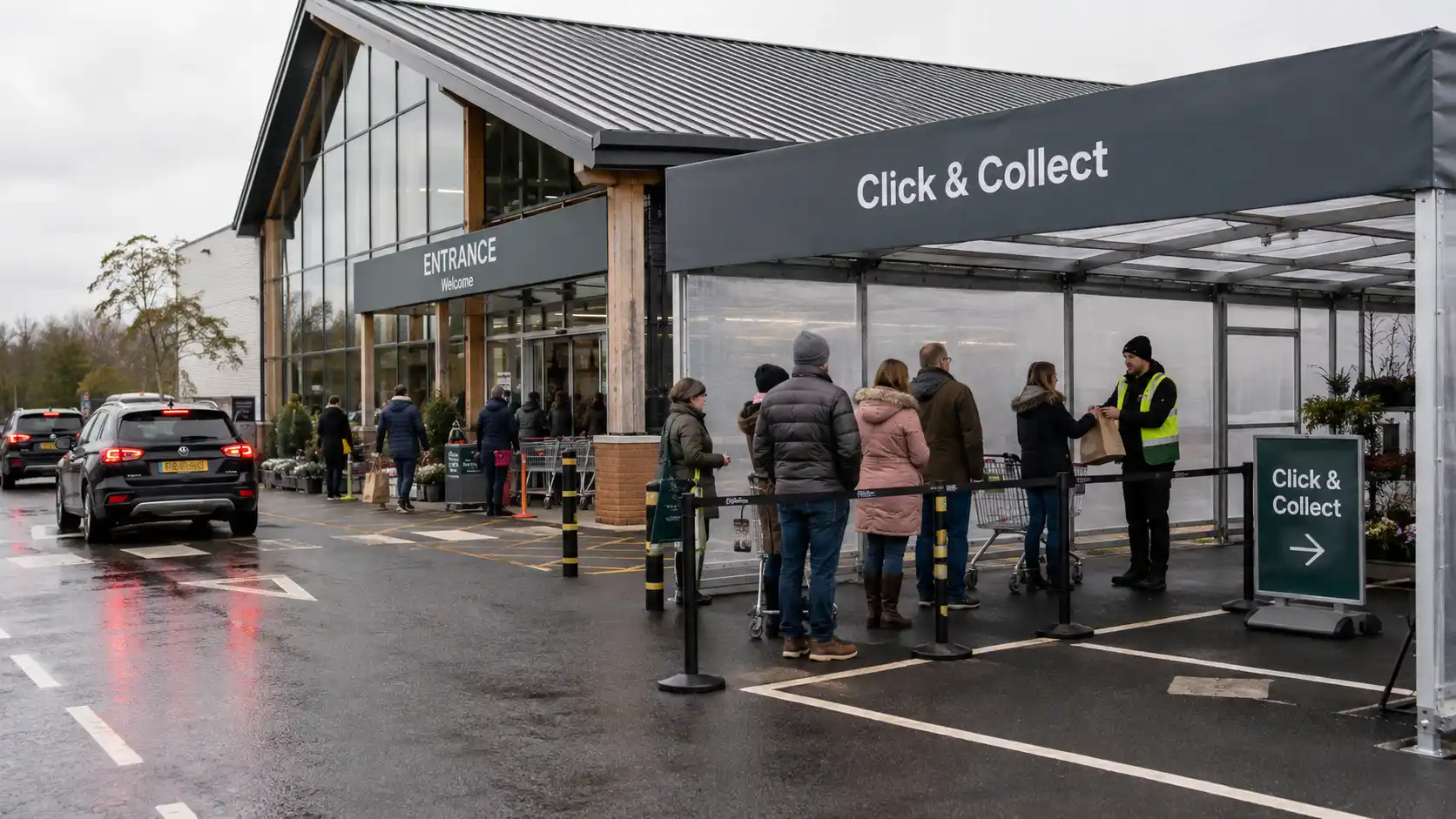
Short-term use usually means a structure is needed for a limited window, such as a promotion, product launch, short sales peak, temporary queueing requirement, click-and-collect pressure point or a defined festive display period. The structure still needs to be safe, practical and appropriate for customer-facing use, but the commercial purpose is narrow and time-bound.
Seasonal use usually means the building supports a full trading cycle rather than a brief event. For retailers, this may include Christmas trading, winter ranges, clearance activity or peak footfall periods. For garden centres, it may include spring planting demand, summer outdoor living, autumn bulb ranges, Christmas departments or weather-protected browsing. A seasonal retail structure generally needs more careful thought around comfort, lighting, flooring, product protection and customer movement than a very short-term space.
Refurbishment-period use applies when permanent retail space is temporarily unavailable because of building works, reconfiguration, store upgrades or phased refurbishment. In this scenario, duration should be aligned to the works programme, handover dates, customer access plan and trading continuity requirements. A temporary retail building should support the refurbishment timeline without creating a disconnected or difficult shopping experience.
Recurring annual use applies when the same space issue returns year after year. This is common for Christmas retail, garden centre seasonality, outdoor living displays, customer-flow pressure and peak collection periods. When the need is predictable, retailers may need to compare temporary retail space for recurring seasonal demand against the cost, disruption and staff planning involved in repeated installation and removal.
Semi-permanent use applies when additional space is needed for months or years rather than days or weeks. This may be relevant where permanent construction is not suitable, capital approval is delayed, lease or redevelopment decisions are unresolved, or the business wants to test additional trading capacity before committing to a permanent change. A semi-permanent retail building should be assessed as an ongoing operational space, not a short-term workaround.
| Duration model | Typical retail use | Main decision issue |
|---|---|---|
| Short term | Promotions, fixed peaks, limited festive windows, queueing or collection support | Is the structure suitable for the specific trading window without unnecessary commitment? |
| Seasonal | Christmas, spring/summer garden centre demand, outdoor ranges, weather-protected browsing | Can the building support customer comfort, stock presentation and changing conditions across the season? |
| Refurbishment-period | Temporary trading space during store works or reconfiguration | Does the duration align with the works programme and maintain trading continuity? |
| Recurring annual | Repeated seasonal pressure or annual customer-flow demand | Is repeated installation/removal still efficient, or is a longer-term approach more controlled? |
| Semi-permanent | Additional retail or garden centre capacity for months or years | Can the structure operate as part of the site with appropriate specification, maintenance and permissions? |
This comparison also shows why seasonal vs semi-permanent retail building decisions should not be reduced to cost alone. Duration affects the way customers use the space, how staff operate within it, how stock is presented, how the structure is maintained and how much disruption the site experiences over time.
When is short-term temporary retail space enough?
Short-term temporary retail space is usually enough when the trading need is fixed, limited and clearly understood. If the structure is supporting a short promotion, a product launch, a brief sales peak or a temporary customer-flow issue, the priority is often to create usable space for a defined period without adding unnecessary complexity.
This approach can work well where the structure has a narrow purpose. A retailer may need extra space for a limited festive display, a click-and-collect queue during a known peak, or a temporary covered area while a small part of the store is unavailable. In these situations, the commercial question is whether the structure can support the immediate trading pressure without creating disproportionate cost, specification or disruption.
Short-term use can also be appropriate where demand is uncertain. For example, a retailer may want to test whether a seasonal shop extension attracts enough customer interest before committing to a longer-term retail extension. A garden centre may trial covered retail space for a specific product range before deciding whether it should become part of a recurring seasonal plan.
However, short-term does have limits. If the space will be customer-facing for several months, used during colder or wetter periods, connected to POS or security systems, or relied on as part of normal customer circulation, a basic short-term approach may not provide enough comfort or durability. The same applies where the same problem returns every year. At that point, the decision may shift from short-term vs seasonal retail structure to whether a more robust seasonal or recurring model would reduce disruption and support better commercial planning.
The risk is not simply that the structure stays in place too long. The greater risk is that it was never specified for the way it ends up being used. A building planned for a short campaign may feel inadequate if it becomes a multi-month customer-facing space. Conversely, a heavily specified structure may be unnecessary for a brief, low-complexity peak.
Short-term temporary retail space is most effective when the use case is genuinely short, the trading window is clearly defined, customer expectations are proportionate, and removal will not interfere with a more valuable trading period.
Can retailers keep a temporary building up for a full season?
Retailers can keep a temporary building in place for a full season where the structure, site and operating arrangements are suitable for that length of use. The important point is that full-season retail use is different from a short sales peak. A structure that works well for a three-week promotion may not automatically be appropriate for several months of customer-facing trading.
Seasonal use is common where the trading opportunity has a defined beginning and end. For retailers, this may include Christmas departments, seasonal product ranges, promotional space or customer-flow support during predictable peak periods. For garden centres, it may include spring planting demand, summer outdoor living displays, autumn bulb ranges, Christmas gifting, festive departments or covered browsing areas.
The Horticultural Trades Association’s garden centre seasonality reporting reinforces why garden centre space decisions are rarely confined to one short window. Demand can shift significantly across product categories, with spring, summer, autumn and Christmas all creating different layout and capacity pressures.
A full-season structure usually needs stronger consideration of customer comfort. If customers are browsing for longer periods, moving between indoor and outdoor areas, using trolleys, viewing stock displays or queuing at busy times, the building has to feel like a planned retail environment rather than a temporary add-on. Lighting, flooring, access, ventilation, weather protection and the route back into the main store all become more important.
For Christmas retail, the structure may need to support high stock volumes, decorative displays, customer dwell time and peak weekend footfall. Readers considering this specific scenario may need more detailed guidance on Christmas retail space, particularly where the building needs to be installed without interfering with trading preparation.
For garden centres, full-season use often depends on product protection and customer movement. A temporary garden centre building may need to accommodate plants, gifts, homeware, outdoor living products or festive ranges at different points in the year. Where weather-protected browsing is the central issue, the reader may also need more detailed guidance on covered garden centre retail space.
A full-season temporary retail building should therefore be assessed around the trading cycle it supports. The question is not only whether the building can remain in place, but whether it will continue to work well for customers, staff, stock, maintenance and commercial return across the full period.
When does recurring demand justify a longer-term structure?
Recurring demand changes the duration decision because the space problem is no longer isolated. If a retailer or garden centre faces the same capacity issue every Christmas, every spring, every summer or every peak collection period, repeated short-term installation may start to create its own operational burden.
That does not mean a longer-term structure is always the correct answer. A short-term install may still be appropriate where the requirement is genuinely brief, the site is straightforward and the commercial return is tied to a narrow trading window. However, if the same temporary retail space is needed each year, the decision should include disruption, staff planning time, installation lead-in, fit-out, handover and removal as well as the hire period itself.
Recurring seasonal retail space may be commercially sensible where the same product category, customer-flow issue or sales opportunity returns predictably. A garden centre with repeated spring and Christmas pressure, for example, may find that the structure is not simply solving one seasonal problem. It may be supporting several trading windows across the year.
Repeated installation and removal can also affect live trading. Teams may need to protect customer routes, manage delivery access, coordinate stock movement, adjust car parking, plan staff movements and avoid peak trading days. Where this happens annually, it can become a recurring operational cost in time, attention and disruption, even if the structure itself is only present for part of the year.
This is where peak retail capacity planning becomes relevant. If the duration question is being driven by predictable peaks, the retailer may need to look at the wider capacity pattern rather than making a single short-term hire decision each time pressure appears.
The decision threshold is usually reached when the need is predictable enough to plan for, valuable enough to protect and disruptive enough to justify a more considered approach. At that point, a seasonal or semi-permanent retail building may offer more control than treating the same requirement as a one-off each year.
How duration affects specification, comfort and maintenance
The longer a temporary retail building remains in place, the more important specification becomes. A short-term structure may only need to support a limited purpose, but a building used for several months, a full season or semi-permanent retail capacity has to work consistently for customers, staff and stock.
Flooring is a good example. For brief use, the priority may be safe, level access and practical customer movement. For longer use, flooring may need to withstand heavier footfall, trolleys, stock movement, weather transfer from outdoor areas and cleaning routines. In a garden centre, it may also need to support customers moving between covered and uncovered areas with wet footwear, plant trolleys or bulky purchases.
Lighting also changes with duration. A short summer promotion may not need the same lighting plan as a winter retail extension or Christmas department. If the building will support darker trading hours, detailed product displays or customer browsing, lighting should be considered as part of the retail experience, not simply as a functional add-on.
Heating, cooling and ventilation become more important as customer dwell time increases. A building used for a brief queueing need may have different expectations from a multi-season retail space where customers browse, staff work and stock remains in place throughout changing weather. Comfort matters because it influences how usable the space feels and how naturally it fits into the wider store or garden centre.
Security, POS/data, power and stock control may also change over time. A temporary display area with limited stock is very different from a semi-permanent retail building operating as an extension of normal trading space. Where tills, payment systems, security measures, lighting, staff areas or high-value products are involved, the structure needs to be planned around real retail operations.
Maintenance should not be left as an afterthought. Retail structure maintenance becomes more important when a building is retained through changing seasons, heavy use or public access. The HSE’s risk management guidance for workplaces emphasises the need to consider employees, contractors, visitors and members of the public when identifying and managing risks, which is especially relevant where a temporary structure is part of the customer environment.
For longer seasonal or semi-permanent use, readers should consider Maintenance & Servicing early rather than after the structure is already in place. They may also need to think through the full customer-ready temporary retail building specification if the space will be used by customers as part of the normal retail journey.
Duration therefore has a direct effect on specification. The longer the building is expected to function as retail space, the more it needs to be planned as part of the site, not simply as temporary cover.
What changes if a garden centre building stays in place for years?
If a garden centre building stays in place for years, it should be treated as an ongoing retail environment rather than a seasonal shelter. The structure may still be temporary or semi-permanent in construction terms, but customers and staff will experience it as part of the garden centre.
This changes the level of planning required. A semi-permanent garden centre structure may need to support different product ranges across the year, including plants, garden care, outdoor living, gifts, homeware, Christmas decorations and seasonal promotions. Layouts may need to change several times, and the building should be able to support that flexibility without repeated disruption.
Customer routes become more important over time. Garden centre visitors often move with trolleys, plants, compost, bulky goods, children, pushchairs and mobility aids. A structure retained for years needs to sit logically within the wider site, with clear movement between indoor retail, outdoor areas, car parks, tills, cafés where relevant and collection points.
Weather exposure is another key issue. A structure used across multiple seasons will face winter rain, summer heat, changing light levels and varying footfall patterns. Product protection, ventilation, heating, cooling, shade, lighting and floor durability may all influence whether the space remains commercially useful.
Maintenance also becomes more central. A temporary garden centre building that stays in place for years should be inspected, serviced and managed as part of the operating site. That does not mean the article should drift into engineering detail, but it does mean the reader should understand that longer use brings ongoing responsibility.
The commercial question is whether keeping a temporary shop extension in place supports enough trading value to justify the specification, maintenance and site commitment. For some garden centres, multi-season retail space may allow better presentation, improved customer comfort and more consistent use of covered areas. For others, a seasonal structure may be more appropriate if demand is concentrated into shorter windows.
A longer-term structure is most appropriate where the requirement is stable, customer use is consistent, and the building can be integrated into the site without becoming a compromise. If the structure will be visible, occupied and relied upon throughout the year, it should be planned as part of the garden centre’s retail environment from the outset.
Planning, permissions and operational considerations over time
Planning, permissions and operational responsibilities become more important as duration increases. A structure used for a very short period may raise different considerations from one retained across a full season, used repeatedly each year or kept in place for semi-permanent retail capacity.
This section should not be read as planning advice. Requirements can depend on site context, local authority interpretation, landlord arrangements, property ownership, structure type, location, duration and how the building is used. The practical point for retailers is that duration should be discussed early, before installation timing, fit-out, trading plans and opening dates become fixed.
Where a building may remain in place for several months or years, retailers may need to consider local planning checks, landlord consent, lease restrictions, site permissions and estate-management requirements. A structure positioned in a car park, service yard, entrance area or customer route can affect more than sales space. It may influence access, circulation, delivery routes, visibility, parking and safe movement around the site.
Operational considerations should also be reviewed over time. A temporary retail building used by customers may need clear access, safe thresholds, appropriate lighting, maintained flooring, suitable signage, fire-safety awareness, emergency routes and routine checks. The longer the structure remains part of daily trading, the more these issues become part of normal site management.
LM Structures Planning & Installation] support is relevant where retailers need to think through site layout, access, installation timing and practical constraints before a building arrives. Where customer-facing use, public access and safe operation are central to the decision, Compliance & Safety may also be relevant.
For retailers, the key is not to treat permissions and operational checks as late-stage administration. If the intended duration changes from short-term to seasonal, recurring or semi-permanent, the planning and site-management conversation may need to change with it.
How repeated installation and removal can affect live trading
Repeated installation and removal can become a significant factor on live retail and garden centre sites. Even when each individual installation is manageable, repeating the process every season or every year can affect customers, staff, stock, deliveries and trading preparation.
Retail sites are rarely empty, quiet environments. Temporary buildings may need to be installed around opening hours, customer parking, delivery access, stock movement, staff routes, tills, entrance points and seasonal merchandising. In garden centres, installation may also need to consider outdoor retail areas, trolley movement, plant stock, weather-sensitive products and peak weekend trading.
The HSE’s workplace transport guidance on deliveries and collections highlights the need for cooperation between delivery companies and sites, including consideration of delivery timing, access routes, parking, unloading areas and keeping non-essential people away from unloading areas. This is directly relevant when temporary buildings are installed or removed on live customer-facing sites.
Repeated installation can also compress preparation time. A Christmas structure installed too late may leave limited time for fit-out, stock placement, POS setup, lighting checks and staff familiarisation. A spring garden centre structure removed too early may reduce covered space before the trading cycle has fully finished.
A seasonal building reinstalled every year may require the same planning conversations, access arrangements and disruption controls to be repeated.
This is why duration should include installation and removal, not just the period when the structure is trading. A short-term structure that takes significant planning effort every year may not be as simple as it first appears. Conversely, keeping a structure in place longer than needed may create unnecessary maintenance, permission or site-use considerations.
Readers looking specifically at live-site logistics may need further guidance on installation without disrupting trading. In this article, the important point is that installation frequency is part of the duration decision. A structure that is installed, fitted out, used, removed and then reinstalled every year should be assessed against the full operational cycle, not only the hire period.
How to choose the right duration for your retail site
Choosing the right duration starts with the retail outcome. The structure should remain in place long enough to support the trading need properly, but not so long that it creates avoidable cost, operational complexity or site-management pressure.
A practical decision framework should begin with the trading period. Is the building needed for a short campaign, a Christmas department, a spring/summer garden centre season, a refurbishment programme, a recurring annual peak or longer-term additional capacity? The more clearly the trading window is defined, the easier it is to avoid both under-specification and overcommitment.
The second question is whether the need is one-off or recurring. A one-off promotion may justify a limited short-term structure. A recurring Christmas space issue, spring garden centre peak or ongoing click-and-collect problem may justify a more planned seasonal or semi-permanent approach.
Customer use should then shape the specification. If the building is primarily for back-of-house stock, the requirements may be different from a space where customers browse, queue, pay, collect goods or move between departments. A customer-facing building needs to be judged by usability, comfort, access and integration as well as coverage.
Installation and removal should also be considered. If the structure can be installed and removed without disrupting customers, staff, deliveries or peak trading, short-term use may be appropriate. If the same disruption returns every year, the retailer should ask whether a longer-term or recurring structure would provide more control.
Permissions, maintenance and site constraints should be checked in proportion to the intended duration. A building retained across seasons or years may need stronger consideration of planning, landlord approval, servicing, safety checks, access and long-term integration. The question is not when does temporary retail space become semi-permanent in theory, but when the practical responsibilities begin to resemble an ongoing retail environment.
Commercial return brings the decision together. The retailer should compare the value of the trading opportunity with the cost of specification, the disruption avoided, the flexibility retained and the risk of removing the structure too soon or leaving it in place too long.
In practical terms, the decision can be framed as follows:
| Decision Question | What it reveals |
|---|---|
| What trading period must the building support? | Whether the need is short-term, seasonal, refurbishment-led or longer-term |
| Is the requirement one-off or recurring? | Whether repeated installation is still practical |
| Will customers use the space? | How much comfort, access, lighting and finish may be required |
| What stock or activity will the building support? | Whether product protection, POS/data, security or display flexibility are needed |
| How disruptive will installation and removal be? | Whether a longer duration could reduce repeated live-site disruption |
| Are planning, landlord or site permissions relevant? | Whether checks need to happen earlier in the programme |
| What maintenance will be required? | Whether the structure can be managed properly over the intended period |
| What commercial return is expected? | Whether the duration is proportionate to the trading opportunity |
This framework avoids treating short-term, seasonal and semi-permanent structures as fixed choices. The better approach is to define the outcome first, then select the duration that supports it with the right level of specification and control.
Choosing duration around the retail outcome, not the label
The right duration for a temporary retail building is not defined by whether the structure is described as short-term, seasonal or semi-permanent. It is defined by the trading cycle, customer-facing use, site constraints, maintenance requirements, installation disruption and commercial return.
A short-term structure may be the right answer for a fixed peak, a limited promotion or a clearly defined queueing need. A seasonal retail structure may be more appropriate where the building needs to support Christmas trading, spring garden centre demand or several months of customer-facing use. A semi-permanent retail building may make sense where additional capacity is needed for months or years, repeated installation is creating disruption, or the business wants flexibility while longer-term property decisions remain unresolved.
The strongest decision is the one that keeps the structure aligned to the retail outcome. Retailers and garden centres should avoid choosing the shortest option simply because the building is temporary, or the longest option simply because the space pressure keeps recurring. The duration should be proportionate to the commercial opportunity, the customer experience expected and the operational responsibility created by keeping the structure in place.
Next step
If your retail site or garden centre is currently deciding whether extra space is needed for a short peak, a full season, recurring annual demand or semi-permanent capacity, this is the right stage to assess duration before specification, installation timing and trading plans are fixed.
Acting at this stage helps avoid under-specifying a customer-facing structure, committing to more space than the trading window justifies, or repeating installation and removal where a longer-term approach would provide more control. LM Structures can help you review the trading period, site constraints, customer use, maintenance requirements and commercial purpose before deciding which duration model is most appropriate.
Explore temporary retail buildings for short-term, seasonal and longer-term use to understand how LM Structures supports retailers and garden centres with temporary buildings planned around real trading outcomes.
Contact our team on 0333 3584989 or email enquiries@lmstructures.co.uk
Written by LM Structures, specialists in temporary buildings for retail, commercial and operational environments.
Temporary retail building duration FAQs
That depends on whether the need is genuinely short and isolated, or predictable and recurring. If repeated installation and removal disrupts trading, staff planning, deliveries or customer access each year, a longer-term or recurring seasonal approach may provide better operational control.
Yes, longer use usually changes the level of specification required. Flooring, lighting, comfort, access, security, POS/data, maintenance and customer-facing finish become more important when the structure is used for several months, multiple seasons or ongoing retail capacity.
A semi-permanent retail structure may be more suitable when additional space is needed for months or years, when the same seasonal pressure returns repeatedly, or when permanent construction is not appropriate at that stage. It should be considered where the building needs to function as part of the operating retail site rather than a short-term overflow space.
Yes, a temporary retail building can be used for a full season where it is specified and managed for that duration. Seasonal use usually requires stronger consideration of lighting, heating, ventilation, flooring, weather exposure, product protection and customer comfort than a very short-term installation.
A temporary retail building can stay in place for a short peak, a full season, a refurbishment programme or longer semi-permanent use, depending on the site, purpose, specification and permissions. The correct duration should be assessed around how the space will be used, how customers will access it and what operational responsibilities apply over time.