Can You Add Warehouse Space on a Restricted Site?
When storage capacity is under pressure but the site already feels full, the real question is not simply whether another structure can fit. It is whether additional warehouse space can be introduced without disrupting access, loading, safety or day-to-day operational flow.
In Short
A temporary warehouse can often work on a restricted site, but only where the available footprint, access routes and operational layout support safe and practical use. The most effective solution is designed around the site’s constraints from the outset, rather than treating the remaining space as automatically usable.
Executive Summary
Sites with limited space or awkward layouts can still support additional storage capacity in some circumstances, but feasibility depends on more than the size of the available area. A temporary warehouse needs to work with the way vehicles move, goods are handled, people circulate and existing operations continue around it.
For Facilities Managers, Site Managers and Operations Managers, the key issue is usability. A structure that technically fits into a yard, service area or unused corner may still create problems if it restricts loading, compromises access, blocks essential routes or increases handling time.
Temporary warehousing can provide a practical alternative to relocation, outsourced storage or permanent construction where the site conditions are suitable. However, the decision needs to be based on a realistic assessment of footprint, layout, access, infrastructure and operational flow.
LM Structures’ temporary warehousing and storage solutions are most relevant where a business needs additional storage capacity on or near an existing operational site, but permanent expansion is either impractical, unnecessary or too disruptive.
Table of Contents – In this Article
What makes a site constrained for warehouse expansion?
A constrained site is any operational site where physical conditions limit how easily additional warehouse or storage capacity can be introduced. This may be due to lack of available land, an awkward layout, restricted access, existing infrastructure or the need to keep critical operational areas clear.
In practice, many constrained sites are not visibly “small”. They may have a reasonable overall footprint, but much of that space is already committed to vehicle movement, loading bays, staff parking, external plant, service routes, fire access, yard operations or production support. The issue is not total land area. It is how much genuinely usable space remains once those operational requirements are protected.
For a Facilities Manager, this distinction matters. A site may appear to have available space on a drawing or aerial image, but that does not mean it can support a working warehouse structure. The space needs to be accessible, serviceable and positioned in a way that supports the movement of goods without creating new inefficiencies.
Common indicators of a constrained site include narrow yards, irregular boundaries, split operational zones, tight turning areas, shared access routes or buildings arranged in a way that limits natural expansion. Existing infrastructure can also create restrictions, including drainage routes, underground services, external equipment, boundary conditions or areas that need to remain clear for maintenance and access.
Planning context can also influence what is possible. The Planning Portal guidance on warehouses and industrial buildings explains that some industrial development may be subject to specific permitted development limits and conditions. For temporary buildings, the Planning Portal also notes that permission depends on the nature, duration and circumstances of the proposed structure, so assumptions should be checked before committing to a solution.
This is why constrained-site warehouse planning should begin with a practical feasibility question: can the site accommodate additional storage space that works operationally, commercially and safely?
How do space and layout limitations affect storage capacity?
Space limitations affect storage capacity in two ways. The first is obvious: there may not be enough clear footprint for the size of structure the business would ideally like. The second is more important: the available space may not support efficient use once the structure is installed.
A temporary warehouse on a constrained site needs to allow goods to enter, move through and leave the storage area without creating unnecessary handling or delays. If stock has to be moved around obstacles, double-handled between areas, or routed through congested parts of the site, the additional capacity may solve one problem while creating another.
Layout limitations can also reduce the practical value of storage. A long narrow area, for example, may technically accommodate a structure, but it may not support efficient racking, vehicle access or internal movement. An irregular yard may offer enough square metres in theory, but the usable area may be reduced once turning, loading and pedestrian movement are considered.
This is particularly important on sites where warehouse activity is closely linked to production, dispatch, servicing or customer fulfilment. If the new storage location sits too far from the point of use, the business may introduce longer travel routes, slower handling or increased pressure on staff and equipment.
Over time, these inefficiencies can create avoidable cost exposure through reduced productivity, slower throughput and more complex day-to-day management.
The Health and Safety Executive’s guidance on workplace transport route safety reinforces the need for safe vehicle and pedestrian movement, including suitable circulation routes and separation where required. On a restricted site, this means layout decisions must consider more than storage volume. They also need to account for how vehicles, pedestrians, forklifts and goods will move around the structure.
In constrained environments, usable capacity is the real measure of success. The question is not “how much space can we add?” but “how much effective storage can we create without undermining the wider operation?”
What types of constraints are most common on industrial sites?
Industrial and commercial sites can be constrained in several different ways. Understanding the type of constraint is important because each one affects feasibility differently.
The most common constraint is limited footprint. This occurs when the site simply has little clear external space available for additional storage. However, footprint restrictions are rarely isolated. They often interact with other issues, such as vehicle access, boundary conditions or the need to keep existing operational areas clear.
Layout constraints are also common. A site may have usable land, but it may be broken up by existing buildings, service yards, access roads or operational zones. This can make it difficult to position a structure where it supports efficient stock movement. In some cases, a smaller, better-positioned storage structure may be more useful than a larger structure placed in the wrong part of the site.
Access constraints can be just as important as space constraints. A temporary warehouse may need to accommodate delivery vehicles, forklifts, loading equipment or pedestrian routes. If access is too narrow, turning space is limited, or the proposed location creates conflict between people and vehicles, the site may require reconfiguration before a practical solution can be considered.
Infrastructure constraints can include drainage, utilities, external plant, lighting, surface condition, boundary restrictions or retained access for maintenance. These issues do not automatically prevent temporary warehousing, but they need to be identified early. Overlooking them can lead to delays, redesign or operational compromise.
Loading and unloading requirements also deserve specific attention. HSE guidance on loading and unloading areas highlights the importance of safe positioning, suitable space, visibility and safe access around loading activity. On a constrained site, this can become one of the most important feasibility factors because storage capacity only has value if goods can be handled safely and efficiently.
For many businesses, these constraints do not mean additional warehouse space is impossible. They mean the solution must be planned around the realities of the site rather than imposed onto it. That is where a diagnostic approach becomes essential.

Can you add warehouse space on a restricted site?
In many cases, yes. However, the answer depends less on whether a structure can physically be installed and more on whether the surrounding operation can continue functioning effectively once it is in place.
A restricted site may still support additional storage capacity if the available space allows for:
- practical loading and unloading
- safe vehicle movement
- workable access routes
- efficient stock handling
- continued operational flow around the structure
This is why constrained-site temporary warehousing should be approached as a feasibility exercise rather than a simple space calculation.
For example, a site with a narrow but accessible side yard may support a compact storage structure that integrates well with existing dispatch operations. By contrast, a larger open area may prove unsuitable if it interferes with turning circles, emergency access or key operational routes.
The most successful constrained-site solutions are normally developed around operational priorities first. Storage capacity is then designed to support those priorities rather than compete with them.
This can involve:
- adapting structure dimensions to available space
- positioning storage around existing circulation routes
- protecting operational access zones
- maintaining loading efficiency
- separating pedestrian and vehicle movement where possible
- phasing installation around live operations
For Facilities Managers and Operations Managers, this often changes the nature of the decision. The question becomes less about “how much storage can we add?” and more about “how much usable storage can we introduce without creating operational friction elsewhere?”
In some cases, this may mean accepting a smaller but more functional structure. In others, it may involve operational reconfiguration to improve site utilisation before additional storage is introduced.
Where businesses are also assessing wider warehouse growth capacity challenges, constrained-site warehousing can sometimes provide a transitional solution that supports continued operation within the existing site footprint while longer-term decisions are evaluated.
How temporary warehousing adapts to constrained environments
Temporary warehousing is often more adaptable than permanent expansion because the structure can be configured around the realities of the site rather than requiring a fixed building footprint from the outset.
This adaptability is particularly valuable on sites where:
- expansion space is fragmented
- layouts are irregular
- operational zones need to remain active
- permanent construction is impractical
- future operational requirements may change
Rather than approaching the site with a standardised layout assumption, constrained-site warehousing typically requires a more responsive planning process. Structure dimensions, positioning, access orientation and operational integration may all need to be adjusted to suit the available environment.
This does not mean every awkward site can accommodate a workable solution. However, it does allow more flexibility than many businesses initially assume.
On some sites, the most practical approach may involve placing additional storage close to the point of operational use, even if that limits overall structure size. On others, maintaining access efficiency may take priority over maximising footprint coverage.
This is also where operational sequencing becomes important. Installation may need to be phased around live traffic routes, production activity, dispatch schedules or access requirements to reduce disruption during implementation.
The ability to adapt temporary warehousing to constrained environments can also help businesses avoid some of the inefficiencies associated with outsourced storage. Moving stock off-site may reduce immediate space pressure, but it can introduce additional transport movement, handling time, stock management complexity and operational delay.
For some businesses, retaining storage capacity within the operational site – even in a more compact format – may provide better long-term efficiency than splitting inventory across multiple locations.
That said, adaptability should not be mistaken for unlimited flexibility. The article must remain realistic about physical limitations. Certain layouts, access conditions or infrastructure conflicts may still prevent a practical warehouse solution without broader site modification.
This is why early evaluating warehouse suitability remains important before operational or financial decisions are made.
What layout and positioning factors need to be considered?
Positioning a temporary warehouse on a constrained site is not simply about identifying unused land. The structure needs to integrate with the wider operation in a way that maintains efficiency, access and safe movement.
One of the first considerations is how goods will move between the warehouse and the rest of the site. If stock handling routes become unnecessarily long or congested, the operational benefit of the additional storage may quickly reduce. In some environments, even relatively small changes to movement patterns can affect productivity, dispatch speed or vehicle circulation.
The relationship between the warehouse and loading activity is also critical. Loading areas need sufficient visibility, access and manoeuvring space to operate safely and efficiently. HSE guidance on loading and unloading areas highlights the importance of maintaining suitable operating space around loading activities, particularly where vehicles and pedestrians interact.
Surface condition and infrastructure also influence positioning decisions. Drainage, underground services, gradients, retained maintenance access and surrounding operational equipment may all affect what areas are genuinely usable.
Operational continuity is another major factor. On live industrial sites, some areas cannot realistically be disrupted for extended periods because they support production, servicing, dispatch or critical circulation routes. In these situations, the warehouse layout needs to support ongoing operations rather than compete with them.
This is one reason why constrained-site planning often benefits from a phased assessment process. Instead of beginning with a preferred structure size, the process starts by understanding:
• what operational routes must remain protected
• what areas can tolerate change
• where access pressure already exists
• how goods currently move through the site
• what future operational growth may require
The outcome is usually more commercially realistic than a footprint-led approach alone.
In some situations, businesses may also compare constrained-site warehousing against broader options for increasing warehouse capacity quickly. However, on restricted sites, speed alone is rarely the deciding factor. The structure still needs to function effectively within the operational environment once installed.
How access and logistics affect feasibility
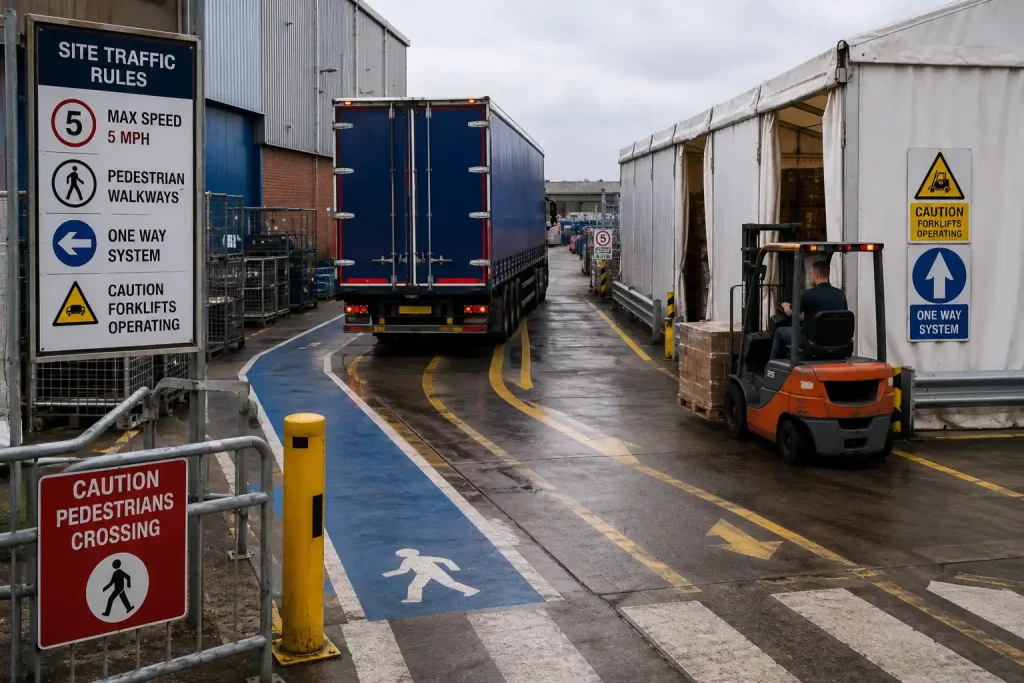
Access is often the deciding factor on constrained warehouse sites.
A site may have enough physical space for a structure, but if vehicles cannot approach safely, turn efficiently or load effectively, the practical value of the additional storage becomes limited. This is especially important where warehouse activity supports time-sensitive operations such as manufacturing, fulfilment, servicing or distribution.
Vehicle circulation needs careful consideration from the beginning. Delivery routes, forklift movement, reversing areas and pedestrian interaction all affect whether a temporary warehouse can operate efficiently within the existing site layout.
The HSE guidance on workplace transport route safety reinforces the need for suitable traffic routes, clear circulation and safe separation between vehicles and pedestrians where appropriate. On restricted sites, these requirements can become harder to maintain once additional structures are introduced.
For Facilities Managers, the challenge is often balancing competing operational priorities within limited space. A new storage structure may solve one pressure point while unintentionally creating congestion somewhere else.
Common access-related feasibility issues include:
- restricted turning circles
- shared access routes
- narrow service yards
- limited loading areas
- conflicting pedestrian movement
- blocked maintenance access
- reduced visibility around operational routes
These issues do not always prevent additional storage capacity, but they may require compromises in positioning, structure size or operational workflow.
This is also where commercial considerations become closely linked to operational planning. Poor logistics flow can increase handling time, create dispatch delays, reduce throughput efficiency and place additional pressure on staff and equipment. Over time, these inefficiencies may offset some of the operational benefit gained from the additional storage itself.
For businesses trying to remain within their existing footprint, maintaining efficient logistics flow is often more important than maximising warehouse size.
When site constraints limit what is possible
Not every site can accommodate additional warehouse space without modification.
This is an important part of the decision-making process because unrealistic assumptions can lead to wasted planning effort, operational disruption or investment into solutions that ultimately create more problems than they solve.
In some cases, the available space may simply be too restricted to support safe loading, vehicle circulation or practical warehouse operation. On other sites, infrastructure conflicts or operational dependencies may leave no suitable area for additional storage without affecting core business activity.
There are also situations where the compromises required become commercially inefficient. A very small or awkwardly positioned structure may technically add storage capacity, but if it creates excessive handling time, poor stock access or operational bottlenecks, the wider benefit may be limited.
This is why feasibility assessment matters more than theoretical footprint calculations.
The article should also acknowledge that some sites evolve into constrained environments over time. Temporary operational workarounds, legacy layouts, expanding production activity and incremental infrastructure changes can gradually reduce flexibility until expansion becomes increasingly difficult.
Where constraints are severe, businesses may need to consider:
- operational reconfiguration
- site adaptation
- redistribution of stock
- off-site storage
- phased relocation planning
The role of temporary warehousing in these situations is not to force an unsuitable solution onto the site. It is to determine whether a workable and commercially sensible approach exists within the operational realities of the environment.
A measured assessment process often prevents businesses from either dismissing viable options too early or pursuing unrealistic ones for too long.
Should you adapt your site or consider alternative solutions?
The right decision depends on the balance between operational practicality, commercial efficiency and long-term site strategy.
For some businesses, adapting the existing site may be the most effective option. A carefully planned temporary warehouse can allow operations to remain within the current footprint while supporting continued growth, improved stock management or increased operational resilience.
This can be particularly valuable where relocation would introduce:
- additional transport complexity
- operational disruption
- workforce challenges
- increased handling requirements
- fragmented inventory management
Keeping storage close to the operational core of the business often improves visibility, coordination and day-to-day efficiency compared with outsourced or split-site arrangements.
However, constrained-site warehousing is not always the right answer. If the compromises required become too significant, broader operational changes may offer a more sustainable outcome.
This is why the decision should not be framed as: “Can a structure fit here?”
Instead, the more useful question is: “Will this improve the operation overall without creating disproportionate inefficiency elsewhere?”
That distinction is commercially important. A warehouse solution that technically works but increases operational friction may reduce productivity over time and create hidden cost exposure through slower workflows, increased movement or more complex site management.
The most effective approach is normally a realistic assessment of:
- available operational space
- access practicality
- logistics flow
- future operational requirements
- infrastructure limitations
- long-term site objectives
This creates a more balanced basis for decision-making than focusing on footprint alone.
What matters most as you move forward?
Where storage pressure is increasing on a constrained site, the priority should be understanding whether additional capacity can function effectively within the realities of the operation – not simply whether space exists on paper.
Temporary warehousing can provide a practical route to increasing on-site storage capacity where permanent expansion is difficult, disruptive or commercially unjustified. However, successful constrained-site solutions depend on careful assessment of layout, access, operational flow and infrastructure limitations.
For Facilities Managers and operational decision-makers, the most important step is usually early feasibility evaluation. Understanding circulation, loading requirements, operational dependencies and usable space at the beginning of the process helps avoid unrealistic assumptions and reduces the risk of inefficient implementation later.
In many cases, constrained sites can support more storage capacity than initially expected. In others, the assessment process may show that operational reconfiguration or alternative solutions are more appropriate.
The value comes from making that decision based on operational reality rather than assumption.
Next step
If your operation is currently struggling with storage pressure but relocation or permanent expansion is difficult, this is usually the stage where a structured feasibility assessment becomes valuable.
LM Structures’ warehouse storage solutions for constrained sites are designed to help businesses evaluate whether temporary warehousing can operate effectively within the physical and operational realities of an existing site. That includes considering layout, access, circulation, infrastructure and day-to-day operational flow before decisions are finalised.
At this stage, the goal is not simply to add more covered space. It is to determine whether additional storage capacity can improve operational efficiency without creating new constraints elsewhere in the operation.
To speak to a member of our team call 0333 358 4989 or email enquiries@lmstructures.co.uk
FAQs: Temporary Warehouse For Restricted Sites
Yes, in many cases it can, but the available footprint is only one part of the assessment. Access routes, loading practicality, vehicle movement and operational flow all influence whether the structure will function effectively once installed.
A suitability assessment should consider usable footprint, access, loading activity, vehicle circulation, operational dependencies and infrastructure constraints together rather than independently.
The objective is to understand whether the additional storage will improve the operation overall, not simply whether a structure can fit within the site boundary.
Where site limitations are too severe, businesses may need to explore alternatives such as operational reconfiguration, off-site storage or longer-term relocation planning. A realistic assessment process helps determine this before unnecessary investment or disruption occurs.
They can be, provided the structure is designed around the operational realities of the site. Irregular layouts may require adapted dimensions, revised positioning or changes to circulation planning to maintain usability.
The most common constraints include limited footprint, awkward site layout, restricted vehicle access, existing infrastructure conflicts and operational areas that cannot be disrupted. In many environments, logistics flow becomes a greater limitation than physical space alone.