What Makes a Temporary Warehouse Suitable for Real Operations?
Businesses often assume that any temporary structure can function as warehouse space, but operational suitability depends on far more than available square footage. A temporary warehouse must support safe stock movement, vehicle access, workflow efficiency, environmental protection and day-to-day logistics activity if it is to operate effectively within a live storage environment.
Executive Summary
Temporary warehousing only becomes operationally valuable when it supports the practical realities of live logistics and storage operations. In many environments, the challenge is not simply creating additional covered space, but ensuring that the structure integrates properly with stock movement, loading activity, forklift circulation and operational workflow.
This article explains:
- why not all temporary structures are suitable for warehousing
- what operational criteria determine warehouse usability
- how workflow and access affect efficiency
- what role layout, surfaces and logistics integration play
- how businesses should evaluate temporary warehouse suitability before committing to a solution
Table of Contents – In this article
Why not all temporary structures work as warehouses
When warehouse capacity becomes constrained, many businesses initially focus on the simplest requirement: creating additional space quickly. However, warehouse operations are shaped by movement, handling processes, access routes and operational flow as much as footprint alone.
A structure may provide weather protection and additional covered capacity while still being unsuitable for live warehousing activity.
In practice, warehousing environments must support:
- stock handling
- vehicle circulation
- loading and unloading activity
- safe personnel movement
- operational visibility
- workflow continuity
- integration with storage systems and logistics processes
Without these elements, additional space can introduce operational inefficiencies rather than solve them.
This is particularly important in industrial and logistics environments where throughput, dispatch performance and fulfilment reliability depend on consistent operational flow. If stock movement becomes restricted or vehicle access becomes inefficient, the additional capacity may create new operational pressure points elsewhere in the warehouse operation.
For Operations Managers and Logistics Managers, the decision is therefore less about whether temporary warehousing exists, and more about whether the environment will function effectively within day-to-day operational conditions.
This distinction is often overlooked when businesses compare structures primarily on dimensions or headline capacity figures. A warehouse is not simply a covered enclosure. It is a working operational system that must support continuous movement, handling and coordination activity.
This is why businesses assessing temporary warehousing and storage solutions often need to evaluate operational suitability before focusing on footprint expansion alone.
Operational suitability also depends heavily on the type of activity taking place inside the structure. Static overflow storage creates different demands from high-turnover logistics operations with constant picking, dispatch and replenishment activity. A temporary warehouse supporting palletised storage and forklift circulation may require entirely different layout considerations from one supporting manual picking or mixed inventory handling.
This operational variation is one reason why generic “temporary covered space” should not automatically be treated as warehouse-ready infrastructure.
The same principle applies to operational safety. HSE workplace transport guidance highlights the importance of suitable traffic routes, safe circulation and clear separation between vehicles and pedestrians within active working environments. UK workplace transport guidance from the HSE reinforces that warehouse layouts must support safe movement as well as operational efficiency.
As warehouse operations become more integrated with wider supply chain activity, suitability increasingly depends on how effectively temporary infrastructure supports real operational workflows rather than simply increasing storage footprint.
What makes a temporary warehouse operationally suitable?
Operational suitability depends on whether the warehouse can support the practical requirements of live storage and logistics activity without creating unnecessary disruption, inefficiency or handling constraints.
In most environments, this evaluation begins with movement.
Goods need to enter the structure efficiently, circulate safely through operational routes and move back out again without creating bottlenecks around loading areas, dispatch zones or storage aisles. If movement becomes restricted, operational performance is often affected long before overall storage capacity is reached.
This is one reason why warehouse suitability cannot be evaluated through dimensions alone. A structure with significant internal footprint may still create operational limitations if:
- access routes are restricted
- forklift circulation is inefficient
- loading areas are poorly positioned
- storage layouts reduce movement efficiency
- dispatch activity conflicts with pedestrian routes
- stock handling processes become fragmented
The most effective temporary warehouse environments are therefore designed around operational behaviour rather than simply structural availability.
For many businesses, this means evaluating how the temporary warehouse will integrate with existing warehouse systems and day-to-day activity.
Questions typically include:
- How will stock enter and leave the structure?
- Where will loading and unloading activity take place?
- Can forklifts circulate efficiently?
- Does the layout support the intended storage method?
- Will the warehouse support the required throughput?
- How will pedestrian movement be managed safely?
- Does the structure align with dispatch and replenishment processes?
These considerations become particularly important where the temporary warehouse is expected to operate as part of a live logistics environment rather than isolated overflow storage.
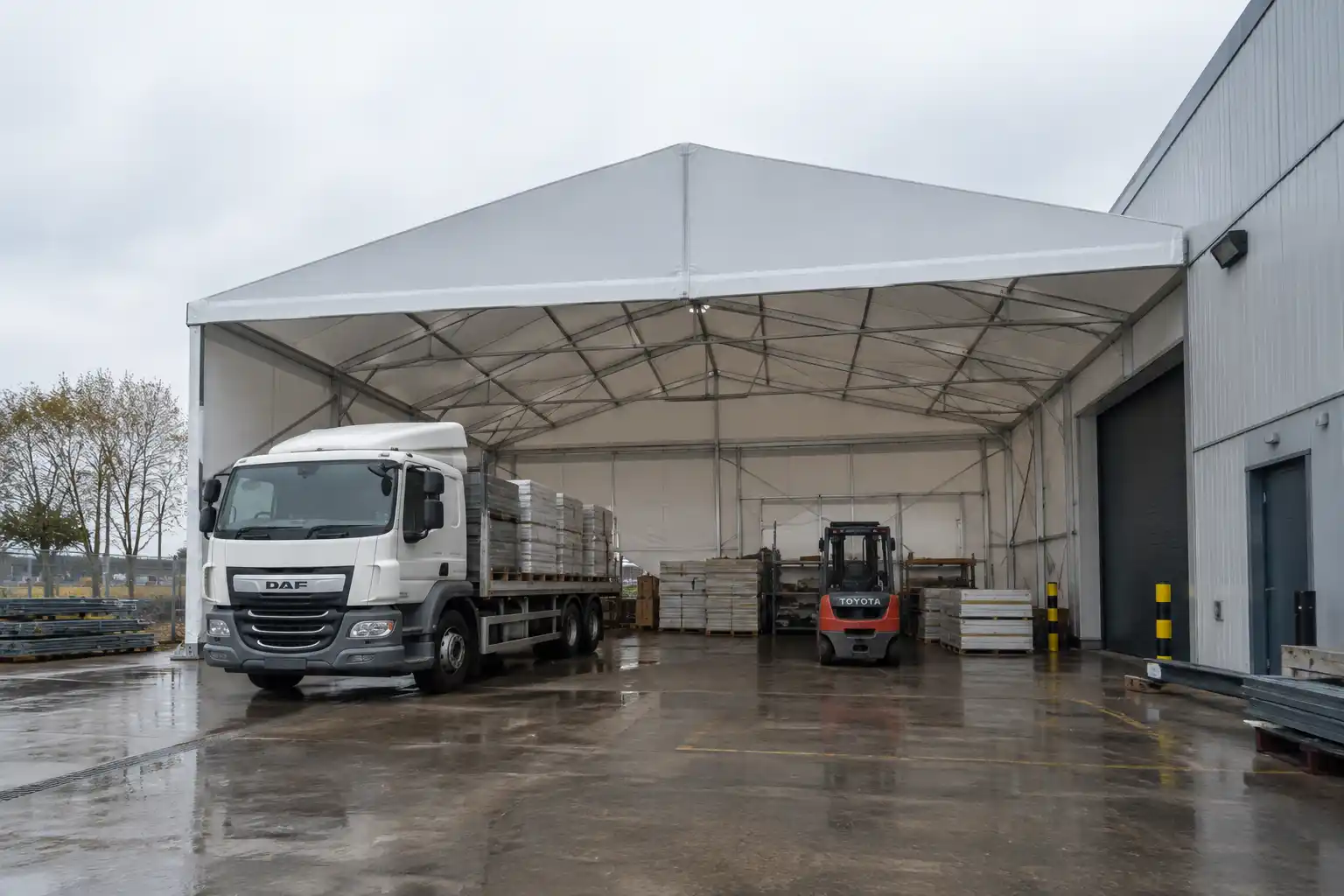
Suitability also depends on how the warehouse interacts with the surrounding site infrastructure. Vehicle access routes, turning areas, loading points and circulation space often determine whether the additional capacity improves operational flow or creates additional congestion.
This is especially relevant on operationally constrained sites where movement efficiency is already under pressure. Businesses evaluating temporary warehouse solutions for constrained sites may find that layout integration becomes as important as the structure itself.
The condition and suitability of the operational surface also matters. Warehousing environments handling forklifts, pallet trucks or wheeled handling equipment require surfaces capable of supporting safe and practical movement. HSE guidance on loading and unloading activity highlights the importance of firm, level operational areas to support safe handling and vehicle activity.
Environmental suitability is another important consideration. Some warehouse operations require little more than dry covered storage, while others may involve temperature-sensitive stock, packaging operations, production support or inventory requiring controlled environmental conditions.
As a result, temporary warehouse suitability should always be assessed against the operational characteristics of the goods being stored, not simply against available footprint.
Commercially, this matters because unsuitable warehousing can reduce operational efficiency even where capacity has technically increased. Poor movement flow, restricted handling routes or inefficient dispatch arrangements may slow throughput, increase labour inefficiency or create avoidable disruption within wider warehouse operations.
The operational value of temporary warehousing therefore depends on whether the structure improves functional capability rather than simply expanding storage volume.
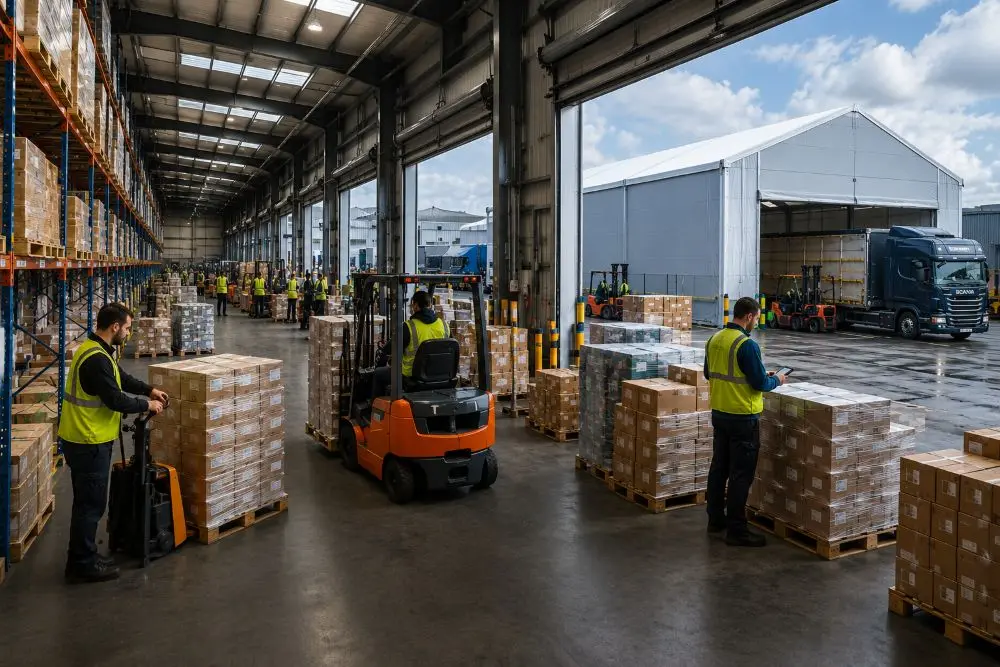
How do workflow and stock movement affect warehouse usability?
Warehouse performance depends heavily on how efficiently goods move through the operation.
In many cases, temporary warehousing becomes operationally ineffective not because the structure lacks capacity, but because stock movement and workflow have not been properly considered during planning.
Warehousing activity is shaped by continuous operational flow:
- inbound deliveries
- unloading activity
- put-away processes
- picking routes
- replenishment cycles
- dispatch preparation
- outbound movement
A temporary warehouse must support these operational patterns naturally if it is to function effectively within a live logistics environment.
This is why movement efficiency is often a more important measure of suitability than footprint alone.
For example, a structure may technically provide enough storage space while still reducing operational performance if:
- forklift routes become congested
- aisles are too restrictive
- loading areas create bottlenecks
- dispatch activity overlaps with inbound movement
- stock locations increase travel time unnecessarily
- pedestrian routes interfere with operational circulation
These problems often emerge gradually once live operations begin, particularly where warehouse suitability was evaluated primarily on dimensions rather than workflow integration.
Operational planning therefore becomes a critical part of temporary warehouse design.
The layout should reflect how the warehouse will actually function day-to-day, including:
expected stock turnover
handling frequency
dispatch intensity
pallet movement patterns
vehicle activity levels
storage methods
operational sequencing
This is particularly important in higher-throughput environments where even small inefficiencies can affect fulfilment speed or labour productivity over time.
Research from CILT UK on warehouse capacity and operational efficiency reinforces that warehouse performance depends heavily on layout, storage configuration and movement flow rather than storage density alone.
The same principle applies to temporary warehousing. Increasing storage volume without considering operational flow can reduce overall efficiency despite adding physical capacity.
Workflow planning should also account for how the temporary warehouse interacts with the wider operation. In some environments, the structure may support overflow inventory with relatively limited movement activity. In others, it may operate as an active extension of the main warehouse with continuous handling and dispatch requirements.
The operational demands in those two scenarios are very different.
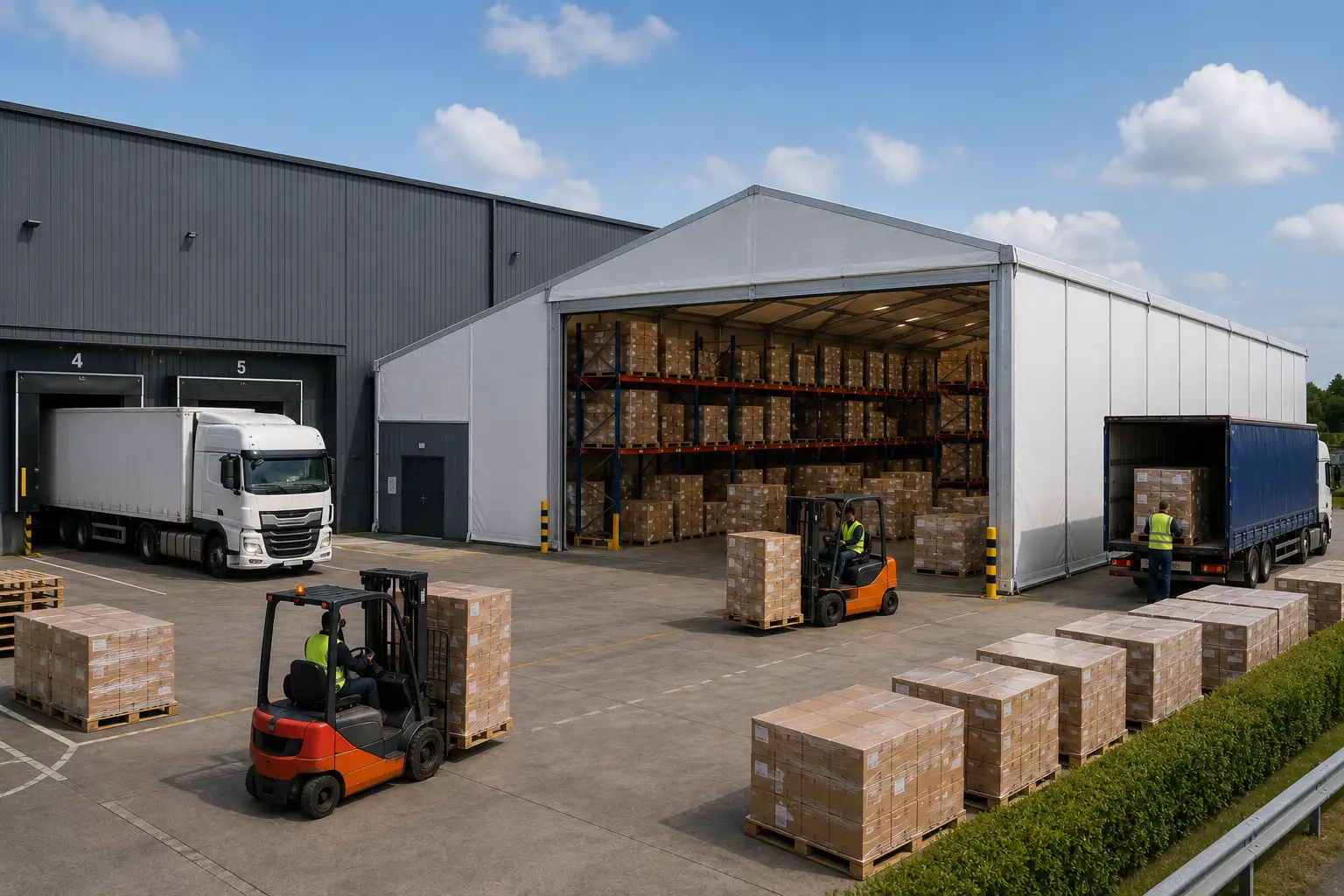
This is one reason why businesses adding capacity quickly often need to evaluate operational functionality alongside deployment timescales. Expanding space rapidly may solve immediate capacity pressure, but long-term usability still depends on how effectively the warehouse supports live operations. Businesses assessing how to add warehouse capacity quickly should therefore evaluate operational integration as carefully as installation speed.
What access requirements matter in live warehouse environments?
Access planning is one of the most important operational factors affecting temporary warehouse suitability.
In live logistics environments, the warehouse must support continuous movement by:
- forklifts
- pallet trucks
- delivery vehicles
- loading teams
- warehouse personnel
- inbound and outbound stock traffic
If movement routes become restricted or inefficient, operational performance can deteriorate quickly even where storage capacity itself appears sufficient.
This is why warehouse access should be evaluated as part of the operational system rather than treated as a secondary infrastructure detail.
For many businesses, vehicle access is the first practical consideration. Delivery vehicles need to approach loading areas safely and efficiently without creating congestion or operational conflict elsewhere on site. Turning space, circulation routes and loading arrangements all influence whether the temporary warehouse integrates effectively into day-to-day operations.
This becomes particularly important on active industrial sites where:
- dispatch schedules are time-sensitive
- HGV movements are continuous
- multiple operational zones are already competing for space
- pedestrian movement must remain controlled
- loading and unloading areas are already under pressure
In these environments, poor access planning can create handling delays that affect wider warehouse performance rather than just the temporary structure itself.
Forklift circulation is equally important.
A warehouse may technically support forklift access while still creating operational inefficiencies if:
- aisle widths are restrictive
- turning space is limited
- storage layouts interrupt movement
- loading routes overlap with pedestrian circulation
- access points create bottlenecks
The practical usability of the structure therefore depends on how movement flows through the environment in real operational conditions.
HSE workplace transport guidance on loading areas highlights the importance of manoeuvring space, safe circulation and suitable loading arrangements within operational environments. These considerations are directly relevant when assessing temporary warehouse suitability because loading activity often becomes a key operational pressure point.
Personnel access should also be considered carefully.
In some temporary warehousing environments, warehouse staff may only enter periodically for stock retrieval. In others, personnel may be continuously active within picking, replenishment or dispatch operations throughout the working day.
The structure therefore needs to support:
- safe pedestrian movement
- operational visibility
- controlled interaction between vehicles and personnel
- practical movement between operational zones
Where these considerations are overlooked, the warehouse may become operationally difficult to use even if the structure itself remains physically adequate.
Access requirements also vary depending on stock profile and operational intensity.
High-throughput logistics environments handling rapid inventory movement typically require different circulation planning from lower-turnover storage environments. Similarly, palletised operations create different handling demands from manual picking or mixed inventory environments.
“warehouse-ready” suitability is not universal. Access planning should always reflect the operational realities of the specific warehouse activity being supported.
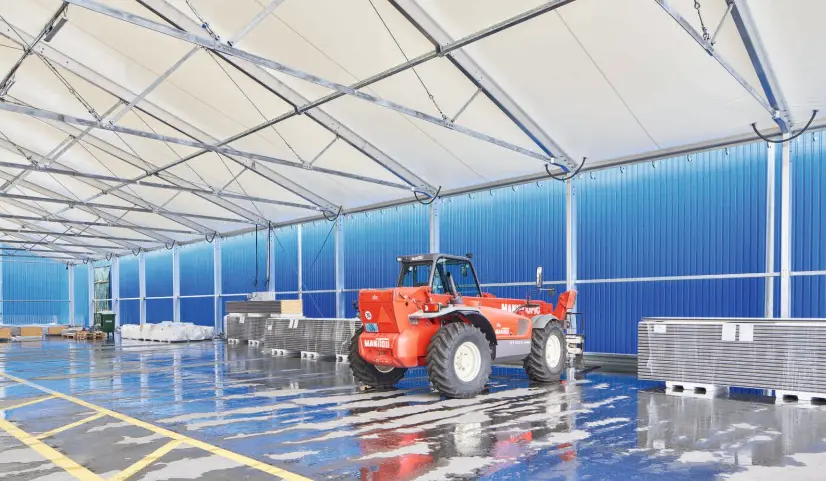
Can temporary warehouses support forklifts, racking, and logistics operations?
Many temporary warehouses can support forklifts, racking systems and live logistics activity when the operational requirements are understood early and incorporated into the planning process.
However, suitability should never be assumed automatically.
The practical question is not simply whether forklifts or racking can physically exist inside the structure, but whether the environment supports safe, efficient and commercially workable operations over time.
This distinction matters because warehouse performance depends on how effectively handling systems integrate with:
- circulation routes
- storage layouts
- loading activity
- stock movement
- dispatch operations
- operational throughput requirements
A temporary warehouse supporting occasional pallet storage creates very different operational demands from one functioning as an active logistics extension with continuous forklift activity and high inventory movement.
Forklift suitability depends heavily on:
- operational surface conditions
- aisle configuration
- turning space
- loading access
- internal clearance
- stock layout planning
- movement separation
Poor circulation planning can reduce operational efficiency even where the structure technically accommodates handling equipment.
This is one reason why warehouse usability should be evaluated operationally rather than visually. A structure may appear large enough for logistics activity while still creating inefficient travel paths, restricted movement or handling bottlenecks once operations become live.
Racking integration also requires practical operational consideration.
Different warehouse operations require different storage approaches depending on:
- stock profile
- pallet dimensions
- inventory turnover
- picking methodology
- handling frequency
- replenishment requirements
The suitability of the warehouse therefore depends on whether the internal layout supports the operational behaviour of the storage system rather than simply fitting the equipment physically inside the structure.
In many environments, operational flexibility is equally important.
Warehouse operations often evolve over time as:
- inventory volumes fluctuate
- fulfilment patterns change
- stock profiles shift
- dispatch activity increases
- operational priorities develop
Temporary warehousing that supports adaptable layout planning can therefore provide greater long-term operational value than solutions designed purely around immediate footprint requirements.
This operational flexibility is increasingly relevant as warehouse environments become more integrated into wider supply chain activity. Research highlighted within the UK Warehousing Association and Savills warehousing sector report reinforces that many warehouse environments now support broader operational functions including fulfilment, handling, processing and dispatch activity rather than passive storage alone.
As a result, temporary warehouse suitability increasingly depends on whether the structure supports operational functionality across the wider logistics process.
For businesses evaluating temporary storage during warehouse disruption, this operational capability can become particularly important where continuity depends on maintaining handling and movement activity rather than simply storing stock temporarily.
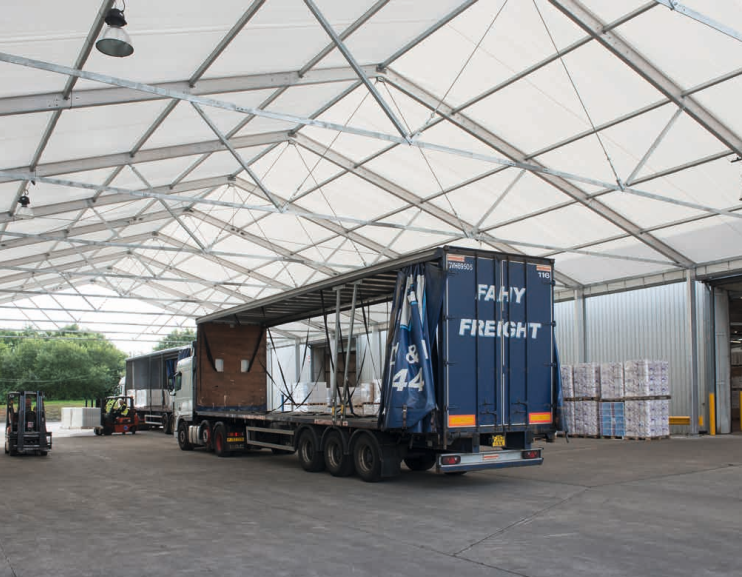
How environmental conditions affect storage suitability
Environmental suitability is often underestimated when businesses first assess temporary warehouse requirements.
In practice, different stock types place very different demands on the warehouse environment. While some goods only require dry covered storage, others may be sensitive to:
- moisture
- condensation
- temperature fluctuation
- ventilation conditions
- dust exposure
- airflow limitations
This means warehouse suitability cannot be assessed independently from the operational characteristics of the inventory being stored.
For example, palletised industrial goods with low environmental sensitivity may place relatively limited demands on the structure beyond weather protection and operational access. In contrast, packaging materials, finished products, electronics or temperature-sensitive stock may require more controlled environmental conditions to maintain product quality and operational reliability.
The operational environment also affects personnel working conditions and day-to-day usability.
In active logistics environments with continuous handling activity, ventilation and internal conditions can influence:
- staff comfort
- operational visibility
- condensation management
- handling practicality
- overall warehouse usability
These considerations are especially important where the temporary warehouse is intended to function as part of a long-term operational arrangement rather than short-term overflow storage.
Environmental suitability should therefore be evaluated alongside:
- stock profile
- throughput intensity
- handling methods
- operational duration
- seasonal operating conditions
- workflow patterns
This operationally grounded approach helps avoid situations where the structure technically provides enough capacity but creates handling or stock protection concerns once live operations begin.
Environmental planning is not purely a technical exercise. It forms part of wider operational suitability assessment.
For Operations Managers and Facilities Managers, the objective is typically to ensure that the temporary warehouse supports reliable day-to-day operation without introducing avoidable stock risks or operational inefficiencies.
What layout and planning considerations matter most?
The most effective temporary warehouse environments are usually shaped around operational flow before storage density.
Businesses under capacity pressure often focus first on maximising available footprint. However, warehouse performance is normally determined by how efficiently movement, handling and operational activity take place inside the structure.
This is why layout planning should begin with operational behaviour rather than simply storage volume.
A suitable warehouse layout should support:
- safe movement
- efficient circulation
- practical stock access
- loading and unloading activity
- operational visibility
- workflow continuity
- future operational flexibility
In practice, this means considering how goods will move through the warehouse from arrival to dispatch rather than treating storage as an isolated requirement.
Operational bottlenecks frequently emerge where:
- aisles become restrictive
- handling routes overlap
- dispatch activity conflicts with replenishment
- loading points create congestion
- stock locations increase unnecessary travel time
- operational zones are poorly separated
These issues may not appear during initial planning but can affect throughput and labour efficiency significantly once warehouse activity becomes live.
Planning should also account for the relationship between the temporary warehouse and the wider operational site.
The effectiveness of the structure often depends on:
- proximity to existing operations
- loading access
- vehicle circulation
- dispatch coordination
- integration with warehouse management processes
- operational sequencing across the wider site
This is particularly important where the warehouse forms part of a phased operational expansion or temporary capacity strategy.
In many cases, businesses evaluating operationally suitable temporary warehousing are not simply looking for additional space. They are trying to maintain operational continuity and efficiency while accommodating changing capacity requirements.
That objective depends heavily on planning quality.
Well-planned temporary warehousing can support:
- smoother operational flow
- more efficient stock handling
- safer movement patterns
- improved operational flexibility
- reduced disruption during expansion or transition periods
Poorly planned warehousing, by contrast, can reduce the operational value of the additional capacity despite increasing available storage space.
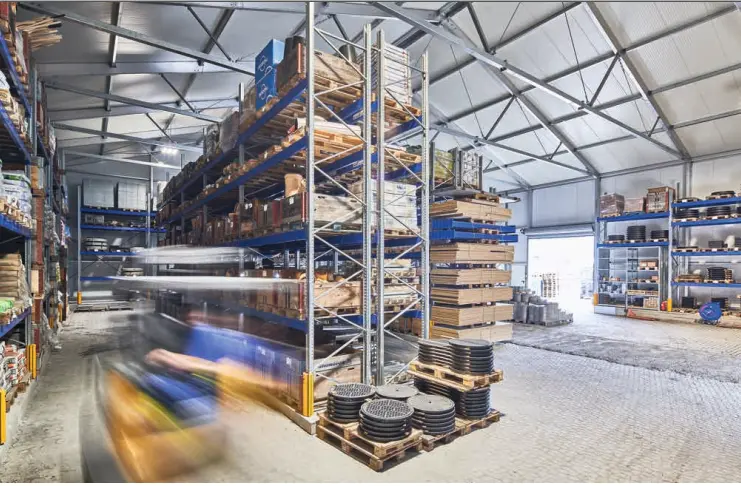
What operational problems come from unsuitable temporary storage?
Unsuitable temporary warehousing rarely fails because the structure itself collapses operationally. More often, problems develop gradually through inefficient movement, poor workflow integration or operational constraints that reduce day-to-day usability.
In many environments, these issues emerge once live warehouse activity begins and operational pressure increases.
Common operational problems include:
- restricted forklift circulation
- inefficient loading and unloading
- dispatch bottlenecks
- poor pedestrian segregation
- difficult stock access
- excessive travel distances within the warehouse
- workflow disruption between operational zones
- reduced picking efficiency
- stock handling delays
Individually, these issues may appear manageable. Collectively, they can reduce throughput and increase operational friction across the wider warehouse operation.
This matters commercially because operational inefficiencies often affect:
- fulfilment speed
- labour productivity
- dispatch reliability
- stock handling performance
- operational continuity
In higher-throughput logistics environments, even relatively small inefficiencies can compound over time as movement volumes increase.
Unsuitable layouts can also create avoidable operational pressure on warehouse personnel. Congested circulation routes, poorly positioned loading areas or restricted operational visibility may increase handling difficulty and reduce workflow consistency during busy operational periods.
The same principle applies to stock protection and environmental suitability.
Where warehouse conditions do not align with the operational requirements of the goods being stored, businesses may encounter:
- condensation issues
- product deterioration
- packaging damage
- operational handling complications
- reduced inventory reliability
This is one reason why temporary warehousing should be evaluated operationally rather than purely structurally.
A warehouse that technically provides additional capacity may still fail operationally if it does not support the movement, handling and logistics processes required by the business.
How should businesses evaluate temporary warehouse solutions?
The most effective evaluation process begins by treating the warehouse as an operational environment rather than simply a storage structure.
Before assessing dimensions or footprint, businesses should evaluate:
- how stock moves through the operation
- what handling equipment will be used
- where loading and unloading activity will occur
- how vehicles will circulate
- what level of throughput the operation requires
- how personnel movement will be managed
- what environmental conditions the stock requires
- whether the layout supports operational efficiency over time
This operational-first approach usually provides a more accurate assessment of suitability than comparing structures primarily on size or headline capacity.
Businesses should also evaluate how the temporary warehouse integrates with the wider operational site.
Key considerations include:
- proximity to existing warehouse operations
- compatibility with loading infrastructure
- access for HGVs and delivery vehicles
- traffic flow interaction
- operational sequencing
- flexibility for future operational changes
In many cases, the suitability of the warehouse depends as much on site integration as on the structure itself.
Operational evaluation should also consider how warehouse requirements may evolve. Temporary warehousing is often introduced during:
- phased expansion
- capacity growth
- operational transition
- refurbishment programmes
- changing inventory requirements
- supply chain adjustments
As operational conditions change, warehouse layouts and handling requirements may also change. Solutions that allow for practical operational flexibility can therefore support longer-term usability more effectively than highly constrained layouts.
Importantly, businesses should avoid assuming that all temporary warehousing products are operationally equivalent.
The most suitable solution depends on:
- stock type
- operational intensity
- handling requirements
- workflow complexity
- site constraints
- logistics processes
- movement patterns
Evaluating these factors early helps reduce the risk of introducing operational inefficiencies that undermine the benefit of the additional capacity.
What matters most as you move forward?
Temporary warehousing only becomes commercially valuable when it supports the operational realities of live storage and logistics environments.
In practice, this means evaluating more than footprint alone.
A suitable temporary warehouse should support:
- movement efficiency
- safe operational flow
- loading and unloading activity
- stock handling
- environmental suitability
- logistics integration
- day-to-day usability across the wider warehouse operation
The most effective solutions are typically those designed around operational behaviour and workflow requirements rather than generic dimensions alone.
For commercially accountable decision-makers, the objective is not simply to create additional covered space. It is to maintain operational performance while accommodating changing storage and logistics demands without introducing avoidable inefficiency or disruption.
Next step
If your operation is currently assessing additional storage capacity, the most useful next step is usually to evaluate how the temporary warehouse will function operationally before focusing purely on footprint or installation speed.
Where warehouse activity depends on forklift circulation, loading efficiency, stock handling or continuous logistics flow, early operational planning can help reduce the risk of bottlenecks, inefficient layouts or movement constraints later in the process.
LM Structures provides temporary warehousing and storage solutions designed around real operational environments, helping businesses assess how temporary warehousing can integrate practically into live storage and logistics operations.
Talk to a team member, call 0333 358 4989 or email enquiries@lmstructures.co.uk
Temporary Warehouse Suitability FAQs
Yes. In many cases, temporary warehousing functions as an extension of an existing warehouse or logistics operation. Effective integration depends on how well the structure supports existing workflows, vehicle movement, stock handling and operational sequencing.
Operational inefficiencies often develop where layout planning focuses mainly on storage density without considering movement flow. Restricted aisles, poor loading access or conflicting operational routes can reduce handling efficiency and create bottlenecks during live operations.
They can be, provided the warehouse is planned around throughput intensity and operational flow. High-turnover environments often require careful consideration of circulation space, loading access, dispatch coordination and handling efficiency.
Businesses should assess operational requirements first, including stock profile, handling methods, forklift activity, loading arrangements, circulation routes and workflow patterns. Site integration and operational usability are usually more important than footprint alone.
Yes, many temporary warehouses are used for medium- and long-term operational requirements where additional storage or logistics capacity is needed. Suitability depends on whether the structure supports the operational demands of the site, including movement, handling, access and workflow integration over time.